

Shortness of Breath ICD-10 Code Explained for Accurate Medical Billing
Use the correct Shortness of Breath ICD-10 code, CPT codes, and modifiers for accurate billing, faster reimbursement, and compliance.
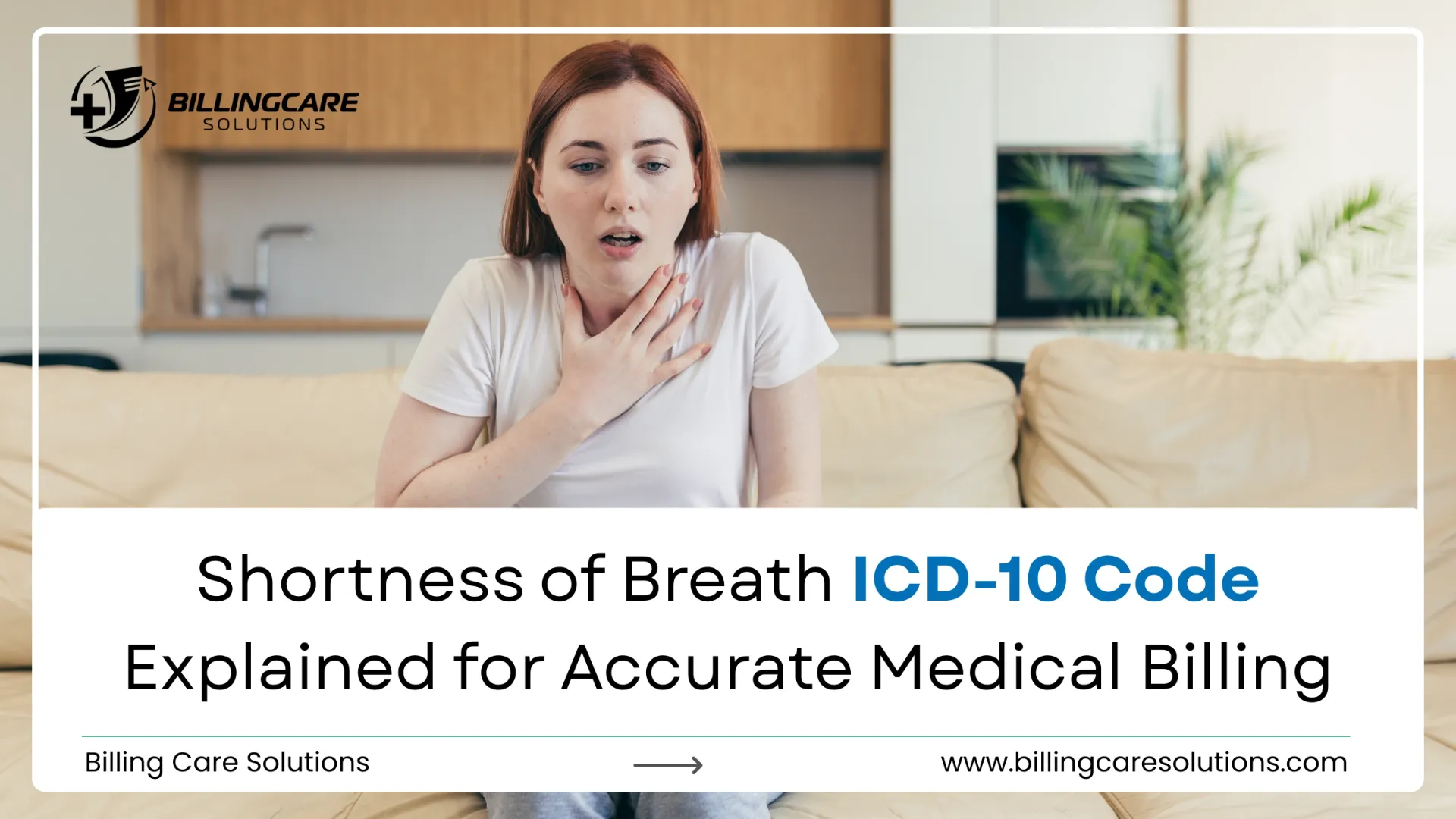
Accurate coding of shortness of breath is very essential to go along with the claim submission, reimbursement, and compliance with the regulations. By using the proper Shortness of Breath ICD-10 Code in conjunction with the appropriate CPT codes and modifiers, the medical practitioners are assured to get their payments on time, and at the same time, they are free from the risk of their claims being rejected.
This detailed manual is a resource that aims to clarify the coding for medical coders, billers, and healthcare providers, thereby helping them to improve their coding accuracy and, consequently, the revenue cycle performance.
Understanding Shortness of Breath
Shortness of breath, medically known as dyspnea, is a condition that can be very confusing for a doctor as it may be an indication of a wide range of different diseases of the respiratory system, heart, or even systemic diseases. The extreme shortness of breath may even lead to death, while mild cases of it may be tolerated even during the activities of daily living.
In order to be able to code properly, it is very important to have the following information documented:
- Onset (acute or chronic)
- Severity (mild, moderate, severe)
- Associated symptoms (wheezing, chest tightness, fatigue)
- Underlying causes (COPD, asthma, heart failure, pulmonary embolism)
Example: A patient with a sudden onset of dyspnea at rest should have documentation that specifies how long the patient had been experiencing the shortness of breath, whether this patient needed oxygen, and if any cardiac or pulmonary findings were present along with the shortness of breath. Such detailed notes enable coders to assign the most specific ICD-10 code and provide a reasonable explanation for the necessity of the medical intervention.
Good documentation is like a key that unlocks the door of payer rules and allows the compliance employees to see that everything is going smoothly and that accurate billing is being done.
Causes of Shortness of Breath
Shortness of breath can be due to various diseases, and each disease is represented by a different code:
- Chronic Obstructive Pulmonary Disease (COPD): For acute exacerbations, J44.1 is used, whereas for chronic unspecified COPD, J44.9 is utilized.
- Asthma: In case of severe or acute attacks, R06.02 (shortness of breath) can be used along with the asthma code.
- Cardiac causes: Heart failure or pulmonary edema leading to respiratory failure may require J96.01 (acute respiratory failure with hypoxia) as a code.
- Pulmonary infections: Pneumonia or ARDS may need the code J80 or R09.89 if the respiratory symptoms are unspecified.
- Other causes: Dyspnea may result from pulmonary embolism, anemia, or systemic conditions.
Coders should be very meticulous in going through the clinical documentation to pick up the right code and be in a position to refrain from undercoding or overcoding.
Importance of Accurate Shortness of Breath ICD-10 Coding
The Shortness of Breath ICD-10 Code literally tells the patient’s diagnosis to insurance companies and is necessary for a few reasons:
Claim processing:
Accurate coding makes the claim approval take less time, and thus the work related to the claim is less, and delays are reduced.
Denial prevention:
If a healthcare provider uses vague or incorrect codes, then the claims are rejected, and the provider has to resubmit them.
Reflecting severity:
Correct codes show how serious the patient's condition was for payment and inspection purposes.
Compliance:
Proper coding is in accordance with government regulations and payer policies, and therefore, the risk of an audit is lowered.
How to Select the Correct Shortness of Breath ICD-10 Code
Choosing the right Shortness of Breath ICD-10 Code is a multi-step process:
- Inspection of the patient chart: Identify the documented etiologies, the duration of symptoms, and the severity.
- Determine acuity: Acute vs. chronic dyspnea will have different codes.
- Align with ICD-10 codes: See which of the patient symptoms and conditions correspond with the ICD-10 descriptions.
- Include comorbidities: If the patient has COPD, heart failure, or ARDS, be sure that these are the ones that are coded as well.
- Recording of supplementary therapy: Oxygen, nebulizers, or mechanical ventilation may be the reasons for a higher complexity code.
Correctly chosen codes lead to fewer claim denials and keep the documentation in line with regulations.
Shortness of Breath ICD-10 Codes
| ICD-10 Code | Description | Notes |
|---|---|---|
| J44.9 | Chronic obstructive pulmonary disease, unspecified | For COPD without further specification. |
| R06.02 | Shortness of breath | General symptom code when the cause is unknown. |
| J44.1 | COPD with acute exacerbation | For acute worsening of COPD. |
| J96.01 | Acute respiratory failure with hypoxia | Severe cases require immediate intervention. |
| R09.89 | Other specified symptoms and signs involving the circulatory and respiratory systems | Use for uncommon or unspecified respiratory symptoms. |
| J80 | Acute respiratory distress syndrome | Critical condition requiring hospitalization. |
| R06.00 | Dyspnea, unspecified | When documentation lacks severity details. |
| R06.09 | Other forms of dyspnea | For less common dyspnea presentations. |
| J96.11 | Chronic respiratory failure with hypoxia | For patients requiring long-term oxygen therapy. |
CPT Codes Related to Shortness of Breath
For the evaluation and management of patients with dyspnea, proper CPT coding is essential. Accurate CPT coding ensures reimbursement for provider services.
| CPT Code | Procedure | Description |
|---|---|---|
| 99214 | Office or other outpatient visit, established patient, moderate complexity | Common for patients with multiple chronic conditions. |
| 99213 | Office or other outpatient visit, established patient, low complexity | Standard visit for mild symptoms. |
| 99204 | Office or other outpatient visit, new patient, moderate complexity | New patient evaluation with detailed history. |
| 99203 | Office or other outpatient visit, new patient, low complexity | Basic evaluation for new patients. |
| 99212 | Office or other outpatient visit, established patient, straightforward | Minimal complexity visits. |
| 99215 | Office or other outpatient visit, established patient, high complexity | Severe or acute presentations. |
| 99202 | Office or other outpatient visit, new patient, straightforward | Basic new patient encounter. |
| 94010 | Breathing capacity measurement | Spirometry for pulmonary assessment. |
| 93010 | Electrocardiogram, interpretation, and report | Cardiac evaluation for dyspnea. |
| 93000 | Electrocardiogram, tracing only | Raw ECG data collection. |
Modifiers Used in Shortness of Breath Billing:
Modifiers provide additional information about the performed service. Using them correctly ensures precise reimbursement and reduces claim denials.
| Modifier | Meaning | Usage Notes |
|---|---|---|
| RT | Right side | Use for procedures performed on the right side of the body. |
| 25 | Significant, separately identifiable E/M service | Use when an E/M service is provided on the same day as a procedure. |
| 76 | Repeat procedure or service by the same provider | Use when a service is repeated by the same provider. |
| 26 | Professional component | Use when reporting physician interpretation only. |
| LT | Left side | For procedures performed on the left side. |
| TC | Technical component | For facility or technician-related service only. |
| 59 | Distinct procedural service | Use for separate procedures performed on the same day. |
| 77 | Repeat procedure or service by another physician | Use when another provider repeats the service. |
| XP | Separate practitioner | For procedures done by a different practitioner. |
| XS | Separate structure | Use when a distinct site of service is documented. |
| XU | Unusual non-overlapping service | For unusual, distinct services that do not overlap. |
Documentation Best Practices Shortness of Breath ICD-10 Code
Accurate and detailed documentation is the foundation not only for precise coding but also for correct reimbursement:
- Firstly, recording the shortness of breath should include the severity, onset, and duration.
- Next, vital signs, lab results, imaging, and oxygen therapy should all be documented.
- Also, the documentation must reflect the inclusion of chronic conditions as well as the acute triggers.
- Furthermore, indicate if the patient is a new or an established one, along with the complexity of the visit.
- Moreover, use crystal clear terms when referring to symptoms such as dyspnea, hypoxia, or respiratory distress.
Accurate and thorough documentation is a key factor in minimizing claim denials and is in agreement with payer guidelines.
Common Shortness of Breath ICD-10 Coding Errors to Avoid
Even coders who have a lot of experience can slip up. Try not to:
- When the exact cause is changed, use generic symptom codes.
- Leaving out changes for extra operations.
- Mistakenly differentiating between new and established patients for CPT codes.
- Not recording the use of oxygen or a ventilator if it is there.
- Disregarding the rules that each payer sets for respiratory and cardiac coding.
Frequent refresher courses and checking one's own work can go a long way in error prevention.
Conclusion:
It is necessary to use the right Shortness of Breath ICD-10 codes, CPT codes, and modifiers for the correct billing, getting the money back on time, and following the rules. Good documentation, following the coding standards, and being aware of the common mistakes will help you lower the number of denials and thus increase your practice’s income.
Medical coders, billers, and healthcare providers may improve their precision by:
- Thoroughly examining clinical notes in order to capture all the relevant details
- Choosing the most detailed ICD-10 and CPT codes
- Using the correct modifiers for each service
- Keeping documentation that is always ready for an audit of every claim
Proper coding is not only a measure of the standard of the care given, but it is also a way of ensuring the financial viability and long-term healthcare practices. Billing Care Solutions is the perfect partner for practices to achieve these objectives, thus helping them to save time, increase their income, and stay compliant.
