


D0210 Dental Code Guide for Full Mouth X Ray Billing
Learn the D0210 dental code for full mouth X ray billing, including usage guidelines, insurance tips, documentation, and claim accuracy steps.
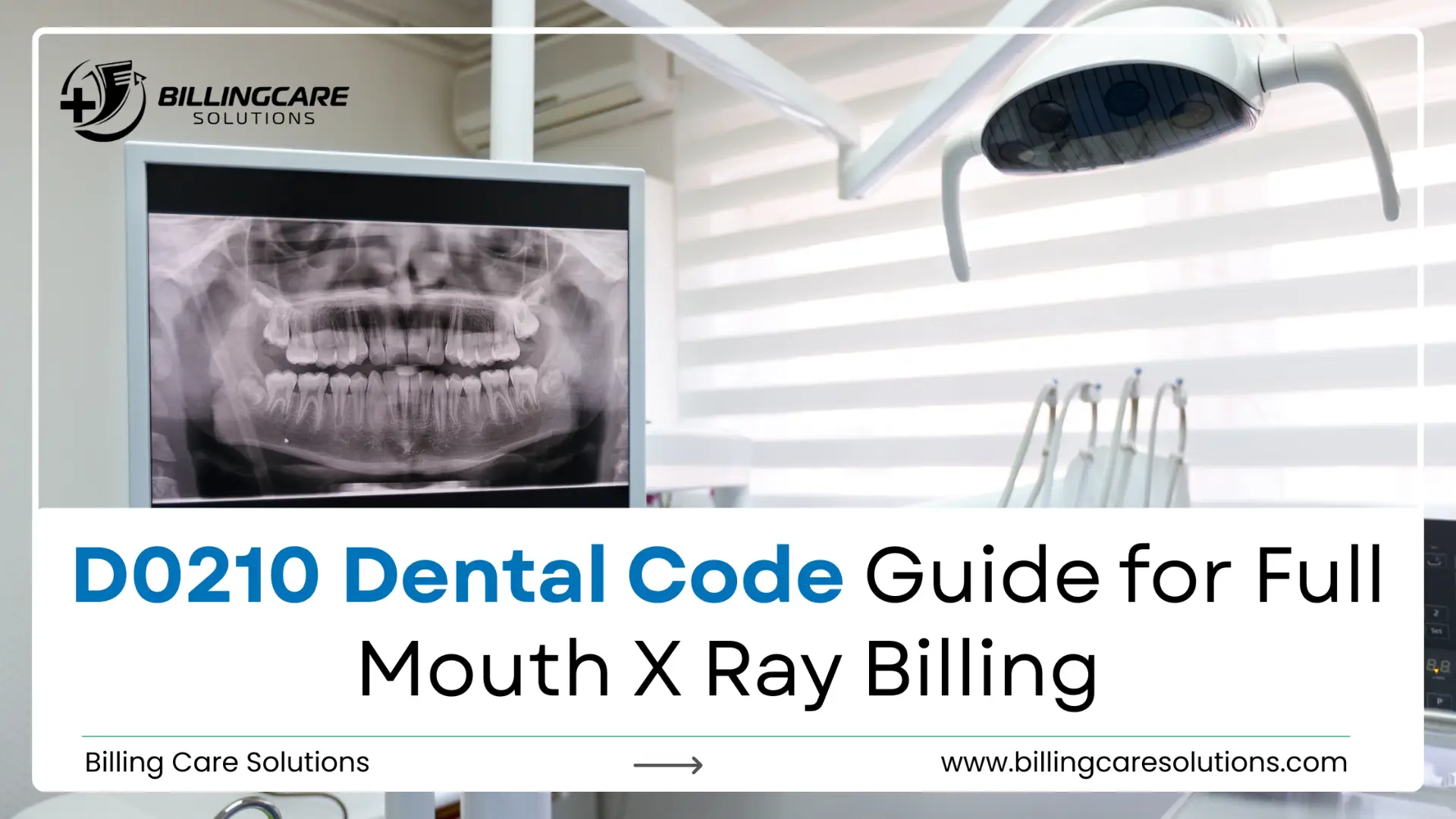
Whether you are a dentist, a dental biller, a front desk coordinator or a practice manager, knowing the D0210 dental code is important. One of the most frequently cited causes that dental claims are delayed or denied is because of incorrect use of this code. This guide explains what it is and when to use it, how to document it properly, and what to do if a claim is denied. This article offers a straightforward and practical guide to full mouth X-rays billing for both new dental billing experience and practicing to enhance your coding skills.
What Exactly Is the D0210 Dental Code?
The dental code D0210 is part of the Current Dental Terminology (CDT) code set of the American Dental Association. It is a complete mouth radiographic survey or full mouth series (FMX). This survey consists of a complete set of radiographic images, usually 14 to 22 individual films and includes both the periapical and bitewing views.
For patients, this is the full series of X-rays a dentist uses to evaluate overall oral health, including the roots of the teeth, bone level and other oral tissue. This is a procedure code that is important to bill correctly for insurance carriers to provide proper reimbursement for billing professionals.
Clinical Situations That Require D0210 Billing
A full mouth series is not necessary for all patient visits. The D0210 code is appropriate for certain clinical circumstance, such as:
- New patient full oral evaluations where baseline radiographs are required.
- Patients requiring full mouth bone level assessment with active periodontal disease |
- Treatment planning for multiple teeth, which may be complex.
- Cases for the evaluation of implants and surgical planning.
Individuals that haven’t undergone a complete radiographic examination inside the frequency of time determined by the payer. There must be medical necessity documented in the patient’s chart anytime it is claimed. One of the most common reasons for a claim denial is for missing notes.
D0210 Compared to Other Radiographic Codes
| Code | Purpose / Coverage | Important Billing Note |
|---|---|---|
| D0210 | Complete Series of Radiographic Images – Full mouth series showing crowns, roots, and supporting bone structures | Use only when a true full mouth series is performed |
| D0330 | Panoramic Radiographic Image – Single wide view image of the jaws and surrounding anatomy | Not a substitute for D0210 |
| D0272 / D0274 | Bitewing Series – Images of tooth crowns for cavity detection between teeth | Does not capture roots or full bone structures |
| D0220 | Periapical First Image – Single tooth image including root and surrounding bone | Multiple D0220 codes instead of D0210 may be considered unbundling |
| Compliance Reminder | Always select the code that reflects the actual service performed | Upcoding or unbundling can trigger audits and penalties |
Insurance Coverage and Reimbursement Rates for D0210
Different insurance companies and individuals will have different coverage for D0210. Most of the major dental insurance plans, such as Delta Dental, Cigna, Aetna, MetLife, and United Concordia, include full mouth x-rays in their coverage, but may have frequency limitations. Most insurance companies provide a full mouth series to be completed every 3-5 years.
Reimbursement rates are based on the contracted fee schedule of the provider. The average amount permitted varies from $80 to $180 depending on the region and the payer. The cost to the patient of these expenses will vary based on the deductible status of their plan and their plan co-insurance percentages. Please confirm benefits prior to the appointment. Before checking the frequency history and eligibility, there will be no surprises about the payment and financial expectations of the patient.
Required Documentation for D0210 Claim Submission
A clean claim relies on the documentation. If filing a claim for it, the following should be presented in the following order:
- ADA 2019 Dental Claim Form filled out in proper procedure code, with appropriate tooth numbers (if needed) and date of service.
- Full mouth series clinical chart notes that explain why the series was requested.
- The x-rays in the patient record keeping as required by your state, and which will be retained as part of the medical record. The x-rays themselves, which will be kept in the patient record keeping as per your state’s requirements.
- Narrative justification for payers that require prior authorization or additional documentation.
Clean and detailed record-keeping are more likely to be ready for payer audits and internal compliance reviews.
Top Reasons D0210 Claims Are Denied
Understanding why claims get denied helps your team prevent those errors before submission. The most common reasons include:
- Frequency limitation violations: The patient was billed for a full mouth series before the prior date, but the prior date was not reviewed prior to billing.
- Bundling with D0150: If a payer chooses to consider the two services as part of a single one, then a denial may be issued if they are bundled with D0150. Billing a comprehensive exam (D0150) on the same date as D0210.
- Duplicate claims: When a claim is submitted again or a claim that is already submitted is submitted again and not marked as a corrected claim.
- Incomplete documentation: Missed clinical notes, no clinical story or no radiographic images when a payer requests them when the documentation is incomplete.
- Coordination of benefits issues: Claims are delayed or denied due to errors in sequencing of the primary and secondary payers.
Running a pre-submission audit checklist for claims can reduce your denial rate significantly.
How to Appeal a Denied D0210 Claim
A denied claim doesn’t necessarily mean it’s a final decision. In most payers’ cases, there is a formal appeal procedure and a well-prepared appeal has a good likelihood of being successful.
This simple method is as follows:
- To see which reason code was used for the denial, examine the Explanation of Benefits (EOB).
- Collect necessary documentation such as patient charts, clinical notes, radiograph(s), periodontal charts (if applicable).
- Prepare a concise, well-documented medical necessity letter including clinical findings and rationale for the need for the complete mouth series.
- File the appeal on time (typically within 30 to 180 days of the denial date).
- If you don’t receive acknowledgement, follow up with the payer within 2 to 3 weeks.
A denial log can assist you in determining the trends and common denominator problems that require a system-wide solution to your billing workflow.
How Billing Care Solutions Simplifies D0210 Billing?
While some of the challenges of dental billing in-house are real, they can be particularly difficult with procedure codes, such as D0210, where payer rules, documentation requirements, and denial trends are constantly changing. Billing Care Solutions is a particular dental billing solution made for dental techniques of all sizes. They have a group of seasoned billing experts who are updated on the latest CDT code changes, payer policies and compliance requirements, which means that your practice doesn’t have to do the heavy lifting.
Billing Care Solutions processes all diagnostic and radiographic claims and follows up on them, processes denied claims and appeals, verifies eligibility and confirms benefits prior to each appointment and reports the results clearly for the practice owner to track performance, without sifting through spreadsheets. When you work with Billing Care Solutions, you’ll experience fewer claims with errors, quicker reimbursements and more time for your clinical staff to spend on patient care. When regular billing troubles have become a real issue in your practice, it makes sense to get the assistance of a billing partner.
Conclusion
Dental diagnostic billing has always had a core Code: D0210, and the use of that Code is an important component to your revenue and standing. From knowing when you should be using the Code, documenting it, navigating your payer’s frequencies, and appealing denied claims, all points are a part of the process.
By implementing knowledge of these CPT codes and an efficient, clean billing system, practices can avoid losing revenue and attracting scrutiny from audit reviews. No matter if you handle your billing in-house, or if you send it out to another company, every claim that is submitted must be one that is billed correctly, once. Use this guide to be sure of any questions that come up, and be sure to share it with all clinical and administrative staff in your office so you have a unified, well-informed group when submitting your claims.
