


AI in Revenue Cycle Management: The CFO's Blueprint for Higher Revenue and Lower Costs
Explore AI in Revenue Cycle Management and discover what CFOs need to know about AI benefits, limitations, ROI, and the future of healthcare finance.
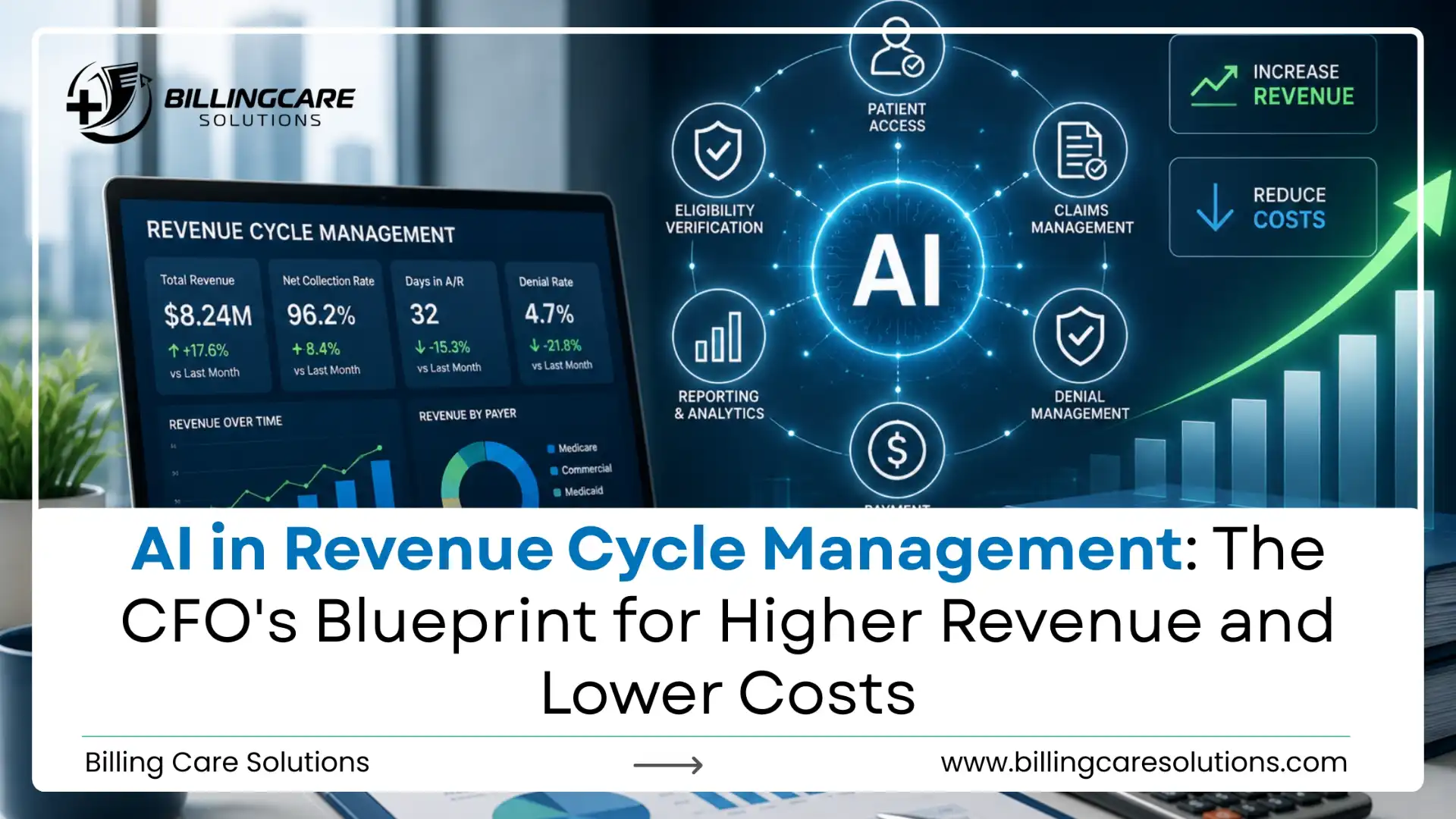
AI is one of the subjects that has been discussed a lot in the field of healthcare revenue cycle management. Vendors guarantee fully automated billing systems, denials-free and dramatic reductions in administrative costs. This excitement is mirrored in the market: The AI market in healthcare is valued at 22.45 billion dollars and is predicted to expand by 36.4 per cent per year until 2030.
For those CFOs whose primary job is to drive financial results, however, the big question is: Where is AI showing up in practice versus hype? This guide cuts through the hype to offer a working evaluation of the practical impact of AI in revenue cycle management. It explores the divide between the promise and the reality of the vendors, pinpoints where AI is generating a proven ROI, and highlights where it’s still lacking.
You will understand the distinctions between specific AI use cases that are effective and general automation that is not yet true. You will also get a hands-on guide to assessing AI investments and deployments and get a real return on investment.
AI in Revenue Cycle Management is proving tangible value in specific and targeted applications, such as denial prediction, coding support and work prioritization. However, complete automation has yet to be achieved. The best companies view AI not as a replacement for human employees, but as a complement.
The 2026 Reality: Why AI Is No Longer Optional
The healthcare financial environment in 2026 is unforgiving. Operating margins are squeezed to 1-2%. Staffing costs have increased 15 percent in the past year. Payer audits have increased 40 percent in the past two years. The number of claims and denials is increasing and the number of workers available to deal with them is decreasing.
Consider these 2026 industry realities:
| Challenge | 2026 Reality | Impact on Healthcare Organizations |
|---|---|---|
| Operating Margins | Compressed to 1 to 2 percent | Every dollar counts; revenue leakage is catastrophic |
| Claim Denials | 30 percent of claims denied or underpaid | Massive revenue at risk; rework costs escalating |
| Staffing Costs | Increased 15 percent in past year | Budgets stretched; hiring difficult |
| Billing Staff Turnover | 30 to 40 percent annually | Institutional knowledge lost; training costs escalate |
| Payer Audits | CMS audits increased 40 percent in past 2 years | Audit risk and compliance costs rising |
| Claims Volume | Growing faster than staffing capacity | Manual processes cannot keep up |
The CFO’s Imperative: Understanding the AI Investment Decision
| Factor | The Hype | The Reality |
|---|---|---|
| Automation Level | Fully autonomous revenue cycle | Human-machine collaboration; 30 to 50 percent of tasks automated |
| Denial Reduction | Zero denials | 40 to 50 percent reduction in denials |
| Staff Requirements | No staff needed | Staff redeployed to higher-value work; headcount reduced but not eliminated |
| Implementation Time | Weeks or months | 6 to 18 months for meaningful integration |
| Cost Savings | 70 to 80 percent reduction | 20 to 40 percent reduction in cost-to-collect |
| ROI Timeline | Immediate | 12 to 24 months |
| Accuracy | 100 percent accurate | 85 to 95 percent accuracy; human oversight required |
There is a huge difference between the hype and the reality. Vendors tend to sell AI that doesn’t exist yet. While the technology is advancing rapidly, it isn’t ready to replace the entire revenue cycle team for CFOs.
However, the truths cannot be denied. AI-powered RCM companies perform better than those that do not use AI. The rejection rate is 40 – 50% lower. They beat deadlines for tax collection by 3-5%. They reduced Collection Costs by 40-50% . They save leadership time in strategising. The reality is that, when it comes to strategy, AI in Revenue Cycle Management offers more ROI than the traditional RCM solution. The trick is to have realistic expectations, and examine the appropriate measures.
2026 Industry Benchmarks: The Hype vs The Reality
Denial Rate
| Performance Level | Without AI | The Hype | The Reality with AI | Improvement |
|---|---|---|---|---|
| Best in Class | 4 to 5 percent | 0 percent | 2 to 3 percent | 40 to 50 percent reduction |
| Industry Average | 8 to 12 percent | 0 percent | 4 to 6 percent | 40 to 50 percent reduction |
| Poor Performance | Greater than 15 percent | 0 percent | 7 to 9 percent | 40 to 50 percent reduction |
The Hype: With AI-powered claims scrubbing and prediction, there are no denials, vendors say.
AI can cut down on denials by 40-50%, but that isn’t possible for achieving the ultimate 0 denials. Payer policies are continually changing. Clinical documentation varies. Edge cases occur frequently. AI can help detect many issues but it’s not always perfect.
Net Collection Rate
| Performance Level | Without AI | The Hype | The Reality with AI | Improvement |
|---|---|---|---|---|
| Best in Class | 95 percent or higher | 100 percent | 97 percent or higher | 2 percent increase |
| Industry Average | 88 to 92 percent | 100 percent | 93 to 95 percent | 3 to 5 percent increase |
| Poor Performance | Less than 85 percent | 100 percent | 88 to 90 percent | 3 to 5 percent increase |
The Hype: Vendors make claims of 100 percent collection rates via the power of AI underpayment detection and denial recovery.
By identifying underpayments and eliminating denials, AI can boost net collection rates by 2-5 percent. However, there are some revenues that will always be lost due to factors beyond the control of AI.
Days in Accounts Receivable
| Performance Level | Without AI | The Hype | The Reality with AI | Improvement |
|---|---|---|---|---|
| Best in Class | 30 to 35 days | 0 to 5 days | 25 to 30 days | 5 to 10 day reduction |
| Industry Average | 45 to 55 days | 0 to 5 days | 35 to 40 days | 10 to 15 day reduction |
| Poor Performance | Greater than 60 days | 0 to 5 days | 45 to 50 days | 10 to 15 day reduction |
The Hype: AI in Revenue Cycle Management can be the key to near instant payments follow-up and escalation.
Though AI can reduce the time spent in A/R by 10-15 days, there is no way to get paid immediately. Payers have their own timetables. There are delays which cannot be avoided due to contractual obligations and regulatory requirements.
Cost to Collect
| Performance Level | Without AI | The Hype | The Reality with AI | Improvement |
|---|---|---|---|---|
| Best in Class | 3 to 4 percent of net revenue | Less than 1 percent | 2 to 3 percent | 25 to 33 percent reduction |
| Industry Average | 5 to 7 percent of net revenue | Less than 1 percent | 3 to 4 percent | 40 to 50 percent reduction |
| Poor Performance | Greater than 8 percent of net revenue | Less than 1 percent | 4 to 5 percent | 40 to 50 percent reduction |
The Hype: Vendors guarantee dramatic cost reductions by going all the way to automation and staff-less operations.
AI can reduce the cost to collect by 40-50% but not 80%. There is still a need for human supervision and complex decisions.
What This Means for CFOs
The hype that comes with the excitement is irresistible. But, the truth remains that it’s still a great story. Here, it will be up to CFOs to choose between the two. It’s not a matter of if AI adds value. It does. The only questions are whether or not it is worth the money and the time. Yes, in most cases, but with a realistic time frame.
The Hidden Costs of Ignoring AI: The Reality Gap
| Cost Category | Without AI | With AI-Enhanced RCM | Annual Savings |
|---|---|---|---|
| Staff Time on Manual Denial Rework | 25+ hours per week | 8 hours per week | 44,200 dollars |
| Claim Resubmission Costs | 35 dollars × 900 resubmissions | 35 dollars × 300 resubmissions | 21,000 dollars |
| Underpayment Detection | 2 to 3 percent leakage | Less than 1 percent leakage | 100,000 to 200,000 dollars |
| Patient Collections Staff | 2 FTEs × 75,000 dollars each | 0.5 FTE × 75,000 dollars | 112,500 dollars |
| Training New Staff | 10,000 to 15,000 dollars annually | 2,000 to 3,000 dollars annually | 8,000 to 12,000 dollars |
| Total Annual Leakage | 800,000 to 1.5 million dollars or more | 150,000 to 350,000 dollars | 450,000 to 1.15 million dollars or more |
The Three Layers of AI Impact: Hype vs Reality
Layer 1: Direct Revenue Protection
The Hype: All denials will be avoided and all underpayments will be recovered with AI. Zero revenue leakage.
The Reality: AI can save 40-50% of denials, and recover 60-70% of underpayments. This is important but not definitive. Not all denials are preventable, because of clinical complexity, or because of the payer’s decision.
Denials without AI: Denials are dealt with on a case-by-case basis. Without a system, underpayments go undetected. The revenue is included in the cost of doing business.
With AI: Proactively prevent denials with AI-powered prediction and prevention. Underpayments are automatically identified & recovered. There are still opportunities for revenue leakage, though they are not nearly as severe.
Layer 2: Administrative Cost Reduction
The Hype: AI will take care of all Administrative Costs. No staff needed.
The Reality: AI can help cut administrative costs by 40-50 percent. Staff re-directed to more valuable activities. Some positions are eliminated as a result of attrition. However, there is still a lot of human oversight needed.
Denials Without AI: 25+ hours of manual work for staff every week. Claims are submitted several times. Time is lost on activities that could be automated.
With AI: Staff spends 8 hours per week on manual tasks. Claims are submitted in pristine condition on the initial submission. Time is utilized effectively to prevent rework, not for rework.
Layer 3: Strategic Opportunity
The Hype: AI to free leaders to focus solely on strategy. All the problems that run the operation will be taken care of automatically.
The Reality: Using AI allows leadership to free up a third of their time. The Reality: AI frees up 30-40 per cent of leadership time. Leaders have more time to focus on strategy and less time on firefighting. However, there is still some attention in the operation that needs to happen.
Denials Without AI: Leadership’s time is dedicated to 60 per cent operational matters. Manual processes are undertaken for staff time. Lack of innovation and growth.
With AI: Leadership is not about firefighting, it’s about strategy. Staff’s time is spent most efficiently on the most valuable activities. Growth and innovation are supported by data-driven insights.
The Ripple Effect: Beyond Financial ROI
Staff Morale and Retention
The Hype: AI in Revenue Cycle Management will make employees happier, more engaged, and help to completely eliminate employee turnover.
The Reality: AI in Revenue Cycle Management will help reduce burnout and boost engagement. Staff value the time that is freed from repetitive tasks. However, turnover is not eliminated. Staff continue to require rewarding work, career growth and fair pay.
Without AI: Staff are burned out by repetitive work. Turnover is high. Institutional knowledge is lost.
With AI: Staff are engaged by meaningful work. Turnover is lower. Institutional knowledge is retained.
Audit Risk Reduction
The Hype: AI in Revenue Cycle Management will be a game-changer for all audit risks. Perfect compliance.
The Truth: AI can help to reduce audit risk by identifying issues early in the revenue cycle management pipeline. But there are also dangers of using AI. AI can cause a lot of damage when it is incorrect. There is still a need for human supervision.
Without AI: Compliance is proactive. Audit risk is high. Penalties are costly.
With AI: Compliance is proactive. The risk of an audit is reduced. Penalties are avoided.
Real-World Case Study: The Hype vs Reality Gap
Background
- Organization: Multi-specialty practice with 15 providers
- Annual Revenue: 18,000,000 dollars
- Location: Multi-state operations
- Payer Mix: 60 percent Commercial, 30 percent Medicare, 10 percent Medicaid and Other
- Challenges: Growing denial rate, A/R days increasing, staff burned out, unable to scale
What the Vendor Promised
- Zero denials within 6 months
- 100 percent net collection rate
- 5-day A/R
- 80 percent reduction in staff costs
- Full automation within 12 months
What Actually Happened
| Metric | Before AI | Vendor Promise | Actual After AI | Actual Improvement |
|---|---|---|---|---|
| Denial Rate | 12 percent | 0 percent | 4 percent | 8 percent reduction |
| Net Collection Rate | 89 percent | 100 percent | 96 percent | 7 percent improvement |
| Days in A/R | 52 days | 5 days | 34 days | 18 days reduction |
| Staff Time on Denials | 30 hours/week | 0 hours | 8 hours/week | 22 hours/week reduction |
| Cost to Collect | 7 percent | Less than 1 percent | 3.5 percent | 50 percent reduction |
The Gap Between Hype and Reality
| Metric | Vendor Promise | Actual Result | Gap |
|---|---|---|---|
| Denial Rate | 0 percent | 4 percent | 4 percent gap |
| Net Collection Rate | 100 percent | 96 percent | 4 percent gap |
| Days in A/R | 5 days | 34 days | 29 days gap |
| Cost to Collect | Less than 1 percent | 3.5 percent | 2.5 percent gap |
The Financial Reality
Despite the gap between hype and reality, the results were still impressive:
| Area | Before | After | Annual Gain |
|---|---|---|---|
| Revenue Lost to Denials | 2.16 million dollars | 720,000 dollars | 1.44 million dollars recovered |
| Revenue Lost to Underpayments | 540,000 dollars | 180,000 dollars | 360,000 dollars recovered |
| Revenue Lost to Write-Offs | 720,000 dollars | 360,000 dollars | 360,000 dollars recovered |
| Total Revenue Impact | 3.92 million dollars | 1.51 million dollars | 2.41 million dollars recovered |
| Category | Annual Impact |
|---|---|
| Revenue Recovered | 2,410,000 dollars |
| Administrative Savings | 312,360 dollars |
| Opportunity Value | 150,000 dollars |
| Total Annual Benefit | 2,872,360 dollars |
| Investment in AI | (200,000 dollars) |
| Net Annual Benefit | 2,672,360 dollars |
| ROI | 1,336 percent |
AI proved to be very valuable, despite the gap between hype and reality. The practice earned back more than $2.6m each year. The ROI was 1336%. But it failed to deliver on the vendors’ promises.
Where AI Delivers Real Value: The Reality
Denial Prediction and Prevention
The Hype: AI will take care of any denials automatically.
The Reality: AI can predict 60 – 70 percent of denials before they even occur. This enables the staff to tackle issues proactively, and thus cuts down denial rates by 40 to 50 per cent.
The Rush University System for Health is an example that comes to mind. One of their biggest payers had made a substantial increase in requests for information denials. They collaborated with their own AI department to create an automated workflow that automatically activates a response to these denials as soon as they are received. This proved to have a dramatic impact on turnaround, operating efficiency and on shifting staff resources to more valuable activities.
What went right: The AI in Revenue Cycle Management (RCM) was designed to address a specific, well-defined problem, with measurable metrics.
What didn’t work: The AI was not able to remove all denials. It decreased them greatly, but there were some still left.
Coding Assistance and Clinical Documentation
The Hype: AI will completely replace human coding.
The Reality: AI helps human coders to produce more code, at a 20-30% increase in productivity and error reduction. AI recommendations are still checked and verified by coders.
Advocate Health scaled AI tools that support coding throughout the workflow. They claim that it enhances both coder efficiency and the amount of denials due to coders. Coders refer to it as having a second set of eyes, as one leader stated: “By exception, they focus on ensuring data is accurate, meaning they don’t do all the data entry tasks. Coders will say they have a second set of eyes, as one leader explained: “By exception, they focus on ensuring data is accurate, meaning they don’t do all the data entry tasks.
What Worked: AI was used as an assistant, not a replacement. Coders remained in control.
What Not to Do: Autonomous Coding. Medical records are complex, and there are a large number of diagnosis codes, making full automation difficult.
Denial Triage and Appeal Prioritization
The Hype: AI will handle all denial appeals automatically.
The Reality: AI can triage denials and recommend appeal strategies. Human staff still handle complex appeals and communications with payers.
Universal Health Services has seen significant impact using AI to triage and appeal insurance denials. With many payers increasing both soft and hard denials, AI helps process the volume efficiently. The primary metric for success is staff efficiency.
What Worked: AI helped staff prioritize their work and focus on the most important claims.
What Did Not Work: AI could not handle all appeals independently, especially those requiring payer communication or complex judgment.
The Barriers to AI Adoption: Reality Check
Data Privacy and Security Concerns
The Hype: AI is inherently safe and ethical.
Data privacy and security issues are the top challenge for healthcare leaders when implementing AI. With the ability to consume massive amounts of data, there’s a risk of sensitive patient data being pulled out. Laws like HIPAA were not designed with modern AI in mind.
Reality Check: Organizations need to have robust governance and security measures in place. This introduces more expense and complexity.
Accuracy and Trust
The Hype: AI is extremely accurate and reliable.
41% of providers state that it’s challenging to entirely believe in AI’s findings. The algorithm needs to be updated regularly to stay current with the changing regulations, policies from payers, and medical cases.
Reality Check: Human oversight will never be replaced. AI is not a decision maker, but a tool. The constraints related to cost and budget.
Cost and Budget Constraints
The Hype: AI saves money immediately.
AI initiatives incur increasing costs for training and running models. Unexpected usage patterns can quickly inflate per-token billing. Twenty percent of health systems have not yet begun their journey with generative AI for revenue cycle management, often due to budget constraints.
The Reality Check: AI requires significant upfront investment and ongoing costs. ROI takes 12 to 24 months to realize.
Integration Challenges
The Hype: AI in Revenue Cycle Management integrates seamlessly with existing systems.
Many electronic health records and electronic medical record systems are not designed to effectively feed machine learning systems. Integration is often difficult and expensive.
The Reality Check: Organizations must invest in integration, which adds cost and time.
The Clinical-First Requirement: Reality-Based AI
The Hype: AI can analyze claims data without clinical context.
Traditional AI in revenue cycle management often relies on historical claims data. This black box approach identifies statistical correlations but misses the clinical context. Consequently, it replicates past errors and lacks the nuance to interpret complex medical records accurately. For AI to be effective, it must go beyond statistical pattern matching and understand the clinical reality of the patient journey. Without this clinical-first foundation, health systems risk increased denials, hidden rework, and compliance vulnerabilities.
The Reality Check: When AI flags minor data variations as errors because it lacks clinical understanding, teams spend valuable time validating suggestions. This is not automation; it is a shifted manual burden.
What CFOs Should Look for in AI Solutions: Reality-Based Criteria
Focus on Targeted Applications
The Hype: Purchase an AI platform that offers all-in-one solutions.
Success in AI requires focused, targeted applications and success has been demonstrated for measurable results. Instead of trying to make a radical overhaul, organizations should begin by addressing specific challenges in their operations and workflows. Singing River Health System is an example. They use technology to enable their teams to work up the ladder in the value chain rather than replacing humans.
Prioritize Workforce Augmentation
The Hype: AI in Revenue Cycle Management will take the place of your staff.
The key focus should be on augmenting the workforce with AI to handle repetitive, high-volume data tasks, thus freeing up human personnel for more complex problems and critical decision-making. As one revenue cycle leader put it, “It’s as if you had a second set of eyes.
Embed AI into Existing Workflows
The Hype: AI in Revenue Cycle Management is an independent solution.
Embedding AI directly into workflows is the best approach. The most successful ones do integrate AI into EHR and billing work queues and present recommendations to staff at the time of decision.
Measure Financial Outcomes, Not Just Activity
The Hype: Track usage of AI tools in the Revenue Cycle Management, such as the number of claims processed.
Executives require a quick and easy to use financial scorecard. Key factors are denial rates, incremental revenue collected, net collection rate, days in accounts receivable and workforce impact.
Establish Governance and Guardrails
The Hype: AI in Revenue Cycle Management does not require supervision.
Revenue Code decisions have a direct impact on reimbursement and regulatory risk. There should be logic and audit trails that are explicitly defined, formal governance councils and release gates for autonomy.
Real-World Success Metrics: The Reality
Singing River Health System
The Hype: AI can take the place of coders.
Singing River used R1’s Phare Audit tool to help teams prioritize effort and to improve coding accuracy. The coding manager said, “It is an amazing technology and so user friendly. This tool surfaces accounts that might need deeper investigation. They still make the final call, however, for the coders.
Methodist Health System
The Hype: AI in Revenue Cycle Management will take over all tasks.
Methodist Health System has been working with AKASA since 2019 to speed up claims resolution. The technology was able to automate the revenue cycle tasks and give the health system more resources to other areas. With the technology, 71 percent of accounts were taken off staff queues doing the work of nearly 14 full-time employees in doing status work. The 56,118 claims were handled by the AI solution and 5,559 hours of work were saved in eight months. However, even for the more complex cases, human personnel was still required.
Why 2026 Demands AI: The Reality of the Moment
1. Payer Complexity Has Exploded
The Hype:All of the rules of the payers will be tracked automatically with AI in Revenue Cycle Management.
The Fact: Medicare has added more than 300 new coding and documentation guidelines during the last 3 years. Commercial payers are using AI-driven denial algorithms which are rejecting 30 percent more claims. While AI can assist in monitoring these rules, ongoing updates and human supervision are needed.
The Problem: Manual processes are unable to cope.
The AI Reality: AI systems can monitor payer needs and identify potential denials. However, they must be continually retrained.
2. The Shift to High-Deductible Health Plans
The Hype: AI in Revenue Cycle Management will automatically gather all patient repayments.
The Fact: Patient Responsibility up 55% from 2018. AI can tailor payment plans and boost the collection rate by 25 to 30 percent. However, human intervention is still a must for in-depth financial discussions.
The Issues: Traditional RCM is not effective for patient collections.
The AI Reality: AI patient engagement tools boost collection rates, but no substitute for real financial counselors.
3. The Rise of Value-Based Care
The Hype: The AI powered Hype: AI in Revenue Cycle Management will optimize value-based performance automatically.
The Fact: 15% of Medicare payments are now based on value. Quality data can be fed into AI and performance metrics can be tracked. However, there is still a need for human judgment to interpret and take action on insights.
The Problem: Traditional RCM doesn’t consider quality parameters.
The AI Reality: Strategy decisions are human, while data and insights come from AI.
4. Labor Market Challenges
The Hype: AI will solve all staffing problems.
The Fact: Healthcare staffing costs have increased 15 percent in the past year. AI can reduce the burden on staff and improve retention. But it cannot replace the human judgment and relationship-building that staff provide.
The Problem: High turnover and training costs.
The AI Reality: AI augments staff, allowing them to work more efficiently and focus on meaningful work.
5. Regulatory and Compliance Pressure
The Hype: AI will make sure to be perfectly compliant.
The Fact: CMS audits have doubled over the last 2 years. AI can check compliance as it happens. AI needs to be closely watched and tested, however. Emphasis on human supervision of compliance is still necessary.
The Problem: Compliance is a reaction.
The AI Reality: AI can identify problems early, but humans have to make final compliance decisions.
The 2026 Healthcare Leader’s AI Action Plan: Reality-Based
Immediate Next Steps
Week 1: Assessment
- Audit your current revenue cycle performance
- Measure your denial rate, net collection rate, and days in A/R
- Identify areas where AI could have the greatest impact
- Calculate your current revenue leakage
Week 2: Reality Check
- Research what vendors actually deliver (not just promises)
- Talk to peers who have implemented AI
- Identify realistic use cases with measurable outcomes
- Set realistic expectations for improvement
Week 3: Decision
- Evaluate AI solution providers with realistic criteria
- Request proposals with clear performance metrics
- Get references and check actual results
- Define success metrics and KPIs
Week 4: Implementation
- Start with a targeted pilot program
- Measure actual results against expectations
- Adjust based on what works
- Scale successful applications gradually
Billing Care Solutions: Your Reality-Based AI Partner
At Billing Care Solutions, we understand the gap between AI hype and reality. With 17 years of experience in medical billing and revenue cycle management, we have helped hundreds of organizations implement AI in Revenue Cycle Management that deliver real, measurable results. Billing Care Solutions is a comprehensive Revenue Cycle Management partner. We serve healthcare organizations across all 50 states, specializing in 50 plus medical specialties. We provide realistic AI-enhanced solutions that deliver measurable financial outcomes.
What We Deliver
AI-Powered Denial Prevention: We reduce denial rates by 40 to 50 percent through AI-powered prediction and prevention.
Recovered through automated Underpayment Detection: 60-70 percent of underpayments are recovered by the AI underpayment detection.
Intelligent Work Prioritization: AI-supported work queues boost employee productivity by up to 20-30 percent.
AI-assisted Coding: Ease coding by 20-30 percent by using our tools.
Real-Time Analytics: Executive dashboards give real-time visibility into all key KPIs with actionable insights.
Compliance Monitoring: AI-powered compliance monitoring minimizes audit risk and documentations.
Patient Engagement: 25-30% increase in collection rates due to AI-driven patient communication.
Conclusion
It’s now a reality, rather than a dream, but the truth is that AI in revenue cycle management comes with a level of caution. The technology is useful in specific areas such as denial prediction, coding and workflow prioritization. But full automation is yet to come and not a reality yet. The way ahead for the CFOs is undeniable. Begin with tangible, impactful use-cases. Integrate AI into existing workflows, don’t add on to them. Focus on expansion, not on staff replacement. Don’t judge success on technology usage, but results by financial return.
Organizations with AI-powered RCM systems have seen a 40-50 percent reduction in denial rates, a 3-5 percent increase in net collection rates, and 40-50 percent lower cost to collect. The financial ramifications are in the millions, not thousands. Deciding between traditional RCM and AI in RCM is a strategic decision that can significantly affect your organization’s financial well-being and sustainability. The early bird gets the worm. Today is the second best time. Billing Care Solutions is here to guide you through the AI world and provide actionable solutions that yield tangible results. Take action now. Your group deserves better.
