
Stop Leaving PPS Dollars Behind: How FQHC RCM Outsourcing Closes Encounter Reconciliation Gaps and Protects Revenue
Learn how FQHC RCM Outsourcing closes encounter gaps, improves PPS accuracy, prevents revenue loss, and strengthens financial performance for centers in 2027.
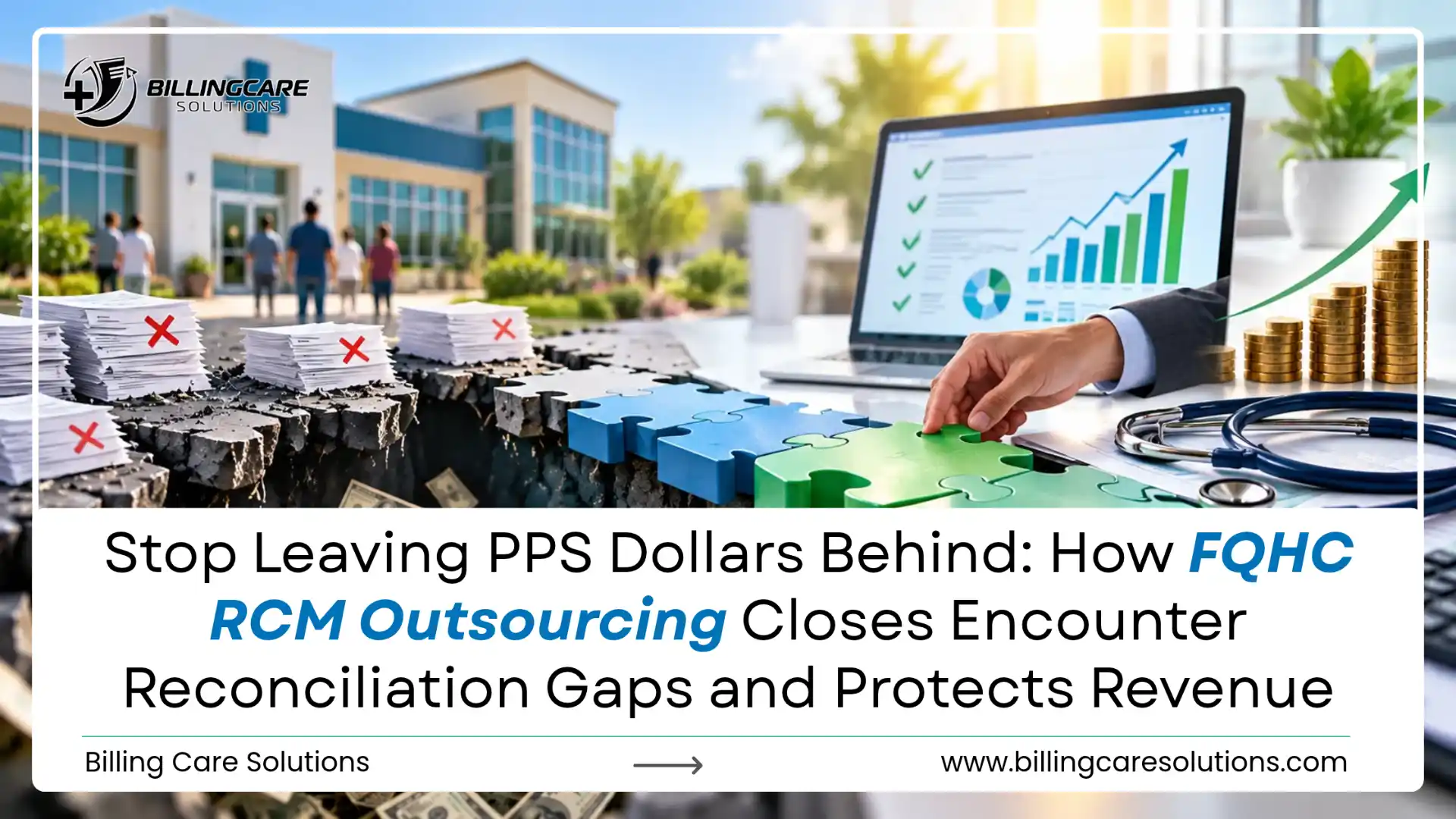
Your FQHC may provide services, bill, and collect payments, without realizing funding opportunities. The issue occurs between the encounters completed, claims submitted, claim payment submitted, and outstanding balances. If these records aren’t in sync, your finance department requires time, precise information and ongoing follow-up. FQHC RCM outsourcing partners are able to help fill in these gaps without providing additional pressure on your current staff.
The question isn’t based on the idea of outsourcing one’s bills. FQHC RCM Outsourcing can benefit your organization with better visibility in finances, accountability in workflow and collection flow-through. A qualified partner analyzes billing procedure, monitors payment inconsistencies, resolves payment discrepancies and reports unclaimed financial matters.
If you and your team are incapable of accounting for the reason why claims stay outstanding, are unable to find discrepancies in payments, or have not identified outstanding claims that have grown outdated. You may need to take a more in-depth look at your existing payment process. Where these problems still remain with internal improvement efforts, a look at FQHC RCM outsourcing might be appropriate.
The Hidden Revenue Problem Inside Your FQHC
A lack of revenue isn’t always the final result of a single billing error at most FQHCs. They tend to build up during the course of everyday practices from minor exceptions. FQHC RCM outsourcing can offer additional capacity to dig deeper into these exceptions before they are more difficult to resolve!
An accomplished encounter could fail to get to claim submission. The rejection may not be corrected by a clearing house rejection. A partial payment may be made and a follow up is not made. It may be necessary to track the supplemental payment separately from the applicable program.
Each problem needs to be investigated, described and planned for action. Exceptions are open beyond the normal time if there is no reconciliation procedure or your team has limited time. Ownership responsibility for addressing the above should be clearly defined in FQHC RCM outsourcing.
Four Warning Signs Your Revenue Cycle Needs Attention
Four indicators that there is a problem in your revenue cycle.
- If you identify with any of these conditions, your organisation’s process should be reviewed.
- It is not possible for your team to line up completed encounters with submitted claims.
- Your accounts receivable reports have growing amounts of aging without specific next steps.
- Payment posting is a way of identifying balances, but nobody is taking the time to look into the disparities.
- No payment or receipt is made to leadership without an explanation of payment settlements.
The following warning indicators do not necessarily indicate loss of revenues at your FQHC. They suggest that you do not report what the causes are, what options you have for recovery and who the responsible owners are. FQHC RCM Outsourcing can be beneficial to evaluate if your internal process can’t regularly answer those questions.
Why PPS Reconciliation Gaps Put Your Revenue at Risk
Federally Qualified Health Centers operate with a set of reimbursement procedures that will differ according to the specific reimburser and program. The requirements for Medicare PPS, Medicaid PPS and applicable supplemental payment arrangements vary. The cost of FQHC RCM Outsourcing should consider these differences, not necessarily all variance in payment.
When Expected Payments Do Not Match Actual Payments
Your finance functions should have one understanding of what reimbursement they can anticipate based on the rules associated with the payments. It should be juxtaposed with actual remittance history and documented changes. When payment reconciliation is a part of the FQHC RCM outsourcing, this can assist in the review.
When billed charges do not match the amount of the invoice, that does not necessarily mean that the company is entitled to claim an underpayment. The actual amount received is the result of contractual adjustments, coverage rules, any patient responsibility, as well as any payment method that is different for each payer.
The team should record information about each variance, and decide whether the variance should be corrected, clarified, appealed, or left as it is. Only additional payments should be requested with FQHC RCM outsourcing when there is supporting documentation for the recovery request.
When Supplemental Payments Need Separate Tracking
Certain FQHCs are Medicaid wraparound or Medicare Advantage supplemental payments. Eligibility, how the benefits are calculated, how to report and when payments will be made will vary according to program and arrangements. If your company processes these transactions, monitor relevant encounters, scheduled payments and delinquent balances on a separate sheet for these transactions. The supplemental elements of payment support should be included as part of the FQHC RCM Outsourcing only if the provider offers payment support and the responsibility is clearly outlined.
When Unresolved Balances Become Harder to Recover
Retesting is not enough for an aging claim. You should get the response of the payer, why the process was delayed, the applicable filing deadline, and the next corrective action steps. Prompt filing and prompt appeal become significant when claims become “old,” that is, multiple days or weeks in age. A delay in investigation also complicates the process of pinpointing common issues in several claims. Using FQHC RCM outsourcing makes it easier to highlight unresolved balances and keep track of follow-up, allowing more time for options while avoidable obstacles stay in place.
How FQHC RCM Outsourcing Changes Daily Revenue Cycle Operations
In what ways will the provider give your organization value? How will work be managed in the process? Will your business get valuable reporting? FQHC RCM outsourcing should not just ease the pain of claim submission, but should also be better equipped to deal with the financial exceptions as well.
1. Reconcile Encounters Against Submitted Claims
An outsourced team matches surgical encounter information with the patient charge and claims submission status. Identifies completed encounters with no corresponding claims, rejects submitted records, and records that need further review. You get a better picture of any gaps in the billing process in your organisation. It is important that these exceptions be visible, actionable, and verifiable in the FQHC RCM outsourcing process to resolve issues.
2. Compare Expected Payments With Remittance Records
The teams reviews remittances and payment postings received from the payers and payment outstanding, contractual adjustments. It defines and records any discrepancies and decides whether they need to be corrected, clarified, appealed or left as such. These findings should be evident in FQHC RCM outsourcing exception reports and follow up tasks. Your internal team should recognize the issues which should be decided, further documented and escalated to payers.
3. Resolve Denials and Outstanding Receivables
The team places a high emphasis on claims where a denial has occurred, claims that need to be filed or are approaching the deadline to file, the dollar balances on claims, the response from payers, and the future promise of recovery. Staff do not address all claims in the same manner, but rather moves towards addressing ones that need quick intervention. Denials should be reviewed with a lens also for things that could have been avoided during the registration, documentation, or submission processes. The goal of FQHC RCM outsourcing must be to deal with the recurrence causes rather than tolerating the occurrence of messes which are easy to prevent.
4. Give Leadership Clearer Financial Reporting
The chief executive officer and maker of the direct mailings require a complete figure, not just the total. They must need to get the answer about claims that still have to be solved, how payments start to differ from expectations and what actions are taken. Useful FQHC RCM outsourcing reports should display open exceptions, ageing balances, denial trends, responsible owners and documented outcomes. This provides leaders with a clearer basis to review the performance of teams and hold them accountable.
Should Your FQHC Keep Billing In-House or Outsource?
Outsourcing does not necessarily make the best sense for every health center. This will differ based on the reconciliation process, performance, residual processing load, technology performance, and complete operating costs.
Use this comparison to determine if there are ways for your current plan to be better.
| Decision factor | Internal team may be sufficient when | Outsourcing deserves consideration when |
|---|---|---|
| Encounter reconciliation | Encounters and claims match consistently | Unmatched records remain unresolved |
| Payment follow-up | Staff meet follow-up deadlines | Aging claims lack clear ownership |
| Denial management | Root causes are tracked and corrected | The same denial patterns continue |
| Financial reporting | Leadership receives reliable exception reports | Reports show totals without explanations |
| Staffing capacity | Workloads remain manageable | Reconciliation competes with essential billing tasks |
| Cost management | Internal costs and results are transparent | Costs rise while unresolved balances accumulate |
After doing this comparison, look for areas that need improvement in your current arrangement. If the needs are already being met by your internal team, then specific process improvements may be the best alternative. But ongoing deficiencies might warrant using an FQHC RCM Outsourcing to bring an extra layer of capacity and accountability to operations. Now the next step is to evaluate your current performance and pinpoint the provider. It is more appropriate for FQHC RCM Outsourcing should address documented operational gaps rather than just be a substitute for one billing system to another.
What Financial Return Should You Expect From FQHC RCM Outsourcing?
Don’t judge outsourcing based solely on collection numbers that boost to come up lower. Your organization will require a baseline measurable target and evidence of results. Verified recoveries, operating efficiency, reporting quality, and total costs of services should be measured to evaluate FQHC RCM outsourcing.
Start by tracking these five indicators.
| Metric | What to review | Business value |
|---|---|---|
| Unmatched encounter volume | Encounters without a corresponding claim or documented resolution | Reveals gaps between services and billing |
| Verified underpayments | Confirmed payment differences supported by payer rules | Identifies legitimate recovery opportunities |
| Denial rate | Denied claims divided by claims submitted, using a consistent definition | Highlights preventable billing problems |
| Days in A/R | Average time receivables remain outstanding | Shows collection delays |
| Cost to collect | Revenue cycle operating costs relative to collections | Supports financial comparisons |
Calculate Potential Value Before Signing
A financial review should distinguish potential discrepancies, under payments verified, actual recoveries and balances un-collected. The figures below show how those categories are to be reported.
| Revenue review measure | Amount |
|---|---|
| Potential payment discrepancies identified | $40,000 |
| Confirmed recoverable underpayments | $25,000 |
| Amount successfully recovered | $20,000 |
| Confirmed underpayments still requiring follow-up | $5,000 |
| Discrepancies not confirmed as recoverable underpayments | $15,000 |
This is a helpful example of why any differences identified should not be reported as revenue that’s guaranteed. FQHC RCM outsourcing should identify verified recoveries versus unresolved balances and discrepancies that don’t qualify for further payment. Analyze the real costs and benefits of outsourcing, versus other costs. Do not count-in internal reductions in labour costs unless there is evidence of cost savings or of productive capacity saved. Documented results or outcomes from a FQHC RCM outsourcing should be used and not projected collections.
Establish Targets Before the Engagement Begins
Consent upon which metrics and reporting definitions will be used before work begins. Establish realistic goals or deadlines for reconciliation completion, denial follow-up, aging of claims, and reporting period. Periodically check results and explain changes in claim volume, payer mix, staffing and reimbursement levels. This way, any normal business cycles are avoided from being wrongly labeled on the outsourcing provider.
What to Check Before Choosing an FQHC RCM Outsourcing Partner
A low service charge doesn’t equate with a good business margin. Your partner should have the necessary skills, the ability to report and have clearly defined duties. The best approach to FQHC RCM Outsourcing is to have an understanding of the scope, performance measures and escalation process between both parties.
Ask prospective providers these questions before making a decision.
Do You Understand FQHC Reimbursement Requirements?
Inquire whether they have experience with encounter-based billing, Medicare PPS, Medicaid billing needs, and supplemental payment systems mentioned by Medicaid and Medicare. Ask for examples of how the team differentiates payment adjustments that are valid from underpayments. Verify what the reconciliation activities are for that proposed scope includes for the different payers.
Will We Receive Actionable Reconciliation Reports?
Request to view an example report with such items as unmatched encounters, exemplary claims, payment variances, aging accounts, etc. and next actions. Your leadership should determine the best issue, who is accountable for this issue and what is planned to resolve the issue without merging all the reports manually. FQHC RCM outsourcing should streamline the financial reporting process for easier reading and interpretation.
How Will You Measure Performance?
Make a commitment on how to report, who to follow up, when, and when to escalate as well as key performance indicators. Your contractual agreement should detail what is done by the provider, what’s done by your team and outline how it is dealt with if something goes unresolved.
How Will You Protect Our Data?
Examine access to the system, security measures, data sharing processes, incident response procedures and relevant aspects of HIPAA regulation. Set up appropriate business associates agreements as needed. Verify the workflow process with your current EHR, practice management and the way the provider will handle financial reporting. FQHC RCM outsourcing should blend in seamlessly with your operational environment; there should not be a vacuum of reporting.
How Billing Care Solutions Fits Into Your Outsourcing Decision
Billing Care Solutions offers revenue cycle management services, such as claims processing and payments, payments posting and reconciliation, payments denial review and resolution, payments AR follow-up, and financial reporting. FQHC leaders should validate the type of services, reporting options and supplemental payment assistance accessing which they need. The offering should not start with a vague service package but rather should start with what are your financial and operational issues. The best FQHC RCM outsourcing should be linked to issues your organization has documented, objectives that both parties can measure.
A review should determine with Billing Care Solutions:
- When there is a discrepancy between encounters and claims.
- Claims and balances not resolved.
- If money differences are considered legitimate recovery options.
- What is the effect of some denial patterns to avoid?
- What are the key examples of an outsourcing engagement should be measured by.
The results will help you decide if it makes sense to completely outsource the RCM, provide partial RCM services, or do internal workflow improvements. Best practice with FQHC RCM outsourcing is to provide a clearly defined scope, reporting and periodic review to the agreed performance targets.
Take the Next Step Toward Better Revenue Control
Don’t base payment differences, explain discrepancy in encounters or aging receivable if there’s difficulty in reconciling, instead of collection totals. Analyze your outstanding claims, reconciliation backlog, denial trends and your running cost to collect to see what changes you must make.
Billing Care Solutions can be a place to begin looking at your needs and the kinds of RCM support that are offered. Ask them to review your existing workflow, establish a services framework and set everyone’s expectations for measurable performance before you sign. The goal isn’t to outsource all billing jobs. To implement a dependable system to manage uncollected revenue, credit for valid payments and provide leadership with the data to monitor financial performance.
