

Thyroid Awareness Month Guide to Thyroid Nodule ICD 10 Billing Accuracy
This Thyroid Awareness Month, review accurate thyroid nodule ICD 10 coding, documentation basics, and billing tips to support clean and compliant claims.
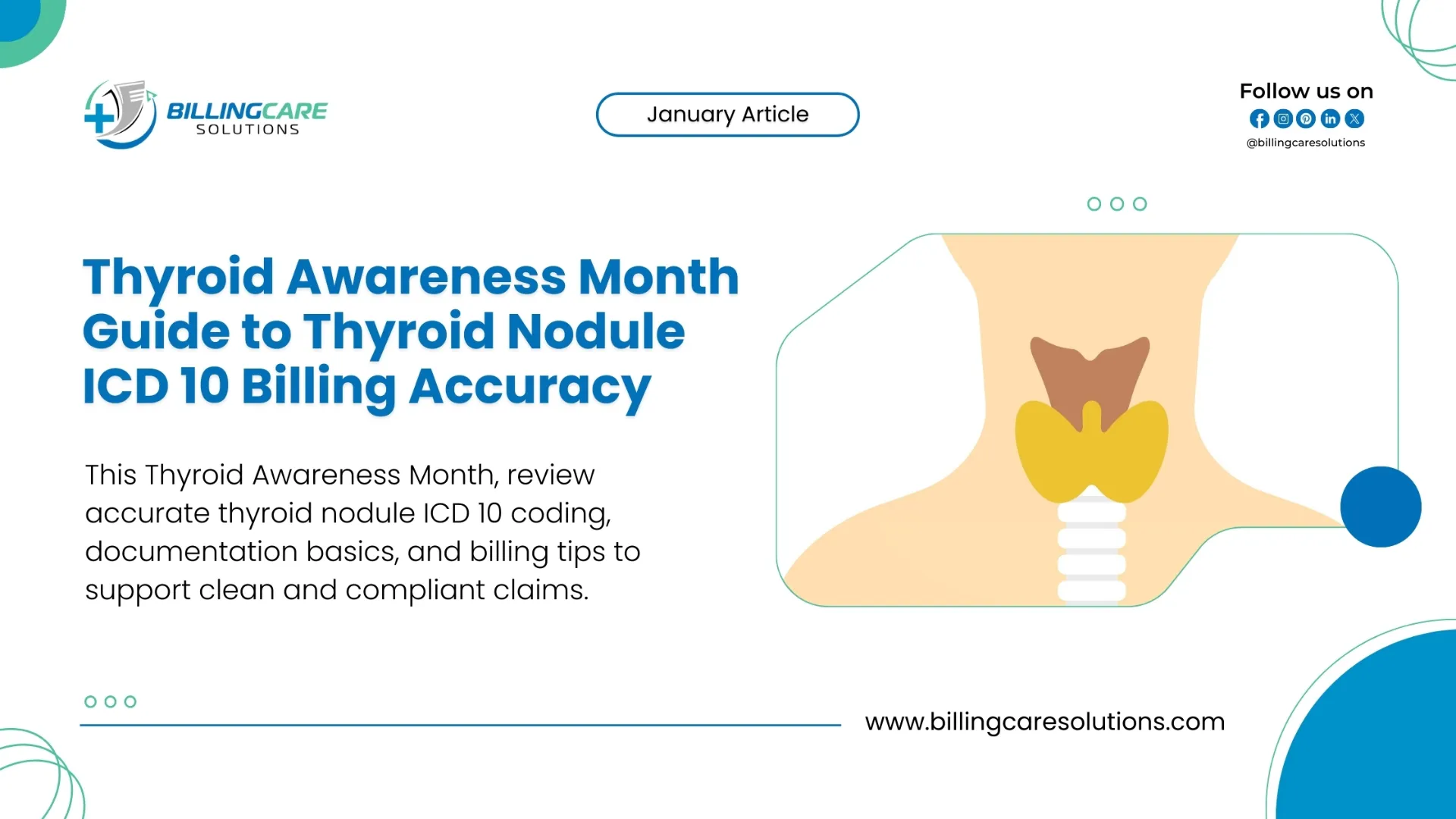
The month of January is Thyroid Awareness Month and perfect time to address one of the most prevalent billing issues in endocrinology practices appropriate thyroid nodule ICD 10 coding. Thyroid nodules occurring in 50-60% of the population have to be properly documented and coded to maximize reimbursement and compliance.
Understanding Thyroid Nodule ICD 10 Codes
The codes of the International Classification of diseases, Tenth revision that describe thyroid nodule ICD 10 are under the E04 category. These codes play a vital role in billing quality because they affect the claim reimbursement and rates directly. The medical billing personnel should be knowledgeable on the intricacies of each and every code in order to classify them correctly and prevent expensive claim rejections.
Correct coding of thyroid nodule ICD 10 codes should be done with great care upon review of clinical documentation. The physicians should specify whether the nodule is single or multiple, whether it has cysts, and whether the nodule has any toxic properties.Nontoxic Thyroid Nodules
The majority of cases of thyroid nodules are made up of nontoxic thyroid nodules. These nodules do not cause excess secretion of thyroid hormone and are usually found during routine physical assessments or when conducting imaging tests.
Primary Thyroid Nodule ICD 10 Codes
The following table outlines the most commonly used thyroid nodule ICD 10 codes in clinical practice:
| ICD-10 Code | Description | When to Use |
|---|---|---|
| E04.1 | Nontoxic single thyroid nodule | Use when a single thyroid nodule is present without evidence of hyperthyroidism. |
| E04.2 | Nontoxic multinodular goiter | Use when multiple thyroid nodules are present without hyperthyroidism. |
| E04.9 | Nontoxic goiter, unspecified | Use when goiter is documented but specific characteristics are not described. |
| E05.10 | Thyrotoxicosis with toxic single thyroid nodule without thyrotoxic crisis | Use when a single toxic thyroid nodule causes hyperthyroidism without crisis. |
| E05.20 | Thyrotoxicosis with toxic multinodular goiter without thyrotoxic crisis | Use when multiple toxic nodules cause hyperthyroidism without crisis. |
Nontoxic Thyroid Nodules
This E04.1 thyroid nodule ICD 10 code happens to be applied to single nontoxic thyroid nodules. This code is suitable in cases where the ultrasound or physical examination proves the presence of a solitary nodule and no signs of thyrotoxicosis. The size, location and character of the nodule should be documented.
Code E04.2 includes nontoxic multinodular goiter, which is the presence of more than one nodule in the thyroid gland. To support the use of this code, billing specialists are to ensure that there are multiple nodules in the documentation and not just a single nodule.
Toxic Thyroid Nodules
Toxic thyroid nodules cause surplus thyroid hormone thereby causing hyperthyroidism. These cases are to be contained under other forms of thyroid nodules ICD 10 than the E05 category. Differences between toxic and nontoxic nodules play a critical role in the accuracy of billing since there is a big difference in treatment patterns and cost of reimbursement.
Code E05.10 is used in the case of thyrotoxicosis of a single nodule of thyroid that is toxic and does not result in a thyrotoxic crisis. Diagnosis will involve laboratory findings of hyperthyroidism and imaging to prove the existence of a single nodule.
E05.20 is the right ICD 10 code of thyroid nodule in case of patients with multiple toxic nodules. Thyroid function tests with inhibited TSH levels and increased thyroid hormones should be properly documented.
Additional Related ICD 10 Codes
| ICD-10 Code | Description | Documentation Requirements |
|---|---|---|
| E05.11 | Thyrotoxicosis with toxic single thyroid nodule with thyrotoxic crisis | Documentation must clearly support the presence of a thyrotoxic crisis. |
| E05.21 | Thyrotoxicosis with toxic multinodular goiter with thyrotoxic crisis | Documentation must clearly support the presence of a thyrotoxic crisis. |
| C73 | Malignant neoplasm of thyroid gland | Biopsy or cytology confirmation of malignancy is required. |
| D34 | Benign neoplasm of thyroid gland | Pathology report confirming benign nature is required. |
| E07.1 | Dyshormogenetic goiter | Documentation should support a genetic or metabolic cause. |
Documentation Requirements for Thyroid Nodule ICD 10 Coding
CDA thyroid nodule ICD 10 coding requires adequate clinical recordings. Medical records should include certain details that align with the diagnosis code chosen and prove the medical necessity of its procedures and treatments.
Thyroid nodule ICD 10 coding can only be accurate when imaging reports are provided. Ultrasound reports need to provide the size of nodules, whether they are solid, cystic or mixed, echogenicity and presence of suspicious characteristics.
The important background to thyroid nodule ICD 10 code selection is laboratory values. TSH is useful in distinguishing between toxic and nontoxic nodules. Toxic nodule codes are used when it is suppressed by high levels of T3 or T4.
Fine needle aspiration biopsy findings have a high influence on coding. Benign cytology justifies the further use of conventional thyroid nodule ICD 10 codes. Nevertheless, suspicious or malignant results necessitate the adjustments of codes to depict neoplasm ones.
Avoiding Common Thyroid Nodule ICD 10 Coding Errors
There are a number of common mistakes in thyroid nodule ICD 10 coding that result in denial of claims and risks of compliance. Knowledge about these traps can assist the billing departments to prevent them and enhance the percentage of first-pass resolution.
Mistakenly attributing single nodule codes and multiple nodule codes are a common mistake. Billers should take time to read imaging reports in order to ascertain the nodule number. When there are more than one nodule, E04.1 should not be used because it will be considered as undercoding and may lead to audit.
There would be a lot of billing issues with the failure to differentiate between toxic and nontoxic nodules. The E04 and E05 types are reimbursed differently and with diverse medical needs. Billing personnel should check thyroid functional tests prior to the conclusive selecting of thyroid nodule ICD 10 code.
Lack of documentation of thyrotoxic crisis in the presence gives rise to undercoding. The categories of severity are impacted by the difference between codes with 0 (no crisis) and 1 (crisis).
Coding unspecified codes in the presence of specific information is the failure to utilize an opportunity of coding correctly. Code E04.9 must not be employed in the instances when the documentation is really not specific.
Impact of Accurate Thyroid Nodule ICD 10 Coding
Accuracy in ICD 10 coding of thyroid nodules is a direct factor in financial performance of various revenue cycle measures. When the accuracy of coding is high then clean claims processing is enhanced, denial rates are reduced and the amount reimbursed is increased.
The results of the initial step in attributing thyroid nodules ICD 10 codes have a notable increase in first-pass resolution rates. Claims can also be processed by the payers without further documentation and less time is taken to pay.
Denial prevention is among the best advantages of correct ICD 10 coding of thyroid nodules. Medical necessity denials are reduced where there is a match between codes and the clinical findings and procedures ordered.
Another important benefit of the precision of coding is compliance risk mitigation. Thyroid condition coding attracts the attention of auditors because of the number of cases and the cost of procedures. Use of proper thyroid nodule ICD 10 codes is an indication of adherence to the coding principles.
Coding for Thyroid Nodule-Related Procedures
Knowledge of thyroid nodule ICD 10 codes and procedure codes interaction guarantee full and correct claims. The medical necessity of the performed procedures should be justified by the diagnosis codes so that reimbursement is received.
Thyroid ultrasounds are normally requested to evaluate nodules. The ICD 10 code of thyroid nodule should be justifiable for the imaging study. To detect nodules at the first stage, the codes such as E04.1 or E04.2 will be adequate.
Fine needle aspiration biopsies have to be justified solidly using thyroid nodule ICD 10 codes. Biopsies are usually accepted by the payers when nodules are of a size or when the nodules have suspicious ultrasound characteristics.
Coding for Thyroid Nodule-Related Procedures
Knowledge of the interaction between thyroid nodule ICD-10 codes and procedure codes will result in full and proper claims. The medical necessity of the procedures undertaken should be supported by the diagnosis codes in order to achieve reimbursements.
Thyroid ultrasounds are normally requested to test the nodules. The ICD 10 code of thyroid nodule should be used to explain the imaging study. To identify nodules at the first stage, such codes are suitable as E04.1 or E04.2.
Fine needle aspiration biopsies must have solid reasons by use of thyroid nodule ICD 10 coding. Biopsies are usually confirmed by the payers when nodules are of the right size or have suspicious ultrasound appearances.
Why Choose Billing Care Solutions?
Our area of specialization in Billing Care Solutions is complicated medical billing situations such as thyroid nodule ICD 10-coding. Our endocrinology certified coders remain updated on new coding developments and payer regulatory demands, so that your practice can optimally recoup its money and remain in total compliance.
We know that billing in thyroid conditions demands expertise of clinical peculiarities, as well as in coding standards. Our team offers a full-service revenue cycle management tool, such as coding audits, personnel training, denial management, and live claim scrubbing. Having our experience in specialty billing, we assist practices to have fewer claim denials by 40% and prompting collections by 25.
Outsource with Billing Care Solutions and change the way you bill thyroid and financial results.
Conclusion:
With the introduction of Thyroid Awareness Month with the emphasis on thyroid health, medical billing professionals should put the emphasis on precision in thyroid nodule ICD 10 coding. Thyroid conditions are so complicated they require attention to detail, thorough documentation review and lifelong learning.
To code thyroid nodules using ICD 10, it is essential to deal with the clinical peculiarities of the nodules of different types and manifestations. With systematic coding practices and regular auditing, high accuracy rates will be realized by billing teams that will assist with compliance and revenue optimization.
