

Accurate NSTEMI ICD 10 Documentation to Prevent Claim Denials
Accurate NSTEMI ICD 10 documentation helps prevent claim denials and supports compliant medical billing
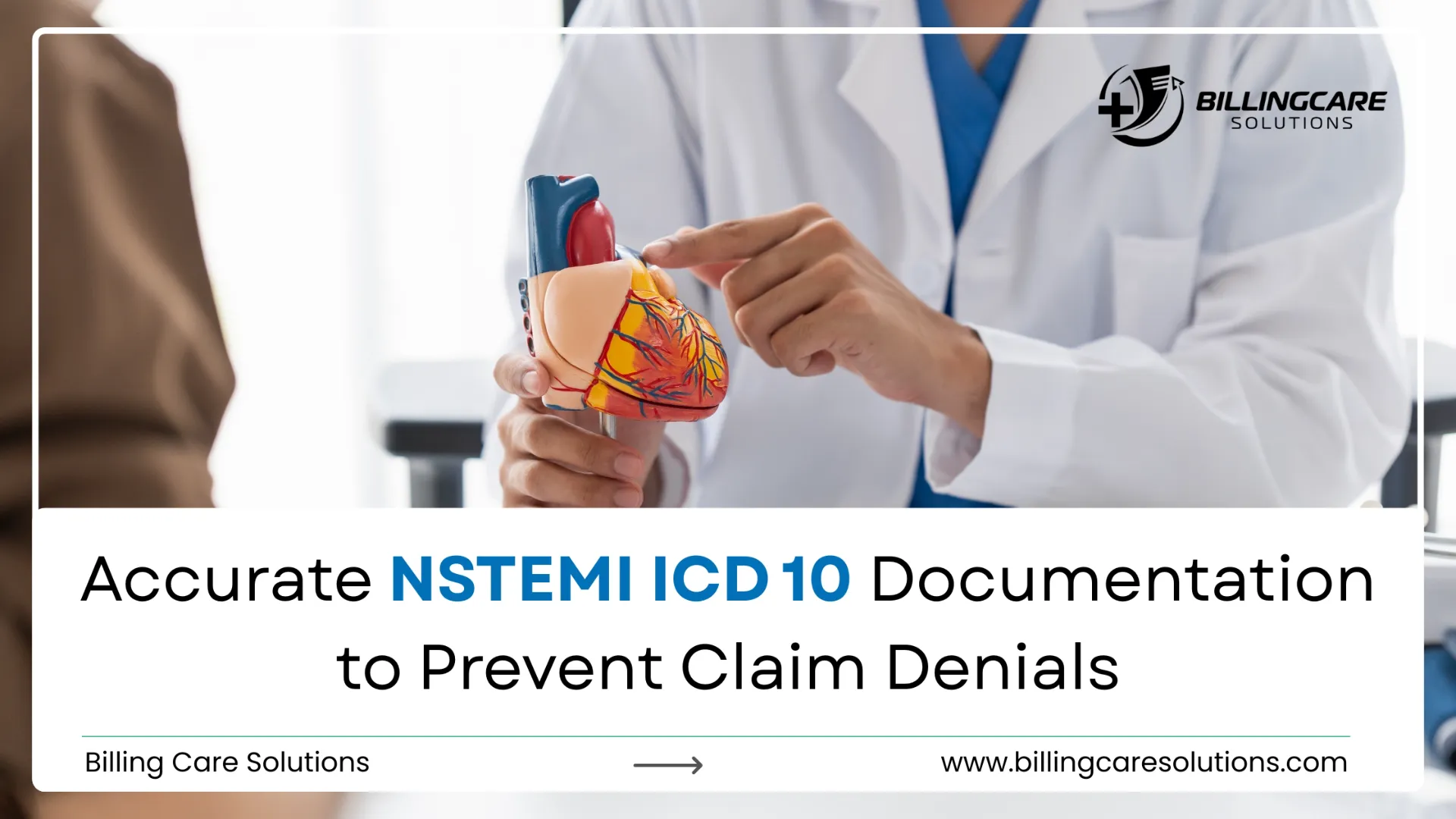
Non-ST-elevation myocardial infarction (NSTEMI) is a very serious cardiovascular disease that needs to be accurately coded and documented in medical records. As a healthcare provider and medical billing professional, it is crucial to be aware of the appropriate NSTEMI ICD 10 codes to make sure that the reimbursement is rendered properly and that the claim denials are not costly. This resource is an all-in-one guide to the complexities of NSTEMI coding, documentation, and best practices to simplify your revenue cycle management.
Understanding NSTEMI ICD 10 and Its Clinical Significance
NSTEMI is a form of acute coronary syndrome whereby the heart muscle is damaged by a lack of blood supply but unlike STEMI (ST-elevation myocardial infarction), it is not associated with elevated ST-segments in an electrocardiogram. The condition is urgent, and it needs a proper coding according to the severity and details of the clinical condition of the patient.
Correct NSTEMI ICD 10 coding has a direct effect on the reimbursement rate, quality reporting, and adherence to regulatory requirements. Wrong or incomplete coding may result in denials of claims, late payments and audit flags.
Primary NSTEMI ICD 10 Codes and Categories
The ICD-10-CM coding system has particular codes in which NSTEMI occurs depending on the involved coronary artery. It is important to know those differences so that it will be possible to make a correct claim.
| ICD-10 Code | Description | Clinical Application |
|---|---|---|
| I21.4 | Non-ST elevation (NSTEMI) myocardial infarction | Primary code for NSTEMI without specific artery documentation |
| I21.01 | STEMI involving left main coronary artery | When STEMI affects left main artery (not typically NSTEMI) |
| I21.02 | STEMI involving left anterior descending coronary artery | Specific LAD involvement with ST elevation |
| I21.09 | STEMI involving other coronary artery of anterior wall | Anterior wall STEMI variations |
| I21.11 | STEMI involving right coronary artery | RCA involvement with ST elevation |
| I21.19 | STEMI involving other coronary artery of inferior wall | Inferior wall STEMI variations |
| I21.21 | STEMI involving left circumflex coronary artery | LCX with ST elevation |
| I21.29 | STEMI involving other sites | Other specific locations |
Subsequent Encounter Codes for NSTEMI ICD 10
| ICD-10 Code | Description | Usage Guidelines |
|---|---|---|
| I21.4 | NSTEMI - initial encounter | First treatment episode within 4 weeks |
| I22.2 | Subsequent STEMI of other sites | Additional MI within 4 weeks of initial event |
| I25.2 | Old myocardial infarction | MI that occurred more than 4 weeks ago |
| I23.0–I23.8 | Complications following acute MI | Post-MI complications within 28 days |
Documentation Requirements for NSTEMI ICD 10
Correct NSTEMI ICD 10 coding requires detailed clinical reports. To correctly code the medical cases, the medical coders need certain information on the physician note to avoid denials.
Essential Documentation Elements for NSTEMI ICD 10
Clinical Indicators:
It must be clear in the medical record, which states NSTEMI, or non-ST-elevation myocardial infarction. Unspecified heart attack or MI are generic terms, which cannot be coded specifically.
Timing Information:
Document the fact whether it is an initial encounter, second encounter, or sequela. The time is an important consideration in selecting the code and the codes related to acute MI can be used within four weeks of the incident.
Artery Involvement:
I21.4 is the general GG NSTEMI, but recording the artery Involvement (LAD, RCA, LCX) offers more clinical information and can influence the choice of code in some situations.
Diagnostic Evidence:
Include supportive data, e.g. troponin levels, ECG results indicative of no ST elevation, cardiac catheterization, and imaging studies. This fact supports the diagnosis of NSTEMI and defends against audit issues.
Complications and Comorbidities
Report any complications that are a result of the NSTEMI, which include heart failure, arrhythmias, or cardiogenic shock. Such conditions necessitate extra codes as well as influence reimbursement.
Common NSTEMI ICD 10 Coding Errors and Prevention
The information about common errors in NSTEMI ICD 10 coding is useful to avoid loss of revenue and claim denials.
Confusing NSTEMI with STEMI in ICD 10:
Misdiagnosis of NSTEMI and STEMI or the opposite is one of the most crucial mistakes. Code I21.4 is used in NSTEMI with the codes of STEMI (I21.01-I21.29) indicating the location of the affected artery and wall. Always question ECG results and physician recording prior to assigning code.
Incorrect Encounter Type in NSTEMI ICD 10:
When there is a lack of differentiating between initial encounter, subsequent encounter, and sequela, there will be errors in coding. I21.4: the acute NSTEMI episode in four weeks. In case of a later MI event within four weeks, I22 codes are to be considered. Occurrences more than four weeks necessitate I25.2 (old MI).
Missing Laterality and Specificity:
Coders have to record this when documentation contains a specific artery involvement. Application of the non-specific I21.4 code where the record specifies a specific coronary artery is incomplete coding.
Overlooking Related Conditions:
Patients with NSTEMI are common in manifestations of comorbidities such as high blood pressure, diabetes, or kidney disease. Such circumstances demand different codes and will have a great influence on risk adjustment and quality indicators.
Additional NSTEMI ICD 10 Codes for Complete Documentation
Related Cardiovascular Conditions
| ICD-10 Code | Description | Relationship to NSTEMI |
|---|---|---|
| I50.9 | Heart failure, unspecified | Common complication post-NSTEMI |
| I50.21 | Acute systolic heart failure | Specific heart failure type |
| I48.91 | Atrial fibrillation, unspecified | Arrhythmia associated with MI |
| R57.0 | Cardiogenic shock | Severe complication requiring additional coding |
| I20.0 | Unstable angina | Pre-MI condition or alternative diagnosis |
| I25.10 | Atherosclerotic heart disease of native coronary artery | Underlying condition |
Procedure Codes for NSTEMI Treatment
| CPT/HCPCS Code | Description | Documentation Requirements |
|---|---|---|
| 92928 | Percutaneous coronary intervention with stent placement | Single major artery |
| 92933 | PCI with stent, each additional branch | Additional vessels treated |
| 93458 | Left heart catheterization | Diagnostic procedure |
| 33533–33536 | Coronary artery bypass graft | Surgical intervention codes |
Strategies to Prevent NSTEMI ICD 10 Claim Denials
Implement Clinical Documentation Improvement (CDI)
A strong CDI program is a guarantee that physicians record all the relevant information that would be used to code NSTEMI ICD 10 accurately. CDI experts will view charts on-the-fly and request providers to provide information they do not have.
Regular Coder Training on NSTEMI ICD 10
Guidelines on the coding of ICD-10 change each year. Frequent training will make the coding staff aware of changes in the NSTEMI documentation in the form of new codes, deletions, and updated guidelines.
Pre-Submission Claim Audits
Pre-payment coding errors are detected during internal audit. Audit high-dollar claims such as NSTEMI claims in order to uncover mistakes that may cause denials.
Leverage Technology Solutions
High-level software programs that have in-built editing checks remind coders of possible mistakes, omission of modifiers or documents that were not documented. These tools minimize errors that occur in humans and enhance first pass acceptance.
Establish Clear Communication Channels
Develop streamlined communication between coders, CDI specialists and physicians. Fast query resolution helps to eliminate delays and assign the code correctly.
Medical Necessity and Supporting NSTEMI ICD 10 Documentation
Claims of NSTEMI are scrutinized by payers because they are costly to treat. It is necessary to prove medical necessity by using full documentation.
Laboratory Values for NSTEMI ICD 10
Cardiac biomarkers of documents such as troponin I or T, CK-MB, and BNP. Patterns of rise and fall in serial troponins are indicative of NSTEMI diagnosis and medical necessity to intervene.
Diagnostic Imaging
Inclusiveness of the ECG results stating the absence of ST- segment elevation, echocardiograms showing the abnormalities in wall movement and coronary angiography results determining the location and severity of stenosis.
Clinical Presentation
The document provides characteristics of chest pain, duration, pattern of radiation, other related symptoms, such as dyspnea or diaphoresis, and response to the initial treatment.
Coding NSTEMI ICD 10 with Complications
When NSTEMI results in complications, additional codes capture the complete clinical picture and justify higher resource utilization.
Complications Within 28 Days
| ICD-10 Code | Complication | Coding Notes |
|---|---|---|
| I23.0 | Hemopericardium as current complication | Bleeding into pericardial space |
| I23.1 | Atrial septal defect as current complication | Structural heart damage |
| I23.2 | Ventricular septal defect as current complication | Requires surgical intervention |
| I23.3 | Rupture of cardiac wall without hemopericardium | Life-threatening complication |
| I23.4 | Rupture of chordae tendineae | Valvular dysfunction |
| I23.5 | Rupture of papillary muscle | Acute mitral regurgitation |
| I23.6 | Thrombosis of atrium, auricular appendage, and ventricle | Thromboembolic risk |
| I23.7 | Postinfarction angina | Ongoing ischemia |
Quality Reporting and NSTEMI ICD 10 Coding Impact
Proper NSTEMI ICD 10 coding would impact quality reporting initiatives such as the MIPS (Merit-based Incentive Payment System) and the quality of hospitals.
Core Measures Impact:
The core measures of acute myocardial infarction provided by the Joint Commission are based on correct coding of ICD-10 to determine the population denominator. Miscoding the NSTEMI cases may disqualify patients in the calculation of quality measures and/or include patients falsely, which will impact the hospital ratings and reimbursement.
Risk Adjustment:
Risk adjustment in Medicare Advantage and other value-based payment models is performed using ICD-10 codes. Registering NSTEMI with I21.4 and all the related conditions correctly would provide the correct risk score and pay the corresponding capitation.
Timeframe Considerations of NSTEMI ICD 10 Coding:
Code selection and processing of claims are greatly influenced by the time of the MI event.
Initial MI Episode (0-4 Weeks)
Apply I21.4 to NSTEMI in the acute stage which is a period of not more than four weeks since the incidence. Any experience throughout this span, hospitalization, emergency care, and direct follow-up appointments are acute MI coded.
Subsequent MI (Within 4 Weeks)
In case a patient has the new MI within four weeks after the first NSTEMI, then the code I22.2 (subsequent NSTEMI) is relevant. This shows a new thrombotic incident at the acute stage of the initial MI.
Old MI (After 4 Weeks)
After four weeks of acute event, code I25.2 (old myocardial infarction) will be used instead of I21.4. The code is applicable in healed MI without the current acute symptoms.
Payer-Specific Requirements to NSTEMI ICD 10
Various payers can have certain documentation requirements when it comes to NSTEMI claims.
Medicare Guidelines:
Medicare demands detailed records that prove the NSTEMI diagnosis, and evidence of biomarkers in the heart, ECG results, and physicians. The Local coverage determination and National coverage determination policies can state the coverage on specifying some of the interventions.
Commercial Payers:
The pre-authorization of such procedures as PCI or CABG in patients with NSTEMI is a common characteristic of commercial insurers. Also, make sure that approval is secured and a record maintained prior to the process so as to avoid rejection.
Medicaid Programs:
State Medicaid programs might have different requirements of NSTEMI documentation. Confirm state-specific instructions to be effective.
Best Practices NSTEMI ICD 10 Documentation.
The use of standardized documentation practices leads to better coding and fewer denials.
Use Standardized Templates:
Create EMR templates particularly used to record NSTEMI that encourages the physician to record all the details needed to be fully coded.
Real-Time Query Process:
Introduce simultaneous CDI reviews with instant physician inquiries to clear up the questionable documentation during the hospital stay of the patient.
Physician Training NSTEMI ICD 10:
Train physicians of cardiology and emergency medicine on documentation of NSTEMI ICD 10 code. Best practices can be strengthened by physician champions.
Regular Denial Analysis:
Monitor and trace the NSTEMI claim denials to find out the pattern and take remedial measures. Provide shared findings to clinical and coding personnel to eliminate recurrences.
Accuracy of Technology Tools NSTEMI ICD 10 Coding Accuracy
Computer-Assisted Coding (CAC):
CAC is a software that interprets clinical records and recommends the right NSTEMI ICD 10 code according to the processing of natural languages. Although CAC does not substitute human coders, it enhances efficiency and accuracy.
Improvement Software, Clinical documentation:
The CDI systems are integrated with the EMR systems to detect the documentation gaps in real-time, when the physician has questions on the information that is not available in the EMR to complete the NSTEMI coding:
Denial Management Systems:
Special software monitors the trend of denials, determines the root cause, and allows appeals. Regarding NSTEMI claims, the systems facilitate the identification of denials as a result of coding mistakes, lack of documentation or medical necessity.
Preparation of the audit concerning the NSTEMI ICD 10 Claims
Checklist of the Documentation Review:
Keep a standard checklist to NSTEMI documentation review that involves physician attestation of NSTEMI diagnosis, cardiac biomarker results along with values and time, ECG interpretation, imaging results, treatment plan, complications, any, and discharge summary with follow-up plans.
Retention Requirements:
Keep medical records supporting NSTEMI claims according to the federal and state regulations, which, in most cases, are 6-10 years according to the type of payer and state rules.
Response Procedures:
Establish standardized mechanisms to respond to payer audits of NSTEMI claims, such as assigned personnel to respond to audits, schedule in place to collect documentation, and clinical review procedure to resolve misplaced claims.
Why Choose Billing Care Solutions?
At Billing Care Solutions, we fully understand the process of cardiovascular medical billing and coding, and your NSTEMI ICD 10 claims can be made correctly and first-time. Our certified coding staff is widely experienced with complex cardiac cases, including NSTEMI ICD 10 coding requirements of all types of payers. We also offer end-to-end revenue cycle management solutions such as clinical documentation enhancement, pre-submission claim audits, denial management, and appeals solutions.
Conclusion
The proper use of NSTEMI ICD 10 is the key to avoiding claims reimbursement and providing maximum reimbursement to cardiovascular care. Healthcare organizations can greatly decrease the denials and enhance the functionality of the revenue cycle by introducing comprehensive documentation, upholding the correct use of the code I21.4, and educating the staff regarding the existing guidelines.
The success of this technique is in extensive clinical documentation, which includes all the important information, such as cardiac biomarkers, ECG results, complications, and comorbidities. By utilizing the services of an accomplished medical billing organization such as Billing Care Solutions, we will make sure that your NSTEMI coding is justifiable to the payers and that the maximum reimbursement is achieved. Optimize your NSTEMI ICD 10 coding practices now to secure your income and increase compliance.
