


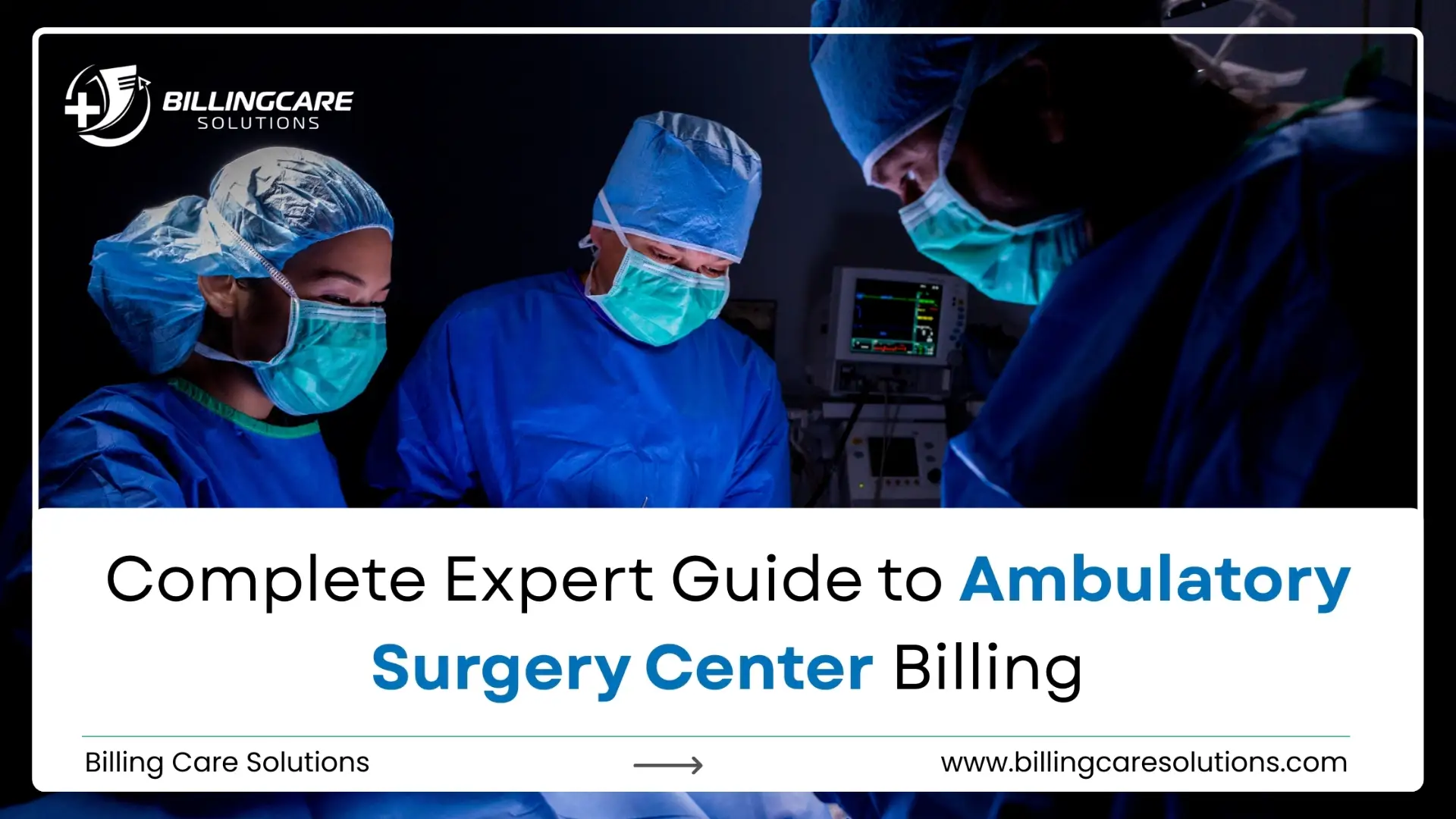
Complete Expert Guide to Ambulatory Surgery Center Billing
Discover key strategies for coding, compliance, and efficient billing at ambulatory surgery centers to reduce denials and optimize your revenue cycle.
Ambulatory surgery facilities are outpatient clinics that do surgical work that make patients not need to spend the night. These facilities offer affordable yet quality care, as they tend to be cheaper and have shorter waiting periods as compared to hospitals.
Due to their performance, correct billing and coding are the prerequisite in order to ensure financial sustainability. Misplaced billing may result in late reimbursement, claim denials, compliance risks that may seriously affect the revenue cycle of an ambulatory surgery center.
This guide provides a general outlook of ambulatory surgery center billing, including all aspects such as coding and workflow, compliance, frequent pitfalls, optimizing the revenue cycle, and integrating technology. These best practices can assist ASC teams to avoid denials, enhance the accuracy of claims, and have their reimbursement in time.
Understanding Ambulatory Surgery Center Operations
An ambulatory surgery facility is a healthcare institution where patients undergo surgical operations and go home on the same day. ASCs have a broad scope of practices, such as orthopedic surgeries, ophthalmology surgeries, gastroenterology surgeries, ENT surgery, and minor cosmetic surgery.
Ambulatory surgery facilities are not the same as the outpatient department in a hospital in a number of ways:
- Cost effectiveness: ASCs tend to be less expensive in terms of facilities than the hospitals.
- Efficient procedures: Differentiated surgical units can process patients faster.
- Payer contracts: ASCs should strictly follow their Covered Procedures List (CPL). There is a high tendency of auto-denial as a result of billing procedures that are not covered by the CPL.
- Staff and workflow: ASCs usually have smaller and specialized teams that are trained on ASC-specific coding and compliance practice.
These operational differences are vital in quality billing of ambulatory surgery centers. In the absence of the relevant understanding of the facility procedures, payer regulations, and coding standards, the likelihood of errors and reimbursement is high.
Ambulatory Surgery Center Billing Workflow
Billing operations of an ambulatory surgery center are different since the center is concerned with facility charges, other than with professional services. Effective workflow leads to correct claims, reimbursements and adherence to payer regulations.
Contracting/ Fee Schedule Management:
Every single ambulatory surgery center should have an updated contract with the payers and a compliance with the Covered Procedures List. All procedures that are not listed here would generally be automatically rejected. It is important to review contracts and fee schedules before every procedure to prevent the loss of claims.
Registration and Authorization of patients:
The correct demographic and insurance details of the patient should be gathered, and pre-authorizations of the procedure done where necessary. Lack of data or misinterpreted data may slow down payment or rejection of claims.
Documentation:
Medical necessity of procedures should be supported with full records, including operative notes, anesthesia records as well as provider signatures. Adequate documentation will guard the ambulatory surgery center against compliance risks and denial of claims.
Coding and Modifiers:
It is necessary to apply the appropriate CPT, HCPCS, and ICD-10 codes. ASC-specific modifiers should be also used properly:
- -SG: There are some procedures that need this to be paid by some payers.
- -73 / -74: Applied to the discontinued procedures.
The inappropriate use of modifiers is one of the frequent grounds of rejection of the claims in the ambulatory surgery centers.
Claim Form Preparation:
The claims submitted in ambulatory surgery centers are often based on the CMS-1500 form, which is similar to the claims made by physician offices, though facility-specific elements of data are provided. The UB-04 forms used by hospitals contain a different list of data items.
Claim Submission and Paying Posting:
Statements have to be provided on time and payments have to be recorded correctly. Monitoring claim status is used to make sure that delayed reimbursements are followed up.
Denial Management:
Rejected claims must be reconsidered to determine the underlying reason e.g. CPL noncompliance, coding errors, or unfinished documentation. It is very important to correct and resubmit claims in a timely manner because of the need to keep the cash flowing.
When implemented in an appropriate way, this workflow minimizes errors, complies, and enhances the financial outcomes of ambulatory surgery centers.
Ambulatory Surgery Center Coding Essentials
Billing in ambulatory surgery centers is based on the quality of coding done. ASCs do not mainly charge professional services but facility services, which means that E/M codes such as CPT 99213 are not suitable to use in facility-based billing. Claim rejections are highly attributed to coding mistakes.
ASC coding essentials include:
- CPT codes of surgical procedures: These are applied to the primary procedure being carried out.
- Implantable device or separately payable item codes under HCPCS Level II: Devices can be billed separately provided there is permission by Medicare or other private payers.
- ICD-10 diagnosis codes: Correct diagnosis codes warrant medical necessity.
Common Ambulatory Surgery Center Codes
| Code Type | Code | Description | Notes |
|---|---|---|---|
| CPT | 47562 | Laparoscopy, cholecystectomy | Common ASC surgical procedure |
| CPT | 66984 | Cataract surgery with lens implant | Frequent ophthalmology procedure |
| HCPCS Device | C1821 | Interspinous process distraction device | Implantable device, may be separately payable |
| HCPCS Drug | J3301 | Injection, triamcinolone acetonide, 10 mg | Reimbursable only if not bundled into the primary procedure |
Important Notes:
- Painkillers such as ketorolac (J1885) are mostly included in the operation and do not qualify as a separate payment.
- There is a low rate of standalone procedures being billed under specialty drugs, such as eptinezumab (C9257) in ASCs.
- Correct coding will produce less denials, will facilitate the correct reimbursement and will also produce regulatory compliance.
Ambulatory Surgery Center Compliance and Regulations
To prevent audit, fines, or denials compliance is essential to the ambulatory surgery centers. Billing regulations should be followed by Medicare, Medicaid, and private payers.
Some of the important compliance practices are:
- Recording processes and medical necessity correctly.
- Adhering to the rules of coding (CPT, HCPCS, and ICD-10).
- HIPAA requirements of patient records maintenance.
- Proper use of ASC-specific modifiers.
The compliance is ensured by regular audits, staff training, and clear internal processes. Ambulatory surgery centers with high levels of compliance minimize errors, penalization, and loss of money.
Common Ambulatory Surgery Center Billing Challenges
Ambulatory surgery centers have some of the most frequent difficulties in billing, which involve:
- Claim Denials: In most instances, this is due to a coding error, lack of documentation or procedures that are not contained within the CPL.
- Wrong Modifiers: The modifiers peculiar to ASC should be used correctly.
- Poor Documentation: Documentation of operative notes or anesthesia records is not done resulting in rejected claims.
- Revenue Cycle Gaps: Delays in payment can occur due to poor management of contracts and lack of validation of the fees schedules.
Positively tackling such challenges enhances more successful reimbursement and less workload on administration.
Optimizing Ambulatory Surgery Center Revenue Cycle
The expense of revenue cycle optimization can be used to sustain cash flow and reimbursement maximization. Key strategies include:
- Reducing claims and payment monitoring through billing software.
- Ensuring that errors are detected by carrying out periodic audits.
- Education of the personnel in coding changes and adherence.
- Contracting the services of specialists in billing where the need arises.
Bill cycle optimization will enable the ambulatory surgery centers to concentrate on patient care and yet carry out billing correctly and in compliance.
Technology and Automation in Ambulatory Surgery Center Billing
Billings that are effective in terms of ambulatory surgery centers need technology. More complex billing software and electronic health records minimize mistakes, enhance accuracy of claims, and speed up the reimbursement. Automation has the ability to detect unrecorded documentation, claim status, and create real-time financial reports.
To be the most effective, ambulatory surgery centers need to make sure that their Electronic Health Record (EHR) or Revenue Cycle Management (RCM) software is configured to accept ASC-X12 837P electronic claims. Such arrangement enables the software to appropriately manage specific data elements of facilities on the professional claim layout that satisfy payer requirements. The appropriate configuration reduces reimbursement denials, accelerates reimbursement, and ensures its regulatory adherence.
By doing so, the ambulatory surgery centers which embrace technology will have fewer denials, quicker payments and more precise reporting. Automation will also liberate personnel to attend to patients rather than fix claims by hand. The implementation of ASC-specific technology and automation is now becoming a major consideration of keeping a viable and conforming billing procedure.
Conclusion:
The ambulatory surgery centers can only be successful with proper billing. Effective coding, documentation, compliance and revenue cycle management are directly related to financial health. Adherence to the workflow specifics of ASC, proper use of CPT/HCPCS codes, and the appropriate application of the modifiers allow to minimize rates of denials and maximize reimbursements.
Outsourcing with Billing Care Solutions would mean that the ambulatory surgery centers will be guaranteed the services of specialists in billing, as the staff will be able to concentrate on the patient care. The best practices will enhance efficiency of the operations, ensure adherence to regulations, and financial stability of ambulatory surgery centers over the long term.
