


Complete Guide to EKG CPT Code for Accurate Medical Billing
Understand EKG CPT code with simple tips to improve billing, avoid common mistakes, and get accurate claims processed faster.
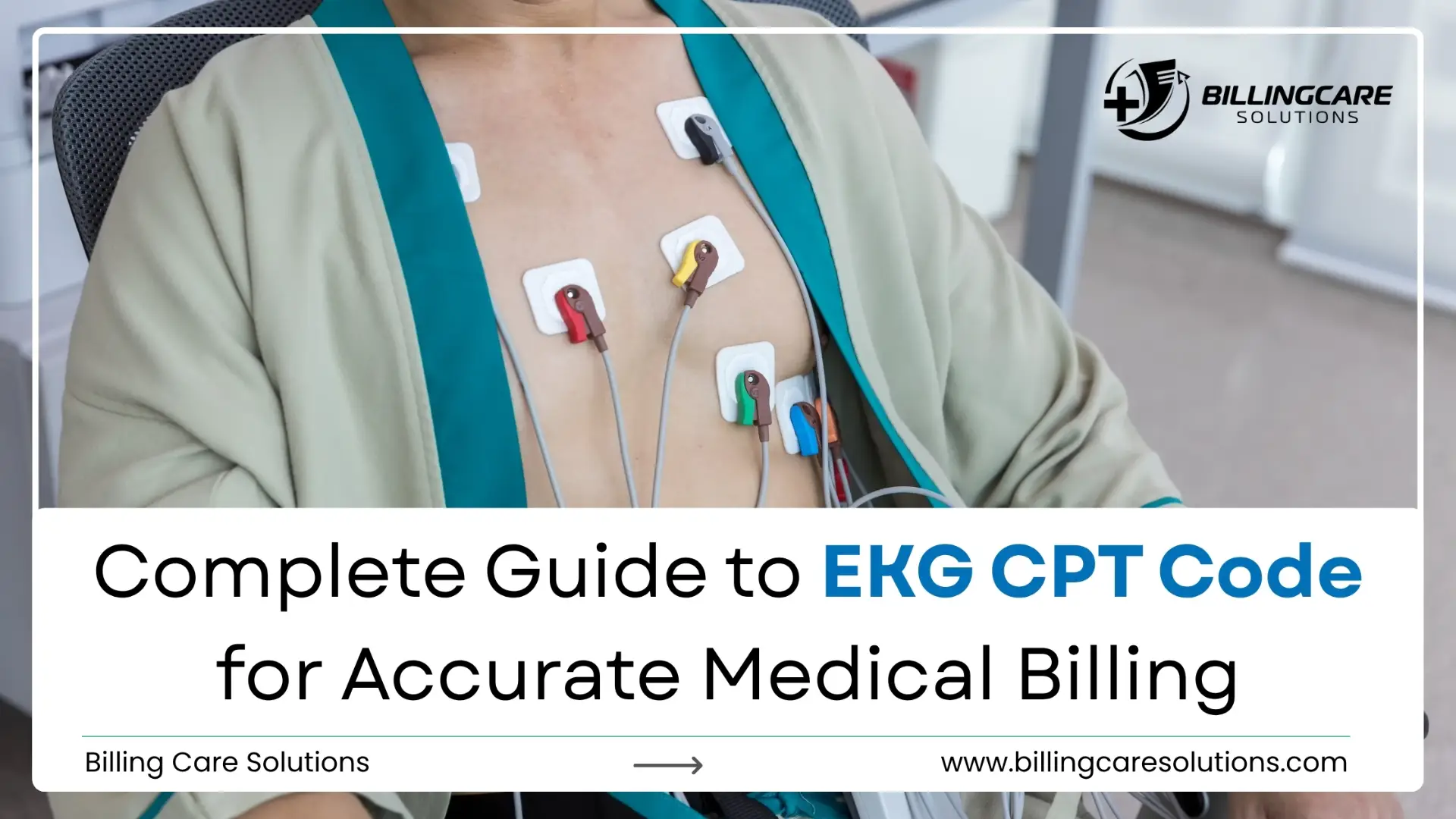
Among the most frequent diagnostic tests that are applied in outpatient clinics, cardiology practices, and the primary care setting is electrocardiogram testing. Although common in occurrence, the billing of such tests has had a high rate of claims refusals, delays in payments, and risks of non-compliance. The major cause of these problems is inaccurate choice of EKG CPT code.
In the medical billers and coders, accuracy in this regard is not a choice. It is an important element of revenue cycle management. This Billing Care Solutions guide will take you through the proper utilization of such codes so that your practice records all the dollars earned and at the same time, adheres to the payer requirements.
Understanding the Basics of EKG and CPT Coding
It is good to know what an EKG or ECG is before getting into bracketing on particular sets of code. The test is a record of the electrical activity of the heart to identify arrhythmias, ischemia, and other heart defects.
- Coding wise, the test is a complex test and therefore the code you will utilize depends on the complexity of the test.
- The codes of current Procedural Terminology in cardiology are very specific.
- They distinguish between a regular tracing with a physician interpretation and the more complicated tracing where a complete report and review is necessary.
- A misuse of the code may lead to an audit or a denial.
- The billing employees should never make the choice without checking the documentation so as to establish the degree of service rendered.
The Primary EKG CPT Code for Routine Electrocardiography
The most common code under this category is 93000. This is an EKG CPT code of a full service. It involves the tracing, the interpretation, and the physician written report.
In case your provider fulfills all three elements, 93000 will be a good option.
- Should the practice own the equipment and the physician fail to do the interpretation in the same encounter, then 93005 should be used to make the tracing only and 93041 to make the interpretation and report.
- The differentiation between these three codes has been the main area of misunderstanding.
- In case interpretation is done by an independent cardiologist or other provider, then the tracing code and interpretation code should be divided.
- The medical record will be properly documented that will explicitly indicate who did each part so that the biller can use the correct EKG CPT code without mistake.
EKG CPT Code Selection for Cardiovascular Stress Testing
Stress testing is another complication to cardiac billing. The tests include heart monitoring during exercises or pharmacologic stimulation of the patient. Stress tests codes differ with that of resting EKG.
- The code of a standard exercise stress test is mainly 93015.
- This code, as is the case with the routine EKG structure, depicts the entire service that incorporates supervision, tracing, interpretation and report.
- In the case of your practice conducting only some of the stress tests, the component codes to use include 93016 in the case of supervision only, 93017 in the case of the tracing, and 93018 in the case of the interpretation and report.
- There is a need to align the EKG CPT code with the work really done.
- Another billing error seen is when one practices bills the full code 93015 but the documentation only supports the tracing component, which is denied and causes delay in reimbursement.
- Never fail to specify the level of involvement of the physician in the note.
Navigating EKG CPT Code for Holter and Event Monitoring
- Ambulatory monitoring codes are not very well understood due to the time and technicalities involved. A separate set of codes is used in holter monitoring which is commonly carried out over a period of 24 to 48 hours compared to event monitoring which can be up to 30 days.
- Full EKG CPT code of holter monitoring is 93224. This involves; connection, recording, scanning analysis, interpretation and report.
- In case your practice is carrying out only the technical component of Holter, use 93225 of the monitoring and 93227 of the professional component.
- As far as event monitoring is concerned, the codes start with 93228 and 93229 which are dependent on the mode of transmission.
- Billers should be very attentive to the quantity of leads they use and the length of auto observation.
The records should explicitly show the beginning and the conclusion of the monitoring period. In the absence of this clarity, the statement can be disqualified as being incomplete.
Global Period Rules and Modifier Usage With EKG CPT Code
Most of the EKG services can be included in a global surgical package or global evaluation and management period. The EKG can be considered bundled when a patient is undergoing a significant surgery or a full visit. You need to use the correct modifier in order to distinguish between these services.
- The modifier 25 is applied to a sizable, distinct separate evaluation and management service provided on the identical day as the EKG.
- Modifier 59 is employed to show that a procedure was separate or independent of other services that were rendered on the same day.
- Using a modifier in the wrong place can be as harmful to use as a wrong EKG CPT code.
- The documentation has to support the modifier. An order that merely indicates that the patient experienced chest pain and nothing was said about the medical decision making is not a reason to use a modifier 25.
- Before adding the modifier, you need to ensure that your billing team supports the individual service using documentation.
Common Denials Related to EKG CPT Code
EKG billing denials are usually divided into three.
- Absence of medical necessity: Payers seek a specific diagnosis that will warrant the execution of the test. It might not be adequate to be diagnosed with a nonspecific symptom or routine screening.
- Mis-selection of the code: This normally occurs when a practice is being done with the full code 93000 when the physician was not present as the tracing was taking place.
- Bundling edits: Medicare and commercial payers employ National Correct Coding Initiative edits, wherein the EKG services are bundled in evaluation and management visits.
To resolve these denials:
- Look at the denial code on remittance advice.
- Review the initial claim to determine whether the billed codes are documented.
- In case of good documentation, an appeal is provided with submission of the concerned medical records.
- In case of your mistake, change the code/modifier and re-file the claim.
Documentation Requirements to Support Your EKG CPT Code Selection
Good billing is based on documentation. In each EKG service, the medical record should contain the following:
- The order for the test
- The indication for the test
- The tracing itself
- The interpretation
In case of billing component codes:
- The record should indicate the person who did the tracing.
- The record should indicate the person giving the interpretation.
- The final report and any clinical correlation should also be mentioned in the note of the physician.
Documents that are not complete make the EKG CPT code unsupportable. This exposes the practice to recoupments in a case of audit. A practice management system that is well developed with periodic training of clinical staff is enough to ensure that the documentation is created in line with payer standards before the claim is even formed.
The Role of Medical Necessity in EKG CPT Code Billing
The force that drives reimbursement is medical necessity. A EKG CPT code may be medically valid and yet deny the procedure in case the diagnosis does not justify the procedure.
- Some of the common covered diagnoses are chest pain, palpitations, syncope, established coronary artery disease and preoperative clearance before a high risk surgery.
- Routine screening with no signs or symptoms EKGs are usually not granted.
- Prior to filing the claim, ensure that the code of diagnosis attached to the EKG is in line with the documentation.
- The connection between the process and the diagnosis should be rational and should be well articulated.
- In case medical necessity is determined at the beginning, the number of denials is reduced, and cash flows are enhanced.
How Billing Care Solutions Simplifies EKG CPT Code Management
Growing practices may be overburdened by managing cardiology coding in the house. With frequent payer updates, modifier rules and the sophistication of split billing, errors are easy to fall through. Billing Care Solutions is a provider of dedicated revenue cycle management services to practices which conduct cardiac testing.
- The specific family of EKG CPT code is the object of training of our team.
- We conduct pre-claim audits in order to determine that the documentation is in place to back the codes.
- Our appeals and denials management are a way of retrieving lost revenue.
- Your clinical staff will be able to concentrate on the patients and we will make sure that your billing is correct, compliant and optimized to get reimbursement by our partnering.
Conclusion:
Proper coding of electrocardiogram services is a very elaborate procedure that involves consideration of documentation, use of modifiers, and rules by payers. The code that EKG CPT you choose should be the code that represents the specific service that you offer a person, be it a regular tracing, stress test, or long-term monitoring.
- Errors in this regard translate to declined payments, late payments, and unwarranted administrative tasks.
- Your practice can have a healthy revenue cycle by learning how to use modifiers properly, how to use complete and component codes and by making sure that medical necessity is well documented.
- In case your team is having issues with cardiology coding, Billing Care Solutions is willing to make the process more streamlined and increase your bottom line.
