


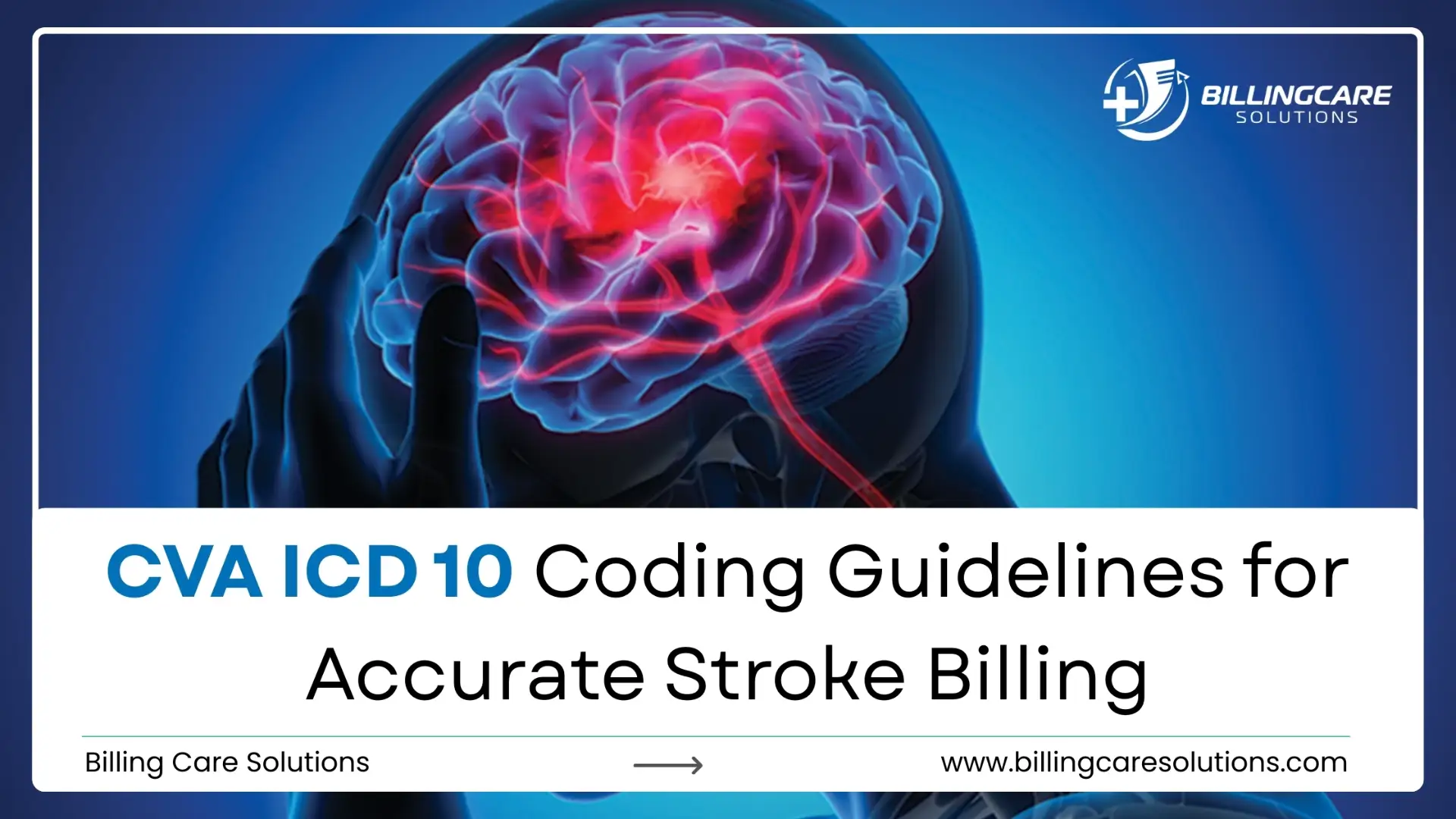
CVA ICD 10 Coding Guidelines for Accurate Stroke Billing
Ensure accurate stroke billing with clear CVA ICD 10 coding instructions. Reduce errors and improve reimbursement efficiency with our guide.n
Medical coding is a matter of precision, which forms the basis of appropriate reimbursement and compliance with the regulations. In the case of cerebrovascular accidents or in other words strokes, the margin of error reduces substantially. The diagnosis of strokes has a significant weight in reimbursement schemes and directly affects quality reporting schemes.
With more specificity introduced with ICD-10, the nature of provider documentation and billing of stroke related conditions was fundamentally altered. The subtle guidance on the CVA ICD 10 code can save your practice due to the denials and audit risks.
Defining the Core CVA ICD 10 Code Categories
Cerebrovascular diseases are classified into several different codes. It is no longer enough to record a patient encounter involving the use of the term CVA and comply with coding requirements. The coders should be able to differentiate between the nature of an event and the current clinical condition of a patient.
Ischemic strokes I63:
The category of I63 is the major classification used in cerebral infarction. Specificity goes further to the cause of anaemia and the artery in question. To go past the unspecified code I63.9, the radiology reports and physician documentation is needed.
Hemorrhagic Strokes I60 I61:
These are of different classes that differentiate between the types of bleeding. Subarachnoid hemorrhages are categorized as I60 with intracerebral hemorrhage being categorized as the I61 series. These differences are important since there are significant differences in treatment strategies.
Transient Ischemic Attacks G45:
The codes to these transient ischemic attacks are to the G45 category, and not acute infarction codes. Temporary episodes do not result in permanent damage, unlike in completed strokes of CVA ICD 10 classification system.
Acute Stroke Coding: Importance of Setting
The acute stroke is a clinical situation that depends largely on the right choice of code to be used. Acute strokes are normally taken in as an inpatient or an emergency and not in the office. This difference eliminates the misuse of codes.
- The issue of inpatient and outpatient is vital in the proper application of correct coding.
- The acute CVA code of I63 series ICD 10 codes are not usually applicable in the routine office follow up.
- In the case of a patient who has come in weeks after the stroke has occurred, the acute phase has already elapsed and the coding will switch to sequelae or history codes.
Coding for Late Effects and Sequelae I69
The I69 group is one of the most misconstrued domains of stroke coding. Such codes can be used to fix residual neurological impairments that remain following the resolution of acute stroke.
Application I69 Codes:
These codes of sequelae are used when the patients still have impairments associated with an earlier stroke. The remaining deficiencies can be weakness, speech problems, or gulp problems. When it is documented that there is full recovery then the use of the codes of sequelae would be invalid.
Specificity Requirements:
Specification under the I69 category goes as far as the specific neurological deficit. The laterality documentation is critical because coders will have to recognize the deficit of the right or left side. Where the physician documentation does not indicate dominance, the coding rule leans toward the left side as non-dominant.
Sequencing Instructions:
Correct sequencing instructions are with I69 codes. These sequelae codes usually come out as a primary code with other codes of specific manifestations required according to guidelines on the coding of CVA ICD 10.
Personal History of CVA vs. Sequelae Z86.73
It is confusing to see the difference between the cases of resolved strokes in which no deficits remain and persistent deficits. Such a difference has big implications on proper coding.
Definition of Z86.73:
This code includes personal history of cerebral infarction without deficit residual. It is specifically applicable to patients that had a stroke, had the treatment and were fully recovered without any residual effects.
Proper Use:
These patients might still need some monitoring, but their present experience is not connected to active stroke intervention.
Common Pitfalls:
A history code will misrepresent the condition of the patient when records indicate that he or she is still weak. On the other hand, the inappropriate application of sequelae codes to the fully recovered patients imply continuous management. The correct coding of CVA ICD 10 is sensitive and needs to be revised meticulously to find out the current status of residual effects.
Common Coding Pitfalls and Audit Risks
Denial rates and compliance issues can be minimized in practices due to an understanding of common mistakes. There are a number of regions that continuously create errors in the coding of the stroke.
Unspecified Code Overuse:
This overuse of unspecified codes is used especially the I63.9 which is a major audit risk. Coders should take advantage of this information to give the specific codings when the radiology reports mention some particular arteries. A lack of specificity on defaulting into unspecified codes when more specificity could be applied results in gaps that auditors are trying to detect.
Intraoperative Strokes:
Intraoperative and postprocedural strokes are under different guidelines than the regular classifications of CVA ICD 10. Such incidents usually code to incidents that occur during the procedures, instead of the I63 category.
Suspected vs Confirmed:
Coding suspected and confirmed conditions is also another challenge. Stroke cannot be discussed as confirmed through the use of symptoms alone. Code assignment must be based on imaging confirmation or by explicit physician documentation. Confirmed code should not be used due to working diagnoses that are under investigation.
Role of Comorbidities in Stroke Coding
Extensive stroke coding goes to related conditions that impact the management of patients. Hypertension, atrial fibrillation, and diabetes are common comorbidities that have to be captured correctly.
Hypertension Link:
Coding guidelines contain certain provisions on the relationship between hypertension and stroke. There is also a code note with the I60-I69 to strengthen the clinical connection between the presence of high blood pressure with stroke.
Cardiovascular Conditions:
There are other cardiovascular disorders such as atrial fibrillation that cause a high risk of stroke. Such comorbidities have an effect on the decision to treat and should be coded distinctly to ensure full representation.
Best Practices for Provider Documentation
Accurate coding is based on the clinician documentation. The application of concrete practices enhances correctness and saves on the number of enquiries.
Employ Accuracy:
Precise language should be embraced by the providers other than broad terms such as CVA. Recording of acute ischemic stroke because of thrombosis of the middle cerebral artery is more specific. This helps in better CVA ICD 10 code assignment.
Note Residual Deficits:
Documentation should cover up any outstanding deficit in a clear manner. Appropriate I69 sequelae codes are justified by the presence of the notes that say the patient has residual right sided weakness. In the absence of this specificity, coders do not have the information that is required in the provision of correct codes.
Indicate Laterality:
Laterality documentation involves special consideration when there is paralysis in only one side. Demanding dominant and non-dominant sides will give equal precision to the choice of code. These differences should be discussed by the providers instead of coders having to make default assumptions.
Conclusion:
Cerebrovascular disease coding is a field demanding expertise which most practices find hard to retain internally. Billing Care Solutions is an expert in stroke coding rules that can help in your revenue cycle management.
Expert Review:
Our coding specialists are aware of details between acute events and sequelae and history codes. We look into documentation to determine the supportive details to a certain choice of code.
Less Denials:
Less denials are achieved through this approach because of low denial rates related to poor CVA ICD 10 coding and prepares your practice to succeed in the audit.
Compliance Focus:
Adherence to requirements by CMS is of the utmost importance. Billing Care Solutions keeps up with the changes to the guidelines that have an impact on the classification of cerebrovascular disease. These updates are done on an ongoing basis making sure that your coding practices comply with the prevailing standards.
Partnership Advantages:
Collaboration with Billing Care Solutions reduces the risks of stroke coding as compliance risk to an efficient accurate reimbursement. We can make your practice be as complex as cerebrovascular care needs to be and as specific as it has to be.
Get in touch with us to know how we can help improve your stroke billing accuracy.
