

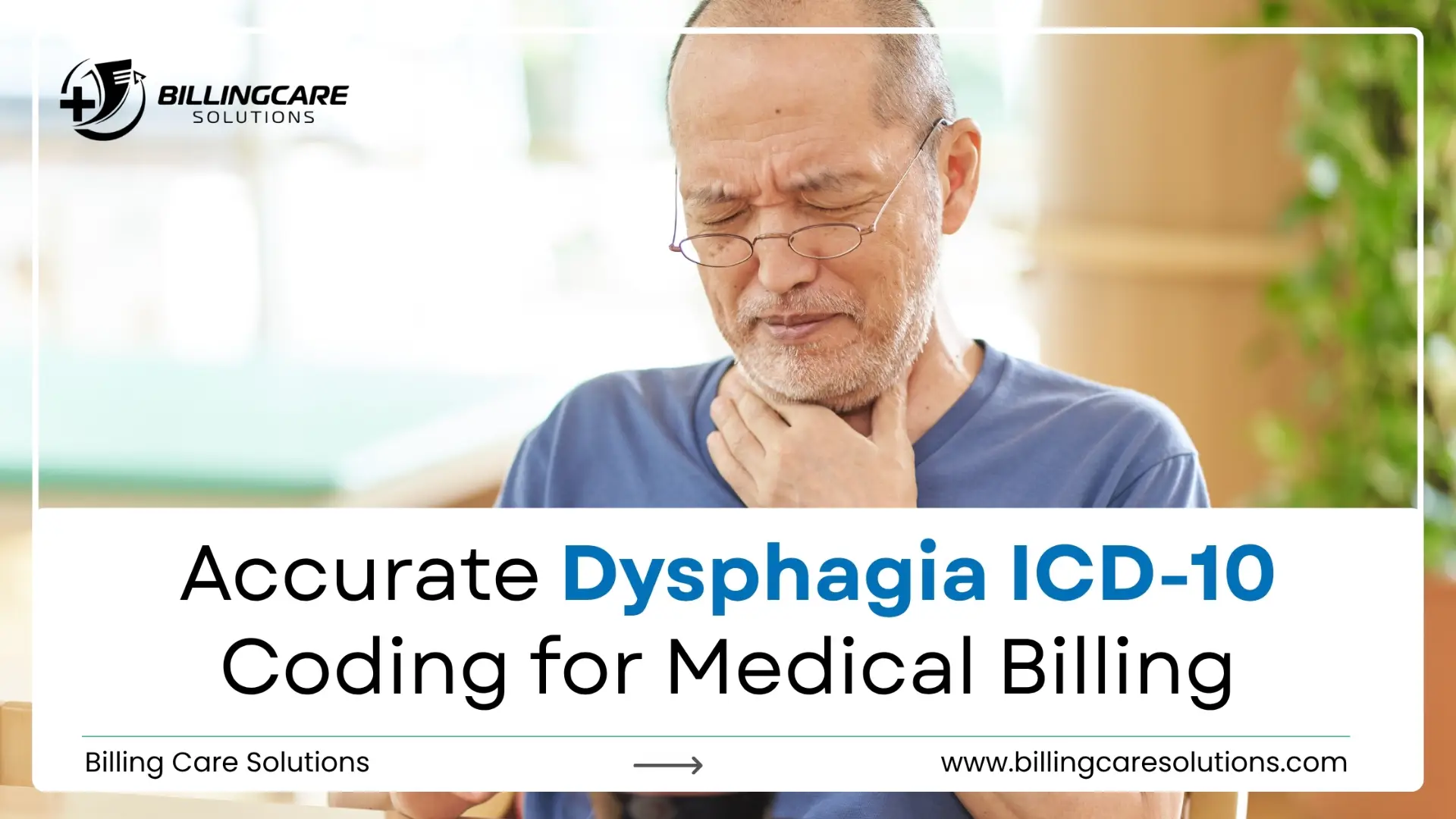
Accurate Dysphagia ICD-10 Coding for Medical Billing
Master accurate Dysphagia ICD-10 coding for medical billing. Avoid denials, ensure compliance, and maximize reimbursement with this essential guide.
Swallowing disorder needs to be accurately billed in medicine. Whenever a patient comes in with the challenge of swallowing, the economic well-being of a given practice is usually determined by the quality of the codes that a given physician would file. The transition to ICD-10 coding system introduced major changes, which necessitates a certain degree of specificity which is not yet attained by many billing departments.
In the case of healthcare providers, knowledge of the peculiarities of Dysphagia ICD-10 code is not a compliance issue only. It is an important aspect of the management of revenue cycles. In Billing Care Solutions, we have experienced the effects of appropriate Dysphagia ICD-10 coding in cutting down the denials and in the provision of adequate services to the providers at reasonable rates.
How are dysphagia ICD 10 codes structured?
The ICD-10 system is much more detailed in categorizing dysphagia than was previously the case. This specificity is meant with the aim of capturing the clinical reality of the condition. Any billing professional must have a close familiarity with the Dysphagia ICD-10 classification. Dysphagia is not a diagnosis but a symptom characterized by clear stages, namely, oral, pharyngeal and esophageal. All stages demand a varying clinical intervention and, therefore, a varied ICD 10 dysphagia code. The most frequent codes belong to category R13 that discusses dysphagia.
Coders should know that not specifying ICD 10 dysphagia code such as R13.10 should be the last resort. The classification system will promote reporting and documentation of the precise stage of the dysfunction by the providers. In the case of a medical billing team, the skill to master the Dysphagia ICD-10 classification would imply that one will not need to look up the code and simply enter it into the system, but will have to conduct a more proficient analysis of the clinical record.
- The replacement of ICD-9 with ICD-10 and the rise of specificity of swallowing disorders in the category of icd 10 dysphagia.
- General description of the key Dysphagia ICD-10 categories: R13.1 (Dysphagia), R13.1x (oral and pharyngeal stages), and R13.19 (other dysphagia).
- Why differentiating between oropharyngeal and esophageal dysphagia is essential to claims processing in choosing the appropriate Dysphagia ICD-10 code.
Which dysphagia ICD-10 codes are most commonly used?
When carrying out the daily billing activities, a few Dysphagia ICD-10 codes are most commonly used. The knowledge about these codes and their correct usage may facilitate the process of billing and minimize errors. It becomes a fast guide to medical billers and coders, providing the clinical guidelines of each Dysphagia ICD-10 code and the application to typical patient situations.
R13.10 Dysphagia, unspecified:
This coding of Dysphagia ICD-10 should be applied when the medical record lacks the stage of dysphagia. The code that will result in a denial in the greatest number of instances is this, and when possible a biller should ask the provider to elaborate further.
R13.11 Dysphagia, oral phase:
This Dysphagia ICD-10 code is typical of neurological disorders including stroke or Parkinsonism in which the muscles of oral feeding are weakened.
R13.12 Dysphagia, oropharyngeal stage:
This is the most used Dysphagia ICD-10 code used in swallowing therapy to describe the problem of the mouth and throat.
R13.13 Dysphagia, pharyngeal phase:
This Dysphagia ICD-10 code is applied when the problem is confined to the throat, and significant attention is paid to the risk of aspiration.
R13.14 Dysphagia, pharyngoesophageal phase:
This Dysphagia ICD-10 code is not confused with etiologies of the esophagus, and itself is commonly applied to structural or motility.
How can you prevent denials for Dysphagia ICD-10?
The problem of Dysphagia ICD-10 coding errors is most likely associated with the lack of specificity or the inability to connect the diagnosis with the service provided. Such pits cause claims to be rejected and interfere with the revenues cycle of the clinics and hospitals leading to late payments and more administrative efforts. The most effective defense against these problems is a good use of the Dysphagia ICD-10 code set.
- The risk of defaulting to a non-specified Dysphagia ICD-10 code in an instance where the medical record reflects the phase of a specific stage.
- The need to associate the Dysphagia ICD-10 code with appropriate CPT code in the assessment and therapeutic intervention of swallowing.
- The role of proper Dysphagia ICD-10 selection in ensuring automatic denials by Medicare and commercial payers due to mismatched diagnosis codes and the necessity of proper icd 10 code for dysphagia coding.
The Role of Detailed Documentation in Dysphagia Coding
The cornerstone of correct Dysphagia ICD-10 coding is the documentation from the clinical encounter. The biller can only bill for what the clinician charts. Close communication between the clinician and biller is vital to ensure the Dysphagia ICD-10 code submitted accurately reflects the documentation. With dysphagia, the documentation must be more than just the diagnosis.
- Specific aspects clinicians MUST document to substantiate appropriate Dysphagia ICD-10 codes site, severity, and cause of dysphagia.
- Use of “code first” and “use additional code” notes when documenting a cerebral infarction which coexists with dysphagia. Dysphagia ICD-10 sequence implications.
- The documentation for the patient’s aspiration status is vital for supporting the diagnosis of pneumonitis due to food/vomit along with the Dysphagia ICD-10 codes.
Best Practices for Dysphagia ICD 10 Coding in Specialty Settings
ICD 10 code for dysphagia coding practices are not the same across all practice settings. Each practice setting has their own billing practices and expectations from payers. This means that when coding for a skilled nursing facility, outpatient rehab clinic, or hospital, the approach to icd 10 dysphagia coding will differ at each practice setting for payment purposes.
Outpatient Therapy: Using appropriate ICD 10 dysphagia codes to support the need for services for speech therapy such as R13.11 and R13.12.
Hospital Inpatient: Complying with Medicare Severity Diagnosis Related Grouping and what a icd 10 dysphagia secondary diagnosis means as a second diagnosis for payment purposes.
Skilled Nursing Facility: Make sure that the Minimum Data Set assessment appropriately supports icd 10 dysphagia coding to maximize payments for Part A and Part B therapy services.
How Billing Care Solutions Streamlines Dysphagia Coding?
Dysphagia coding is complex and will need specialized skills and resources. We are thorough in our approach at Billing Care Solutions so that our clients can maximize their revenue and remain compliant. Our team is aware that coding is not a one time activity. We reduce denials associated with dysphagia coding by specializing in audits, training of coders, and denial management measures.
- Complete Audits: Before claims are submitted, we view the documentation to verify that the maximum specificity is applied to Dysphagia ICD-10 codes.
- Denial Management: Denials due to coding differences are vigorously appealed by our team to recapture lost revenue that would otherwise be written off.
- Coder Education: Training We offer ongoing training on the most recent changes in ICD-10 in the areas of gastroenterology and speech language pathology to maintain your staff up-to-date.
- Revenue Cycle Optimization: We remove coding mistakes and expedite the claim cycle to enhance your practice cash flow.
Conclusion:
Correct ICD 10 dysphagia coding is an essential technique in medical billing personnel. It involves profound knowledge of classification systems, consideration of documentation, and consciousness of establishment of particular rules. Malpractices in this field may result in expensive reimbursements and compliance risk.
With the collaboration of an experienced billing team for the ICD 10 code for dysphagia, providers can concentrate on patient care and also make sure their financial activities proceed without difficulties. By having the right systems in place, the complexities of dysphagia coding can become a strength, and practices can receive the reimbursement they rightly deserve as a result of the critical service they offer.
Frequently Asked Questions
R13.19 other dysphagia.Use this code when any of the other dysphagia codes above do not cover the specified condition, or if documentation is listed by phase and not a specific type, or the dysphagia phases covered in codes R13.11 through R13.14 are not fully documented.
Sequence I63.9 or stroke code first, followed by dysphagia type, i.e., R13.12 for oropharyngeal phase.
Guidelines from AAPC dictate the use of R13.19 esophageal dysphagia if a specific phase of dysphagia is documented and there is no structural diagnosis of the esophagus. For obstruction, code from Chapter K, such as K22.9, etc.
