


Understanding E11.9 Diagnosis code in Medical Billing and Coding
Discover how to apply the E11.9 code in medical billing effectively. Follow expert and clear steps to ensure accurate claims and efficient billing.
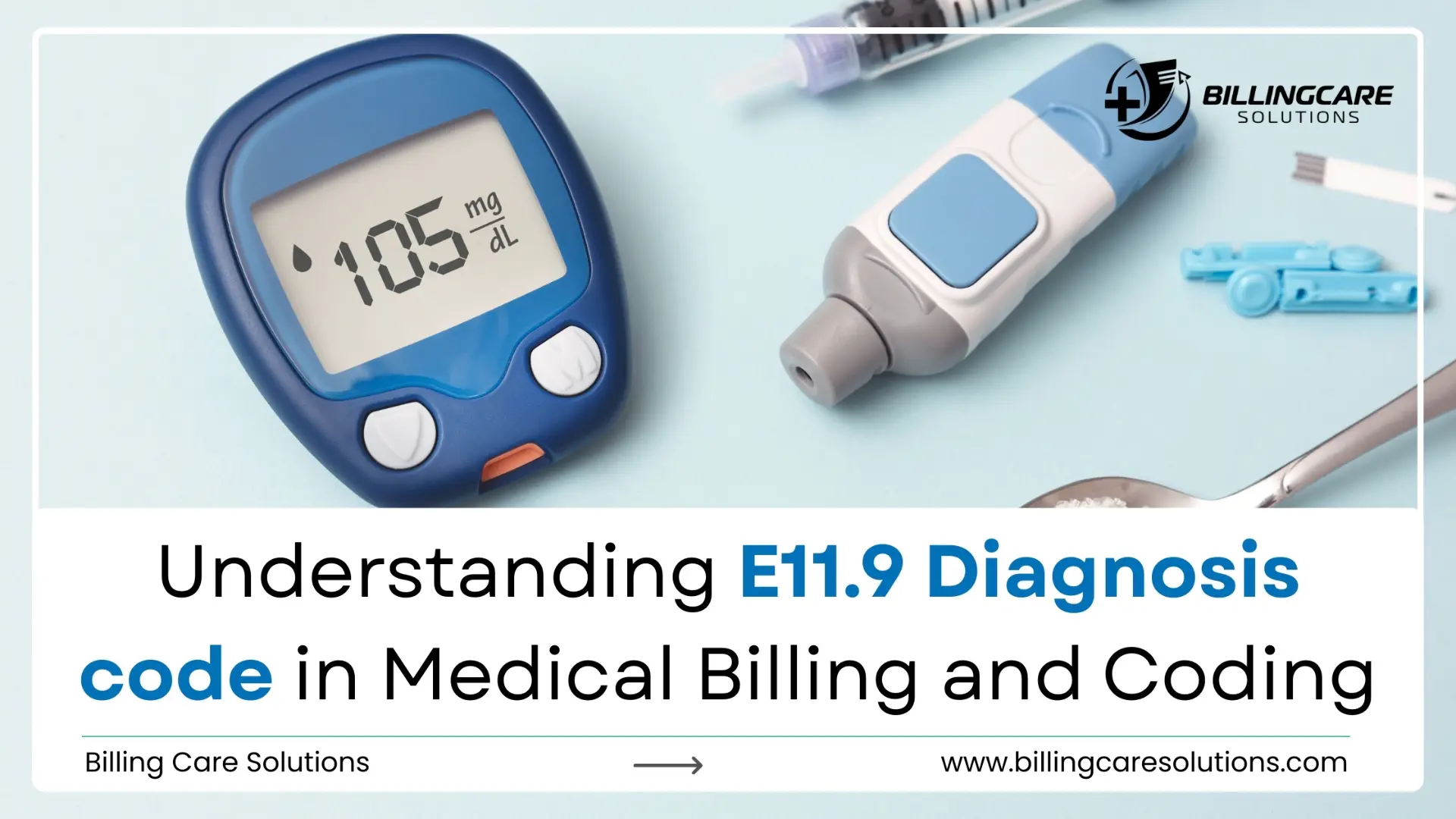
Type 2 diabetes is one of the most prevalent chronic diseases that is treated in the health sector today. To the medical coders and billers, proper diagnosis coding of this condition will have direct consequences to reimbursement, risk adjustment scores and adherence to payer policies.
One such ICD-10 code is e11.9. It is Type 2 diabetes mellitus without complications. This particular code is administered to denote a diagnosis in the form of reimbursement. It belongs to the group of endocrine, nutritional and metabolic diseases.
This guide will deal with the details of this significant code on diabetes. We shall explain when it should be employed, how to record it properly and when to prevent possible errors in coding.
What exactly is the ICD-10 Code E11.9?
It is applied to Type 2 diabetes mellitus free of complications. It implies that the patient has diabetes but it has not led to a reported harm in certain organs and body systems.
This code accommodates diabetes because of the defective insulin secretion. It also incorporates diabetes NOS and insulin resistant diabetes. The most important part is the wording without complications. The code can only be utilized in the case of simple diabetes when the healthcare provider did not associate diabetes with any particular condition.
What E11.9 Excludes
It is equally important to know what this code does not cover. It does not include Type 1 diabetes mellitus, with codes beginning with E10. It does not also include diabetes having certain complications such as eye problems or kidney disease or nerve damage. Those conditions necessitate codes of combinations between the E11.0 and E11.8 category. E11.A code diabetes in remission is also independent and it cannot be used interchangeably.
Clinical Criteria and Documentation Requirements for E11.9
Confirming the Diagnosis
Before assigning the diagnosis code, understand the clinical picture that supports it. Health care professionals use high blood sugar levels as a diagnosis of type 2 diabetes. This may be a fasting glucose of 126 mg/dl or more, or 6.5 percent HgA1C or more. Patients can also be characterized by a frequent urination, excessive thirst and weight loss.
The Importance of Specificity in Documentation
The documentation of the provider is the most crucial aspect. You cannot suppose that there are no complications. It has to indicate clearly on the record that it is type 2 diabetes without complications. In case the note is ambiguous, you might have to ask the provider. This ICD-10 code can be used only in instances where the documentation clearly shows that there are no complications.
What “Without Complications” Means to the Provider?
In case a provider treats a patient with diabetes and also after the same visit treats diabetic neuropathy, the code of uncomplicated diabetes is incorrect. The combination code that you should use is within the E11.4 range. When selecting the code, the documentation will be used.
Using E11.9 with Additional Codes for Comprehensive Billing
Insulin and Medication Use Capturing
Other codes are oftentimes required to give you a complete picture even where the diabetes is uncomplicated. ICD-10 manual has institution of instructions of the use of additional codes to diabetes. These would include the treatment plan of the patient and justify medical necessity.
The most popular codes to accompany this diagnosis code are those under category Z79. Should a patient be utilizing insulin then add Z79.4 to long term use of insulin. Should they use oral medications, charge Z79.84 oral hypoglycemic drugs. These codes are not optional. They put the treatment plan into perspective and are often mandatory regarding the risk adjustment.
Linking to Common Comorbidities
The code of type 2 diabetes without complications with codes of other chronic conditions will also be seen. One of the comorbidities is hypertension, which is coded as I10. It is normal to pay I10 to this diabetes code. Other typical combinations are hyperlipidemia and obesity which tend to co-occur with diabetes.
The Role of Z Codes
Z codes can also be used to measure social determinants of health. Medical necessity can be justified by Z71.3 of dietary counseling. These codes enhance the patient record and facilitate the care it gives.
Common Coding Pitfalls and How to Avoid Them with E11.9
Pitfall 1: Using E11.9 for Patients with Documented Complications
Coders even with experience error in this diagnosis code. The most common mistake is applying it to those patients who have recorded complications. In case the physician comments on any diabetic manifestation, find a narrower code. E11.40, not the uncomplicated code, would be required in a patient, whose condition is type 2 diabetes and peripheral neuropathy.
Pitfall 2: Assuming "Uncontrolled" is "Without Complications"
Another fallacy is to make mistakes uncontrollably without complications. These are various concepts. Uncontrolled diabetes is inaccurate blood sugar control, usually accompanied by high HbA1c. The appropriate code of uncontrolled diabetes type 2 and hyperglycemia is E11.65. The code of uncomplicated diabetes is used in cases of patients whose diabetes is in a stable state and in a non-damaging organ state.
Pitfall 3: A Quick Reference Guide.
This is a fast reference table to aid in the difference of similar codes.
| ICD-10 Code | Description | When to Use |
|---|---|---|
| E11.9 | Type 2 diabetes mellitus without complications | Use when the patient has type 2 diabetes and no documented complications |
| E11.40 | Type 2 diabetes mellitus with diabetic neuropathy | Use when the patient has type 2 diabetes and nerve damage or pain |
| E11.65 | Type 2 diabetes mellitus with hyperglycemia | Use when blood sugar is uncontrolled or elevated |
| E11.22 | Type 2 diabetes mellitus with diabetic chronic kidney disease | Use when the patient has type 2 diabetes with documented kidney disease |
| E10.9 | Type 1 diabetes mellitus without complications | Use only for patients with type 1 diabetes; never use for type 2 |
| Z79.4 | Long term (current) use of insulin | Use as an additional code with E11.9 when the patient takes insulin |
The Impact of E11.9 on Reimbursement and HCC Coding
Hospital Admission Status
Complicated Diabetes code of uncomplicated type 2 diabetes has reimbursement implications. It is marked "Questionable As Admission Dx" in the hospital. This code is not enough to recommend inpatient admission. Uncomplicated diabetes patients can be treated as an outpatient.
Linking to CPT Codes
When you code an office visit with the code of diagnosis, you have to connect it with any of evaluation and management CPT codes such as 99213 or 99214. Also connect it to such lab tests as hemoglobin A1c, code 83036. This demonstrates medical necessity and avoids refusal of claims.
Differentiation between E11.9 and Related ICD-10 codings
| ICD-10 Code | Description | When to Use |
|---|---|---|
| E10.9 | Type 1 diabetes mellitus without complications | Do not interchange with E11.9; reflects a different disease process |
| E11.A | Type 2 diabetes mellitus without complications, in remission | Use only when remission is documented with normal glucose levels |
| E13.9 | Other specified diabetes mellitus without complications | Use for genetic defects, post-pancreatectomy diabetes, or other specified causes |
Why Choose Billing Care Solutions for Diabetes Coding Support
Billing Care Solutions offers dedicated assistance on the correct coding and claims management of diabetes. Our team is aware of the documentation requirements in type 2 diabetes without complications and we make sure that all claims are thoroughly reviewed and sent in. This enhances the minimization of errors and bettering of reimbursement schedules.
Our specialization is in clean claim submission, the prevention of denials and compliance control. Through the reviewing of provider documentation and ensuring that they have the right diagnosis, we assist practices in reducing audit risk and ensuring that the same coding standards are used in all patient visits.
Our methods are a combination of professional-trained coders, new knowledge of the ICD-10, and effective billing processes. Billing Care Solutions would enable the healthcare providers to enhance the effectiveness of their revenue cycles without compromising on the observance of full compliance and proper patient records.
Conclusion:
The e11.9 diagnosis code is an essential coding tool to be used in coding an uncomplicated type 2 diabetes. Diabetes related billing is based on its proper usage. Being able to say the definition correctly and in an appropriate manner makes claims accurate and adhering.
The right coding demands a careful overview of the clinical records. Before issuing this code, ensure that without complications really does not mean anything. It is important to master this diagnosis code and other associated codes to be able to comply with it and to help in reimbursement as well as improved population health data.
We request you to reconsider your existing cases of diabetes. When a more specific combination code is to be used, be sure that you are not defaulting to the uncomplicated code. The quality of data and revenue depend on your attention to detail.
