

How to Use Anxiety ICD 10 Codes Correctly in Medical Billing
Simple guide to anxiety ICD 10 codes for accurate billing. Learn correct coding, avoid claim errors, and boost reimbursements with clear guidance.
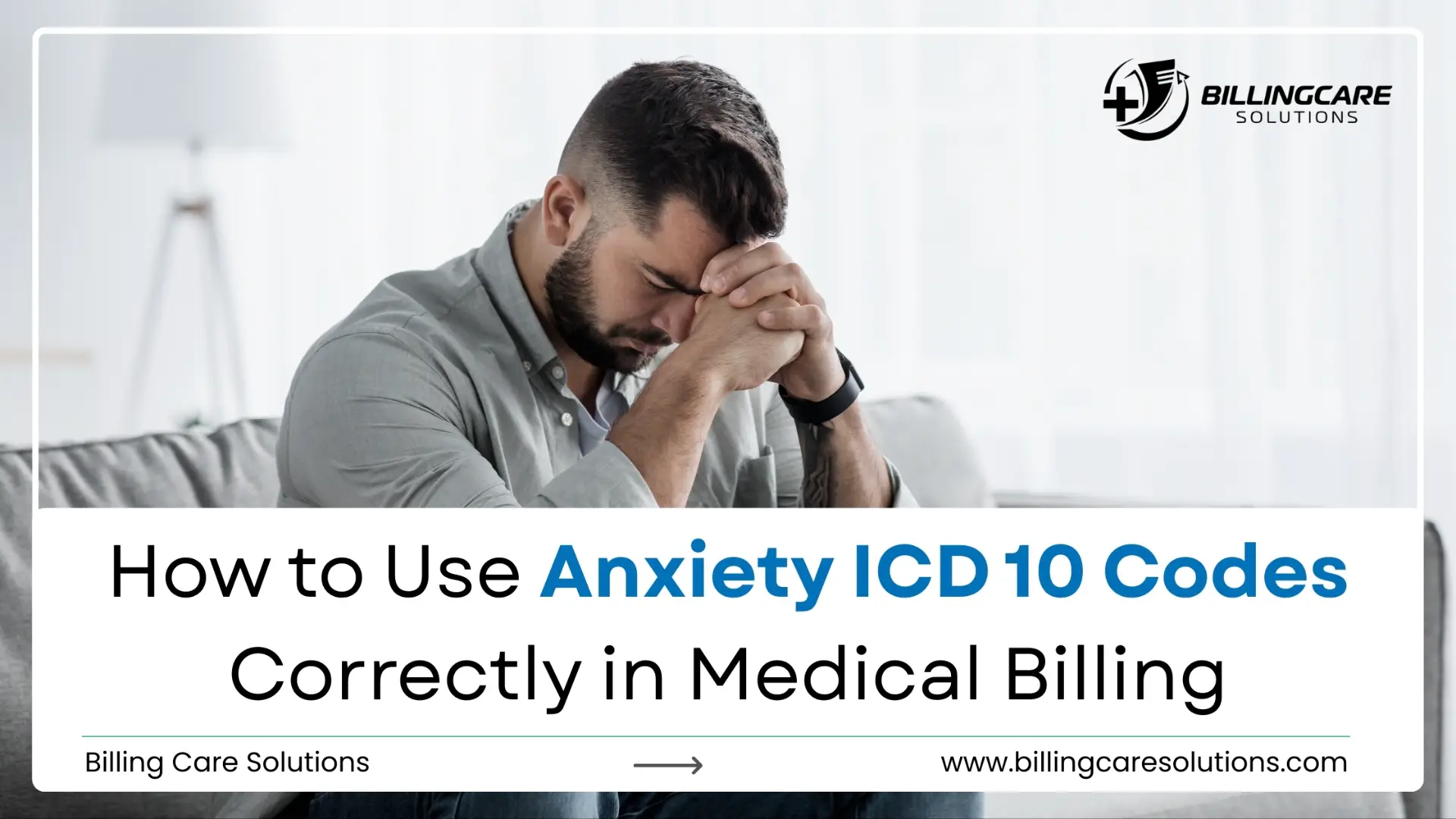
Medical billing of mental health services requires one thing, which is to use the correct diagnosis codes. In the practice of treating patients with anxiety disorders, it is important to master the anxiety icd 10 code set to be reimbursed and to be in compliance.
Anxiety disorders have a tremendous number of patients throughout the United States, and these codes are present in a high proportion of behavioral health claims. This roadmap will assist you in knowing how to choose, order and use these codes in the right way and save your income and prevent expensive penalties.
Understanding the Anxiety ICD 10 Code Set for Accurate Billing
Anxiety icd 10 does not describe an individual diagnosis but is a group of codes. These codes are classified as Chapter V of the ICD-10 coding structure, in either the F40 or F41 code block. ICD-10 overturned the focus of ICD-9 to specificity, and it is important to the coding of anxiety.
Key points about the anxiety icd 10 code set:
- The F41 block provides other anxiety disorders and has various specific diagnoses.
- Generalized anxiety disorder has the most frequently used codes of F41.1.
- Another commonly used code is F41.0 of a panic disorder.
- F41.9 unspecified anxiety disorder should only be used when there is a need to do so.
- All the codes are unique clinical presentations, which carry some diagnostic criteria.
Why specificity matters:
- Failing to use a specific icd 10 code of anxiety as generic will result in claim denials.
- Audits are also exposing unspecified codes to scrutiny by payers.
- The auditors want to see documented clinical rationale where specificity was present.
- The initial thing to comprehend is the difference in codes to make correct billing.
Specificity Matters Choosing the Right Anxiety ICD 10 Code
To choose the right anxiety icd 10 code one must pay great attention to the clinical documentation. The following are the most common codes and the occasions when they are used.
F41.1 Generalized anxiety disorder: When to use this code
- The patient has more than six months in which he experiences excessive anxiety and worry most of the days.
- The patient cannot cope with worry.
- The patient has at least three related symptoms including restlessness, fatigue or sleeping disturbance.
- Symptoms result in clinical distress or impaired functioning.
F41.0 Panic disorder: When to use this code
- Patients are subjected to repeated unpredictable panic attacks.
- The patient reports a minimum of one month of continuous worry regarding the possible attacks.
- There are severe behavioral changes in patients as to the attacks.
- It is documented that attacks are not situational.
F41.9 Unspecified anxiety disorder: When to use this code
- Clinicians diagnose patients with an anxiety disorder but it is not fully evaluated.
- The symptoms do not precisely belong to a single category of anxiety.
- As more clinical data is awaited, working diagnosis is underway.
- The additional evaluation is required to make a more specific code.
Important observation: F41.9 must never be applied indefinitely without clinical reconsideration. Again information is available, updated to a particular code.
The following table is a reminder of the most prevalent codes of anxiety and their use.
| ICD-10 Code | Description | When to Use |
|---|---|---|
| F41.1 | Generalized anxiety disorder | Excessive worry for 6+ months with 3+ associated symptoms |
| F41.0 | Panic disorder | Recurrent unexpected panic attacks with persistent concern about future attacks |
| F41.9 | Anxiety disorder, unspecified | Working diagnosis, incomplete evaluation, or symptoms don't fit specific criteria |
Common Medical Billing Errors with Anxiety ICD 10 Codes
Experienced billers too make errors with anxiety icd 10 codes. Knowing these pitfalls would allow you to avoid denials and reviews.
Error 1: Inappropriate use of unspecified codes
- Applying F41.9 to a patient when he or she obviously falls within the criteria of a particular disorder such as F41.1.
- It is being played safe with unspecified codes that in fact increases audit risk.
- The omission of certain codes in instances where clinical documentation is supporting them.
Error 2: Coding anxiety because of medical conditions improperly
- Applying F41 codes in cases where F06.4 codes are supposed to be used.
- MI forgetting the code first rule of anxiety with medical conditions.
- Ordering the behavioral health code as a precursor to the medical condition.
Error 3: The confusion of adjustment disorders and anxiety disorders
- F41 codes of stress related anxiety were used to imply F43 codes.
- Missing the diagnosis of F43.22 adjustment disorder with anxiety.
- Absence of the identifiable stressor that implies adjustment disorder.
The importance of the knowledge of these differences in proper coding and reimbursement is paramount.
The Link Between Anxiety ICD 10 Codes and Medical Necessity
Proper reimbursement is based on medical necessity. The anxiety code that you have selected icd 10 has to support the type of treatment you are offering which could be psychotherapy, medication management or more intense care.
Documentation requirements for F41.1:
- Endorse all requirements of DSM-5 such as 6 months.
- Record the three symptom thresholds evidently.
- Incorporate chief complaint given by the patient.
- Give a comprehensive symptom inventory in terms of duration and frequency.
- Inclusiveness of the evaluation of the clinician of what specific criteria were met.
Why documentation matters:
- The most frequent cause of denial of claims is the absence of documentation on some criterion.
- Weak documentation can be downgraded to F41.9 on audit.
- Unspecified codes demand more documentation by payers.
- Both the diagnosis and medical necessity is well documented.
For higher levels of care:
- Other clear diagnoses such as F41.1 tend to be more authorised.
- The unspecified codes might have a higher medical necessity requirement.
- The partial hospitalization and intensive outpatient programs are more scrutinized.
Anxiety and Comorbidities Sequencing Anxiety ICD 10 Codes Correctly
The anxiety patients often suffer other mental illnesses. The correct coding will be done, and the right reimbursement will be made possible through proper sequencing.
When anxiety and depression occur together:
- Code when both satisfy the criteria of diagnoses.
- Do not apply one mixed code to different conditions.
- In the United States, the ICD-10-CM lacks F41.2 as a valid diagnosis.
- F43.23 is applied to adjustment disorder with mixed anxiety and depressed mood.
- F41.8 can be applied to other specified anxiety disorders.
How to sequence multiple diagnoses:
- Identify the main condition depending on which one should be treated.
- Take into consideration the cause of the interaction when identifying the key diagnosis.
- Make sure that the primary diagnosis is what the primary condition treated at that visit is.
- Name secondary diagnoses which must also be treated or monitored.
For anxiety disorders due to medical conditions:
- The proper sequencing code first rule should always be remembered.
- First sequence underlying medical condition.
- Continue with the relevant anxiety icd 10 code of the F06.4 family.
Example: A patient who was COPD and developed anxiety would be coded to J44.9 then F06.4.
How Billing Care Solutions Optimizes Your Anxiety ICD 10 Claims
Billing Care Solutions eases behavioral health practices anxiety ICD 10 coding. To verify the accuracy and compliance of claims, we review documentation, payer trends, and assist in managing coding, submission, and denials. Our services minimize denials, avoid audits, and enhance reimbursement through the choice of accurate codes such as F41.0, F41.1 and F41.9 with the help of in-depth documentation and the criteria of symptoms.
Attention is paid to proper sequencing of comorbidities. Working with us is time-saving, revenue cycle optimization, and focus on patient care. Proper coding and professional assistance are the solutions that guarantee your practice is reimbursed correctly and reduce the amount of errors and compliance risks.
Conclusion:
Proper reimbursement and compliance in behavioral health billing requires accurate use of anxiety icd 10 codes. The distinction between a paid and a denied claim is usually determined with the choice of an appropriate code and covering it with detailed documentation.
It is important to remember that F41.1 needs six months of symptoms along with three related features, F41.0 needs recording of recurrent panic attacks and persistent concern, and F41.9 is only used as a transitory code until additional clinical data is collected.
Effective sequencing in case of comorbidity and preventing common pitfalls such as confusing the adjustment disorders with the anxiety disorders will save your practice against audits and lost income. With the steps in this guide, you would be safe to make certain that your anxiety coding is correct, compliant, and optimized to reimbursement.
