

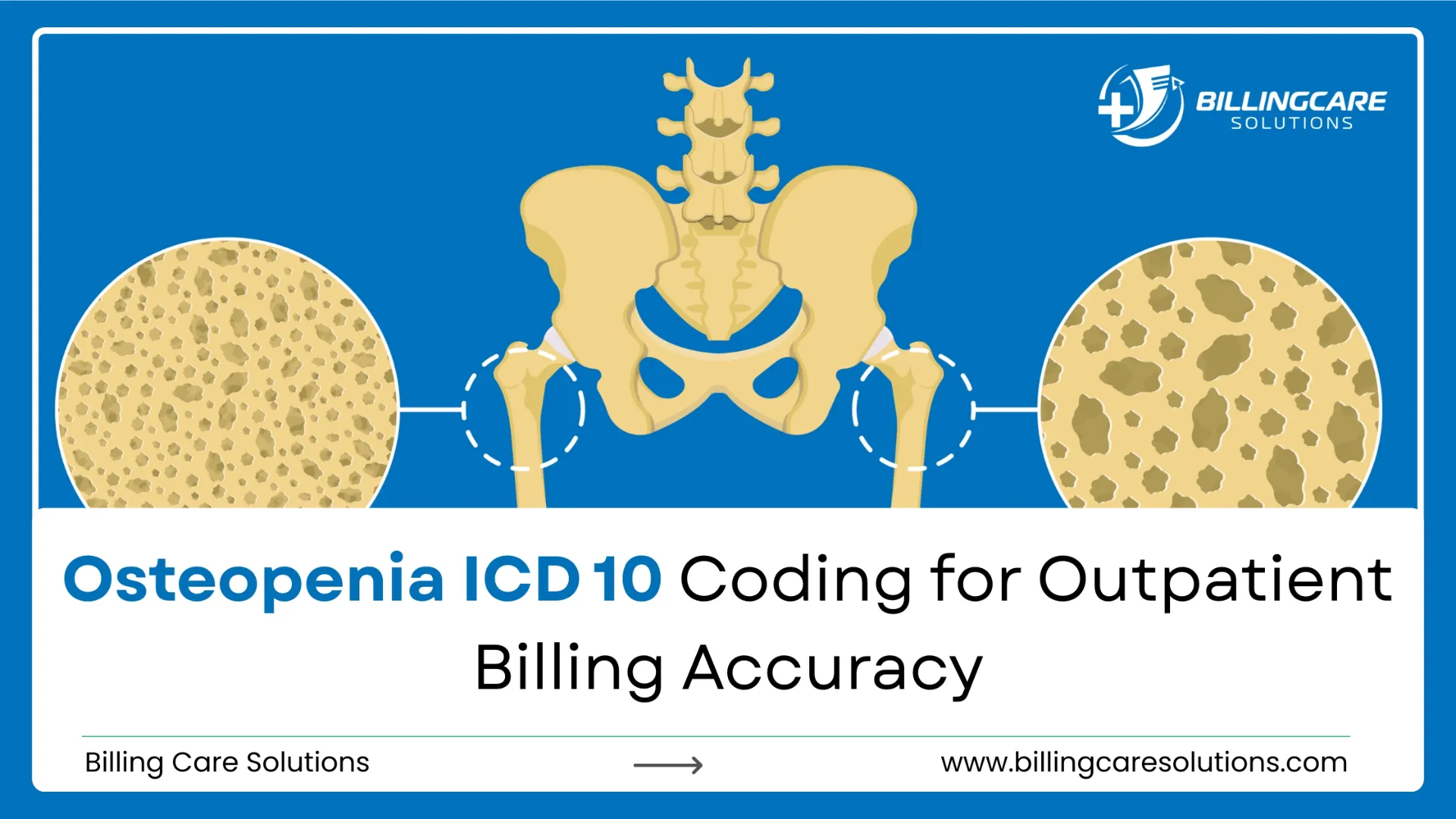
Osteopenia ICD 10 Coding for Outpatient Billing Accuracy
Accurate osteopenia ICD 10 coding supports proper outpatient documentation, reduces billing errors, and helps prevent claim denials.
The efficient healthcare revenue cycle management is based on correct medical coding. In the bone density disorders case, it is important to master Osteopenia ICD 10 codes to ensure accurate and compliance outpatient billing. The complexity of the diagnosis coding requirements is the issue that healthcare providers are forced to work around to ensure the appropriate reimbursement provided, at the same time keeping documents that meet the payer requirements.
Osteopenia, a condition such that bone density is less than expected, is a condition that afflicts millions of patients all over the world and requires accurate coding habits. This is a detailed guide which would help medical billing professionals, healthcare providers and the coding specialists in understanding Osteopenia ICD 10 coding and the appropriate billing to do and fewer claims denials.
What is Osteopenia and Why Accurate Coding Matters?
Osteopenia is an intermediate between normal bones and osteoporosis. Osteopenic patients do possess bone mineral density (BMD) with a population range of 1.0 to 2.5 standard deviations of less bone mass compared to the normal peak bone mass. The condition is a significant alarming factor, as it is a marker of higher risk of fractures, and may lead to osteoporosis without any treatment.
Medical practitioners determine osteopenia with the help of the double-energy X-ray absorptiometry (DEXA) procedure, which assesses the bone density of vital regions such as the spine, forearm, and hip. The T-score of these scans is used to determine who has normal bone density, osteopenia or osteoporosis.
Billing wise, proper coding would enable healthcare centers to have proper reimbursement on diagnostic procedures, treatment services, and patient management. Improper coding causes rejection of claims, delayed payments and compliance, which affect the financial performance of your practice.
Primary Osteopenia ICD 10 Codes You Need to Know
The ICD 10 codes have dedicated codes to be used in recording osteopenia in various clinical conditions. The primary code is M85.8 - Other specified disorders of bone density and structure. This code needs further specification with addition of seventh character extensions to demonstrate the anatomic site of reduction in bone density.
| ICD-10 Code | Description | When to Use |
|---|---|---|
| M85.80 | Bone density disorder, unspecified site | Location not documented in chart |
| M85.851 | Bone density disorder, right thigh | Right femur osteopenia identified |
| M85.852 | Bone density disorder, left thigh | Left femur osteopenia identified |
| M85.88 | Bone density disorder, other site | Trunk or multiple specific sites |
| M85.89 | Bone density disorder, multiple sites | Generalized osteopenia documented |
Understanding these codes assists you in making the most appropriate diagnosis depending on what you are writing in your clinical note. The trick lies in correlating the code with the exact anatomical point that is determined in the result of the DEXA scan.
Related Bone Density Codes for Complete Osteopenia ICD 10 Coding
Although osteopenia has its own code family, you must be conversant with the other bone density disorders that can be used with your patients. Osteopenia and osteoporosis have their differences that are essential in proper coding.
Related Diagnostic Codes
| ICD-10 Code | Description | When to Use |
|---|---|---|
| M81.0 | Age-related osteoporosis without fracture | T-score below -2.5, no fracture |
| M80.0 | Age-related osteoporosis with fracture | Osteoporosis with documented fracture |
| Z13.820 | Screening for osteoporosis | Preventive screening visits |
| Z87.310 | History of osteoporosis fracture | Past fracture documentation |
| M85.9 | Disorder of bone density, unspecified | When specific diagnosis unclear |
It is important to remember that there are differences between osteopenia and osteoporosis diagnosis by T-score criteria. The range of T-score of -1.0-2.5 refers to osteopenia (M85.8 codes) and T-score below -2.5 refers to osteoporosis (M80/M81 codes). The use of a mismatched code family results in claims denials and compliance.
Documentation Requirements for Osteopenia ICD 10
Accurate code selection is based on proper documentation. Medical records should include certain components that can support Osteopenia ICD 10 codes and pass payer examination in audits.
What Your Documentation Must Include
DEXA Scan Results:
Provide the entire report of the DEXA scan and the T-score of all the sites measured. The documentation should include what anatomical sites were assessed and what were the values of bone mineral density as the results. In the absence of this information, coders are not able to choose the suitable site specific code.
Explicit Diagnosis Statement:
The provider should state clearly in his or her clinical notes that it is osteopenia, and should relate it to the results of the DEXA scan. General words such as the decrease in bone density without mentioning whether this is osteopenia or osteoporosis cause coding issues and possible mistakes.
Anatomical Specificity:
Explicit identification of the sites in the affected bones allows the selection of the seventh character correctly. During the process of record keeping, record whether the osteopenia occurs in the right hip, left forearm, spine, or the multiple sites. This particularity has a direct effect on code assignment.
Clinical Context:
Capture factors in the clinical situation, including age, gender, family history, or medication use, or lifestyle factors. This data can be used to justify services to the payers by supporting medical necessity to continue monitoring and treatment.
Common Documentation Mistakes to Avoid
A substantial number of mistakes in the coding are a result of incomplete documentation. These pitfalls should be circumvented by the providers:
- The ambiguous wording of unstated osteopenia.
- Not recording right versus left to appendicular skeleton sites.
- Failure to indicate the anatomical sites that were involved.
- Leaving T-scores out to clinical notes in case of referring to DEXA results.
- Confusion of the use of osteopenia and osteoporosis.
Educating your clinical personnel on documentation needs enhances more accurate coding and lessens billing personnel inquiries.
Osteopenia ICD 10 Coding Best Practices for Billing Accuracy
Effective coding involves compliance with official instructions and industry best practices that would guarantee compliance and maximize reimbursement.
Selecting the Most Specific Osteopenia ICD 10 Code
The ICD 10 system is based on the specificity principle. Always use the most accurate code that is backed by your documentation. In the case of osteopenia coding it is important to use the seventh character to code the anatomical location where possible.
In instances where documentation indicates a certain location such as right hip or left forearm, the site-specific code is to be used instead of M85.80 (unspecified site). Only in cases where documentation has really failed to be anatomically specific, should reserve unspecified codes be used.
Handling Multiple Site Involvement
Individuals who have osteopenia that is generalized and which impacts more than one region of the skeleton need to be carefully selected with regard to code.
You have two approaches:
Option 1: Code M85.89 (multiple sites) in order to identify the generalization of the condition when it is reported as commonplace in many areas.
Option 2: Report individual site-specific codes when documentation explicitly identifies each site of the affected location and the payer guidelines allow multiple code reporting.
Review your policies on payers to decide on their preference as some would want a single comprehensive code and some would accept multiple code with detailed documentation.
Proper Sequencing Guidelines
When osteopenia is associated with other legacies, by the right sequencing, it is guaranteed that the clinical picture of the patient is represented accurately. The main diagnosis must depict the main cause of the encounter.
The Osteopenia ICD 10 code is the main diagnosis used in the case of regular visits to the monitoring office of osteopenia. But in a situation when a patient comes with a fracture due to osteopenia, osteopenia code is overridden and secondary osteopenia is reported to clarify the weakness of the bone.
Common Osteopenia ICD 10 Coding Errors and Solutions
The awareness of the common errors will enable you to take preventive actions and increase the accuracy of billing.
Confusing Osteopenia with Osteoporosis
This is the most frequent mistake in the coding of bone density. The conditions are different with their T-score criteria and have different code families. Always evaluate the findings of the DEXA scan:
- Osteopenia: T-score between -1.0 and -2.5 (use M85.8 codes)
- Osteoporosis: T-score below -2.5 or fragility fracture present (use M80/M81 codes)
This is an expensive error that can be avoided by introducing a verification process by coders comparing T-scores prior to the assignment of code.
Using Unspecified Codes When Specificity Exists
The fall to M85.80 (unspecified site) when the documentation is more specific in nature diminishes the accuracy of coding. Unspecified codes might be challenged by the payers or demand further proof.
Solution: Educate personnel to derive anatomy information out of DEXA reports and clinical notes. Design templates or checklists that require providers to record certain sites when attending patients.
Incorrect Laterality Assignment
The incorrect code assignment occurs with the transposition of right and left designations or the inability to identify bilateral documentation.
Solution: Have the coders check the laterality with the source documentation prior to finalizing the choice of codes. Highlighting or color-coding your workflow can help you attract attention to laterality specifications.
How Osteopenia ICD 10 Coding Impacts Your Revenue Cycle
Proper coding has a direct impact on the financial performance and regulation of your practice. Such connections can be understood in order to give quality coding the top priority.
Clean Claims and Faster Payment
ICD 10 codes help payers to establish coverage eligibility, medical necessity, and payment levels. Clean claims are processed by using correct Osteopenia ICD 10 codes that match submitted CPT codes of DEXA scans, office visits, and treatments.
With matching codes between documentation and supporting medical necessity, claims are easily cleared by payer systems. This will minimize denials, shorten work on reimbursement and lessen the administrative workload on your billing department.
On the other hand, codes that are not given proper specificity or do not correlate with clinical documentation will result in edits, denials or delays in payment. The expense of rework, reimbursement denials, and filing of corrections also have a large effect on your revenue cycle efficiency.
Reducing Audit Risk
Payers and government programs, as well as compliance reviews, put a healthcare organization under scrutiny. Correct Osteopenia ICD 10 coding with extensive documentation will minimize susceptibility to audit results and reimbursement to the maximum possible extent.
Proactive Strategies:
- Carry out frequent internal bone density coding audits.
- Review one quarterly of osteopenia claims.
- Present findings in feedback and education to providers.
- Improvement actions and results of document audit.
Compliance programs with brute force protecting your revenue and good faith efforts at ensuring billing integrity support your revenue.
Quality Reporting and Data Analytics
Outside billing applications, ICD 10 codes are used to fill quality data bases, registries, and analysis systems. Correct Osteopenia ICD 10 coding will help to have correct data that will inform:
- Bone health intervention clinical studies.
- Population health management programmes.
- Policy making in healthcare.
- Value-based care contract stratification Risk.
The accuracy of your coding has much broader implications than just on single claims payment, as it helps in larger healthcare quality efforts.
Technology Tools for Improving Osteopenia ICD 10 Coding
In contemporary healthcare organizations, technology is utilized to make the process of coding more accurate and efficient.
Computer Assisted Coding Systems
Computer-assisted coding systems (CAC) systems employ natural language processing to process clinical documentation and prescribe suitable codes. These tools are able to detect osteopenia diagnoses in clinical notes and DEXA reports and suggest the respective M85.8 code depending on the information about the anatomical sites reported.
Benefits include:
- Faster code assignment
- Better coding inter-rater consistency.
- Less human error due to manual code look-up.
- Built-in compliance checks
Technology is however an aid, but not substitute for professional medical coders. CAC recommendations have to be checked on documentation by human coders to validate them.
Clinical Documentation Improvement Programs
The clinical documentation improvement (CDI) specialists facilitate the communication between coders and providers. CDI initiatives aimed at bone density disease conditions teach physicians on how to write documentation to achieve Osteopenia ICD 10 correct coding.
CDI reviews concurrently enable specialists to question providers as long as patients are still receiving care and get clarification to enhance the correct coding without postponing claims. This is a proactive measure of avoiding denials in advance.
Electronic Health Records Optimization
Current EHRs can be set up to facilitate proper Osteopenia ICD 10 Coding by:
- Documentation templates which trigger anatomical site documentation.
- Auto-population of DEXA reports T-scores.
- Suggestive decision support systems.
- Reporting tells when essentials are not available.
Accommodate your team with an EHR vendor to tailor workflows that simplify your team to record accurate documentation and code.
Osteopenia ICD 10 Coding in Various Clinical Practice
Knowledge of the application of codes in different situations will guarantee consistent billing.
Preventive Screening Visits
In cases where the patient is subjected to bone density screening with no current symptoms or diagnosed bone disorders, Z13.820 (encounter for screening of osteoporosis) is the primary diagnosis to be used. In case of screening indicating that there is osteopenia, include the corresponding M85.8 code as a secondary diagnosis in order to indicate the abnormal findings.
This sequencing is a true reflection of the purpose of the encounter, which was screening, osteopenia being one of the findings.
Follow-Up Management Visits
The site-specific IC 10 code of Osteopenia is the primary diagnosis in established patients who come back to treat osteopenia. The documentation should indicate:
- Current bone density status
- Intervention of response to treatment.
- Any upward or downward development since the previous assessment.
- Ongoing treatment plan
The visits aim at the management of the known condition, and therefore osteopenia becomes the primary diagnosis.
Consultation Services
Code selection is dependent on the rationale of consultation when specialists assess patients to consult osteopenia. In case the referring provider feels the likelihood of osteopenia given the area of risk and the specialist confirms the issue, the correct code to be used is M85.8.
Note the recommendations, communication and findings of the specialist to back up the consultation service billing.
Why Choose Billing Care Solutions?
Billing Care Solutions is the reliable partner in full-service medical billing solutions that will maximize the performance of the revenue cycle. Our group of qualified coding specialists is highly knowledgeable about the complicated aspects of coding, such as coding osteopenia ICD 10 and billing bone density disorder.
Our solutions are transparent reporting, committed account management, and custom solutions based on your specialty and the size of your practice. By outsourcing your medical billing business to Billing Care Solutions, you will be able to concentrate on the patient and we will do all possible to ensure that you optimize your revenue potential by using accurate coding, comprehensive documentation support, and active compliance management.
Conclusion:
Osteopenia ICD 10 coding is a skill that should be mastered by healthcare organizations that deal with bone density diseases. Proper reimbursement can be achieved by the accurate code selection regarding detailed documentation, specificity of the anatomy, and code guidelines in order to remain compliant. The M85.8 code family is the one that gives recommendations on how to report osteopenia of different anatomical locations with A7C selection to be keenly observed.
Knowing the difference between osteopenia and osteoporosis, the most frequent errors in coding, and the strategies to enhance the quality of the assurance process enhance your payment accuracy. Your organization will be in a good position to succeed in the revenue cycle through investment in coding education, technological solutions, and documentation enhancement initiatives. Making the coding of Osteopenia ICD 10 the first priority shows how seriously you take the importance of billing integrity and compliance excellence.
