

Chest Pain ICD 10: Diagnosis Coding Guidelines for Providers
Accurate Chest Pain ICD 10 coding and documentation guide for providers to ensure compliance, proper reimbursement, and reduced claim denials.
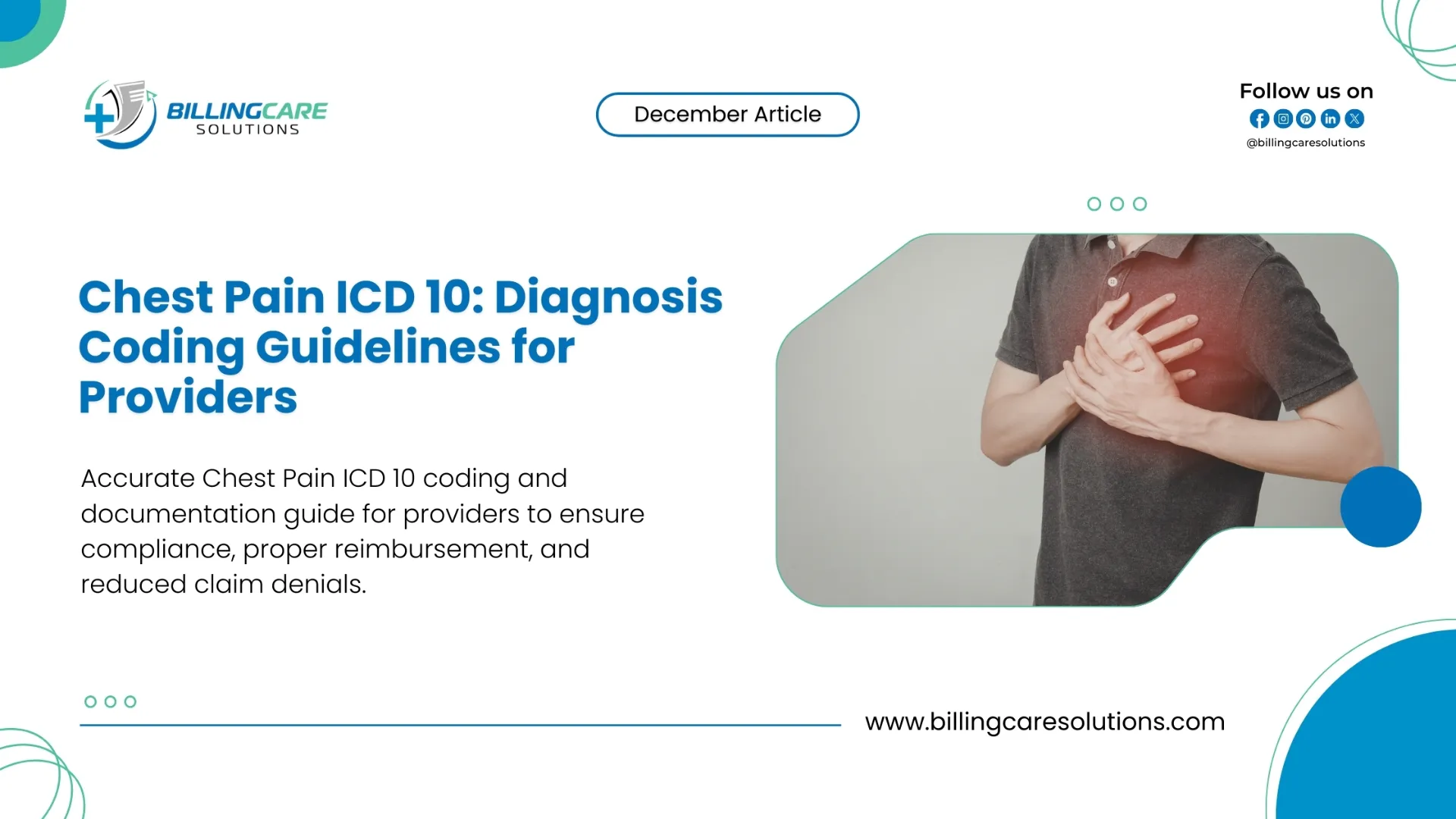
Chest pain is one of the most frequent presenting complaints in clinical practice, as it causes millions of emergency department visits every year. To medical billing professionals and healthcare providers, proper coding of ICD 10 of chest pain is needed to ensure that they will receive the necessary reimbursements, quality reporting, and that they comply with the rules and regulations.
This overall guide will discuss ICD 10 codes of chest pain, the best practice when it comes to documentation, and the essential coding principles that should be implemented by the providers to submit claims correctly and to manage their optimal revenue cycle.
Understanding ICD 10 Codes for Chest Pain
The International Classification of Diseases, 10th Revision (ICD 10) offers a coding scheme for documenting the diagnosis of chest pain. In contrast to ICD 9, which provided a limited specificity, ICD 10 codes give providers an opportunity to record detailed clinical information concerning the location, the character of the chest pain, and its underlying cause.
The chief ICD 10 code that would be used to classify chest pain would be in the category of R07 that includes throat and chest pain. This group consists of various specific codes that the providers need to know to choose the most suitable diagnosis code in the case of every patient encounter.
Primary ICD 10 Codes for Chest Pain
| ICD-10 Code | Description | When to Use |
|---|---|---|
| R07.9 | Chest pain, unspecified | Use when documentation does not specify the type, location, or cause of chest pain and no confirmed diagnosis is available. |
| R07.89 | Other chest pain | Use when chest pain is documented but does not meet criteria for cardiac, pleuritic, or precordial pain. |
| R07.1 | Chest pain on breathing | Use when pain is clearly associated with respiration and pleuritic features are documented. |
| R07.2 | Precordial pain | Use when pain is localized to the anterior chest area near the heart. |
| R07.0 | Pain in throat | Use when pain originates in the throat region and extends toward the chest. |
Documentation Requirements for Accurate Chest Pain ICD 10
Correct ICD 10 coding is based on proper documentation. Specific clinical information should be documented by the providers as it helps to substantiate the chosen diagnosis code and prove the medical necessity of the provided services.
The critical areas of documentation are the exact site of chest pain, which may be substernal, left-sided, right-sided, or diffuse chest pain, as anatomical landmarks. The nature and the nature of the pain must be well reported, such as the pain may be sharp, dull, crushing, burning, or pressure-like.
The providers are expected to record the length of time and onset of the symptoms, whether the pain is acute, chronic, periodic, or constant. Other related symptoms like shortness of breath, diaphoresis, nausea, or radiation of pain to the arm, jaw, or back should be noted in the clinical notes.
The correlation of pain with activities, such as exertion, breathing, eating, or changes in position, gives useful diagnostic data. The medical record should clearly provide any aggravating or relieving factors.
Differentiating Cardiac from Non-Cardiac Chest Pain ICD 10
Among the most important issues in coding chest pain is to differentiate cardiac causes of chest pain and non-cardiac causes. The effect of this difference on the choice of code and further treatment procedures is direct.
Providers should apply distinct ICD 10 codes within the chapter of the circulatory system as opposed to symptom codes within the R07 category when suspected or confirmed cardiac causes are involved. As an example, acute myocardial infarction will need codes I21 through I22 categories, whereas angina pectoris will need codes I20 category.
The non-cardiac chest pain could have a gastrointestinal, musculoskeletal, pulmonary, or psychological origin. ICD 10 coding system offers specific codes to these conditions that ought to be used in place of symptom codes in case the etiology behind the condition is discovered.
Coding Guidelines for Emergency Department and Outpatient Settings
There are guidelines to be used in the emergency department and outpatient coding of chest pain, which are not similar to the inpatient coding practice. This knowledge of these differences will help in the proper assignment of the codes in the various settings of care.
When encountering a patient in the emergency department, the providers tend to assess the chest pain as the chief complaint without identifying the underlying cause. In case the diagnostic workup is inconclusive in case of an ED visit, the symptom should be coded with the use of R07 codes, which is in compliance with coding guidelines.
Nevertheless, when testing makes a definite diagnosis, which is acute coronary syndrome, pulmonary embolism, or pneumonia, then the proven diagnosis overrides symptom codes. The provider in the emergency department is supposed to code the underlying condition and not the symptom that is presented.
In case of outpatient follow-up visits, in which the patient had already been assessed regarding the chest pain, the providers are to code the known underlying conditions first and then the symptom code only when the chest pain has not subsided despite the treatment or is another complaint to be made.
Coding Chest Pain with Associated Conditions
Most of the patients report chest pains as well as other medical conditions that have to be concurrently coded. Knowledge of sequencing more than one diagnosis is a way of ensuring that patient complexity is represented properly and that the patient is charged accordingly.
In cases of a symptom of a diagnosed condition where the chest pain was present, the underlying disease process should be coded, and then the chest pain coded secondarily should be a significant component that needs further assessment or management during the encounter.
Providers should assign the specific cardiac condition primary code to patients presenting with chest pains and having known coronary artery disease. In case the chest pain is a new or other pattern than what was used in the earlier episodes, it would be suitable to include an additional R07 code to capture the acute presenting complaint.
The unique aspects of code sequencing of patients with multiple comorbidities, including diabetes, hypertension, and hyperlipidemia, whose chief complaint is chest pain, depend on the focus of the clinical interaction and the conditions being actively treated at the time of interaction.
Common Coding Errors and How to Avoid Them
Among the most common mistakes, the use of unspecified codes where a more specific code is indicated in documentation should be mentioned. The providers are not supposed to default to R07.9 in cases where the clinical notes have more specific clinical information that can be used to code it, like R07.1 or R07.82.
The other widespread error is that providers carry on with the symptom codes once they have made a conclusive diagnosis. After testing to establish the underlying cause of chest pain, the code of the symptom must be substituted with the disease-specific code.
The inability to connect the coding of chest pain with supporting documentation is another major mistake. All coded diagnoses should possess clinical evidence in the medical record with regard to medical necessity and to justify the choice of the code.
Poor specificity of clinical documentation does not allow the coders to choose the best ICD 10 code. Providers are encouraged to describe the features of chest pains in detail instead of putting chest pain in records without further characterization.
Why choose Billing Care Solutions
Billing Care Solutions offers a complete service to healthcare organizations that deal with ICD 10 coding needs. The services offered are documentation check, coding advice, and payer-specific compliance plans.
Coding of chest pain is a complex issue that has to be adequately evaluated because it is a subject of high reimbursement scrutiny. Professional billing assistance guarantees accuracy of coding and provides the healthcare provider with the opportunity to concentrate on the patient.
Conclusion:
The issue of chest pain is a broad range of clinical manifestations, so ICD 10 coding becomes extremely important. The right choice of the code requires proper documentation, consideration of the nature of pain, its manifestations, and diagnostic results. Symptom codes are proper in the first assessment, whereas diagnosis codes are supposed to replace the symptom codes when a disease has been diagnosed.
Coders collaborating with the providers will be able to provide the correct documentation and billing. Proper coding of chest pain assists in reimbursement, auditing defense and enhancing the quality of patient records. Adhering to well-laid instructions improves clinical and financial outcomes of healthcare organizations.
