


Where Healthcare Revenue Is Lost Before the Claim Is Paid: A Revenue Integrity Playbook for CFOs
Revenue integrity gaps often start before payment. See where healthcare revenue is lost and how CFOs can strengthen coding, billing, claims, and collections.
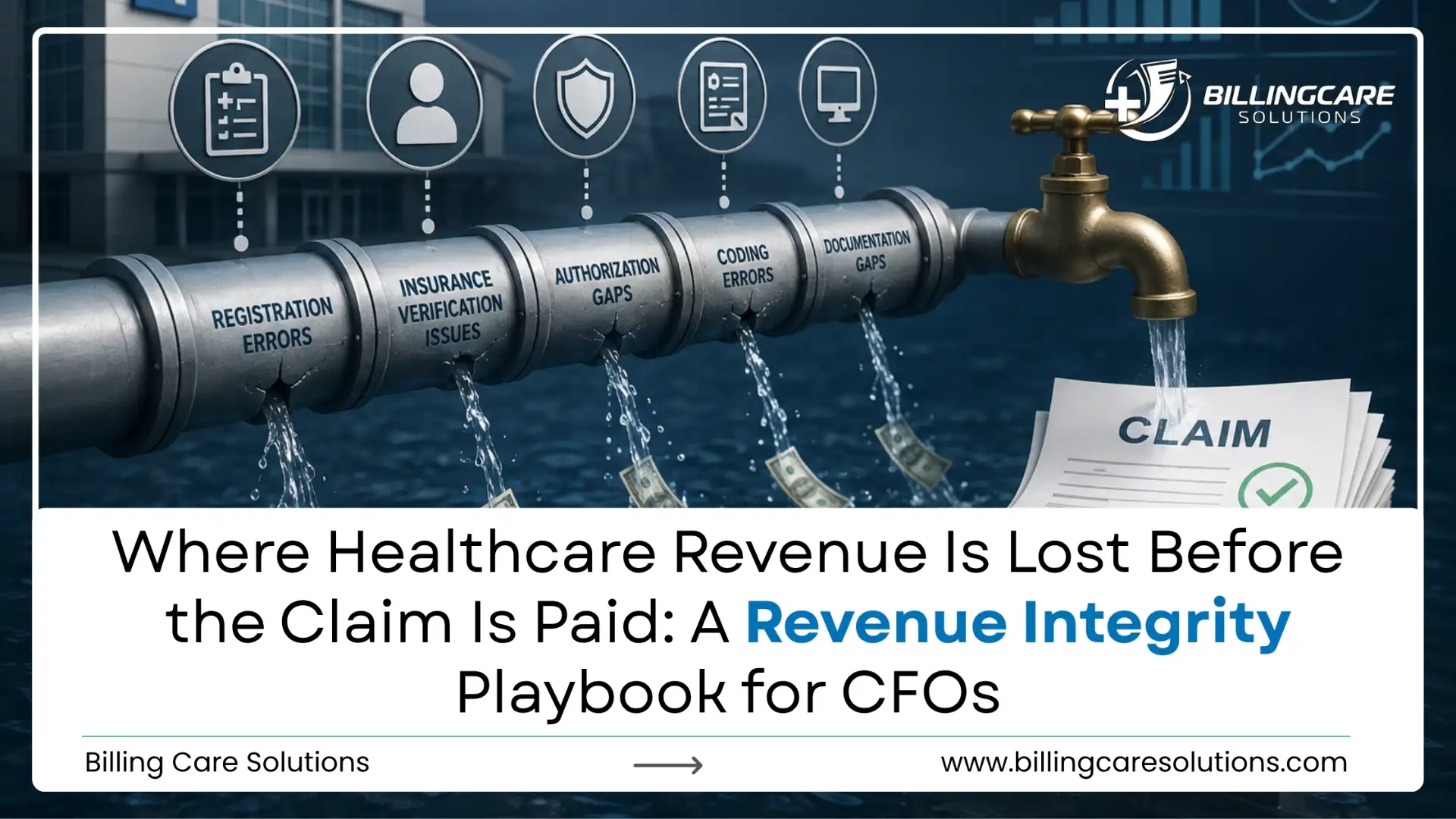
The Financial Performance of a healthcare industry is directly impacted by Revenue Integrity. Revenue leakage can start even before a claim is submitted to the payer. A number of factors expose the financial risks, including missed charges, documentation gaps, coding errors, authorization failures and payer configuration problems. These issues also add to rework, slow reimbursement and hurt financial projections.
Revenue integrity is more than just coding compliance for CFOs. It should link clinical documentation, charge capture, coding, billing, Payer rules and financial reporting. The goal is to make sure that all relevant services are accounted for, supported and correct. This means that you need to be able to see your finances throughout the entire revenue cycle, well beyond the point of claims submission.
Revenue leakage health systems encounter continues to be large throughout the revenue cycle. According to a January 2026 report by HFMA, hospitals are losing approximately 3% to 5% of net revenue annually due to leakage, such as missed billing opportunities, inefficiencies and underpayments. Leakage happens in the front-end, mid-cycle and back-end processes, too, HFMA adds.
Executive Summary
Revenue leakage typically doesn’t start with a denied claim. Loss of financial resources often begins prior to the service, when it is not rendered, recorded, coded or submitted without proper authorization. These problems decrease the value of earned revenue prior to a payment decision. It is also important for a CFO to have visibility of the revenue risks upstream.
A strong revenue integrity program connects clinical activity with financial outcomes. It compares services delivered with charges captured, documentation with codes reported, and expected reimbursement with actual payments. This approach helps organizations identify recurring leakage rather than treating each claim problem separately. It also gives finance leaders stronger evidence for operational and payer decisions.
The financial effect is magnified when multiplied by the number of users. If a healthcare organization had a preventable leakage rate of 1%, they will have $1 million exposed to leakage for a net patient revenue of $100 million. A 2% rate would equal the same as $2,000,000, a 3% rate would equal the same as $3,000,000. These statistics make a compelling case that CFOs need to think of leakage in terms of dollars, and not percentages.
The 2026 Revenue Integrity Problem
Protections for operating margins are growing in pressure for healthcare organizations. Financial performance remains a challenge with labor costs, complexity of payers, administrative burden and reimbursement pressures. According to HFMA, revenue cycle performance is becoming more closely tied with financial sustainability and operating stability more than ever before.
This environment makes upstream revenue leakage more expensive. A missed charge creates no claim and therefore no payment opportunity. A documentation gap can weaken reimbursement support before submission. A contract configuration error can affect hundreds of claims before finance teams recognize the pattern.
CFOs should therefore treat revenue integrity as a financial control. The first question should be where revenue is leaking. The second should be why the leakage occurs. The third should be how many dollars the organization loses from each root cause.
Where Revenue Leakage Starts
Revenue leakage occurs across several stages before payment. Each stage creates a different financial risk. Some problems prevent revenue from entering the billing system, while others reduce the amount eventually collected.
| Revenue Leakage Point | What Goes Wrong | Financial Consequence |
|---|---|---|
| Charge capture | Services never become charges | Lost billable revenue |
| Documentation | Required details are missing | Unsupported reimbursement |
| Coding | Services are coded incorrectly | Lower reimbursement or denial |
| Authorization | Required approval is missing | Nonpayment or delayed payment |
| Medical necessity | Documentation fails payer criteria | Denial or reduced payment |
| Contract setup | Rates or rules are configured incorrectly | Systematic payment variance |
| Claim edits | Preventable errors remain unresolved | Rejection or delayed payment |
| Billing | Claims submit late or incorrectly | Delayed cash flow |
These risks also interact with each other. A documentation problem can create a coding issue, while a coding issue can create a denial. The resulting correction work then adds labor costs and delays cash collection.
Charge Capture Creates the First Risk
Charge capture determines whether documented services enter the billing system. A service that never becomes a charge creates revenue leakage before coding begins. No denial appeal can recover revenue that the organization never billed. CFOs should compare clinical activity with captured charges. Significant differences often indicate workflow gaps, system configuration problems, or inconsistent staff practices. These variances should be measured by department, service line, provider, and procedure.
Charge lag also affects cash flow. When services enter the billing system days after delivery, claim submission moves later. Repeated delays increase the time between service delivery and payment, creating unnecessary pressure on working capital. These departments should be examined more carefully if they have a high volume of items. Emergency medicine, surgery, imaging, infusion and outpatient services typically have intricate charge structures. It can be a bigger financial issue if you don’t catch it early, and regular charge monitoring can help you do just that, on both a daily and monthly basis.
Coding Accuracy Protects Expected Reimbursement
Coding translates clinical documentation into billable information. Errors therefore affect both reimbursement and compliance. Upcoding creates compliance exposure, while undercoding can reduce appropriate reimbursement. CFOs should avoid relying on one organization-wide coding accuracy figure. A high overall rate can hide significant problems within specific providers, procedures, departments, or payers. Financial analysis should therefore connect coding errors with their reimbursement impact.
For example, a 98% coding accuracy rate might appear strong. However, the remaining 2% could involve high-value procedures and create material financial exposure. Revenue integrity teams should therefore measure errors by financial value as well as frequency. An integrity review of revenue should compare the coding patterns that are expected with the claim data. If there are significant differences, then they should be pursued for investigation and corrective action. It is not to increase coding intensity, it is to give an accurate representation of the services provided.
Authorization Gaps Create Preventable Losses
The other financial risk is prior authorization. Denials, delays or nonpayment are common due to missing or incorrect authorization details. Larger exposures occur with the availability of high cost procedures, specialty drugs, advanced imaging, or infusion services provided by organizations. Revenue integrity teams should link authorization status to desired services. This provides a “first cut” point at which to determine missing approvals. It also helps to minimize the likelihood of providing services without the necessary authorization from a payer.
The payer-specific approach is one way CFOs should look at Upstream financial controls . This includes rules for reimbursement, authorization, claim edits, modifier policies, medical necessity and reimbursement methods. These differences may not be evident in organization-wide averages. Authorization should therefore be measured as a financial control. The objective is not simply to increase approval rates. The objective is to protect expected reimbursement before services generate financial exposure.
Documentation Supports Revenue Capture
Clinical documentation supports the services reported on a claim. Incomplete documentation creates financial and compliance risks because coding teams cannot report unsupported services. Providers might deliver appropriate care while failing to document required elements. Revenue integrity programs should identify documentation patterns linked to coding changes, denials, and reimbursement variance. These patterns provide a basis for targeted provider education. They also help organizations identify recurring problems within specific service lines.
The objective should remain accurate documentation. It should reflect the care delivered and support the codes reported. Financial performance improves when clinical activity and billing data remain aligned. Documentation also affects financial forecasting. When documentation problems increase coding changes or denials, expected revenue becomes less predictable. CFOs should therefore treat documentation trends as an upstream financial indicator.
Payer Rules Create Financial Variability
Payer policies differ across contracts, plans, and service lines. A workflow that works for one payer might fail with another. Contract terms also determine expected reimbursement for specific services and procedures. CFOs should examine revenue integrity through a payer-specific lens. This includes reimbursement rules, authorization requirements, claim edits, modifier policies, medical necessity criteria, and payment methodologies. Organization-wide averages often hide these differences.
Payer-level reporting provides better visibility into recurring leakage. It can show whether problems originate from internal processes, contract configuration, or payer adjudication. This distinction matters because each cause requires a different financial response. Contract performance should also connect with revenue integrity reporting. A recurring payment variance deserves financial review when it affects a high-volume service line. The analysis should determine whether the variance reflects contract terms or payment behavior.
The Financial Impact of Revenue Leakage
Gross charges are not the only revenue leak impacted by revenue leakage. It affects cash flow, labor cost, a/r, forecasting and operating margins. Another monetary consequence is the repair of issues after they have been identified. Let’s think of a health system whose net patient revenue totals come to $100 million per year. $1 million in potential exposure equals the 1% preventable leakage rate. A 2 percent rate equates to $2m and a 3 percent rate equates to $3million.
These figures illustrate the need for the executive’s attention to these small percentages. An operational “small” leakage rate can cost millions of dollars when scaled up to the organizational level. CFOs should then convert the Upstream financial controls results into yearly financial exposure. Financial prioritization should follow the dollar value of each problem. A recurring $25,000 issue deserves different resources than a recurring $2 million issue. This approach helps finance leaders allocate resources where revenue protection has the greatest potential impact.
Revenue Integrity Metrics CFOs Should Monitor
Revenue integrity requires metrics that connect operational performance with financial outcomes. Traditional revenue cycle measures remain important, but CFOs also need upstream indicators. These measures help identify problems before they become collection issues.
| Metric | What It Reveals | CFO Question |
|---|---|---|
| Charge capture rate | Missed billable services | What services are not being captured? |
| Charge lag | Delayed revenue entry | How quickly does earned revenue enter A/R? |
| Coding accuracy | Coding-related leakage | Where are coding errors reducing reimbursement? |
| Clean claim rate | Upstream claim quality | How much preventable rework exists? |
| Denial rate | Revenue at risk | Which failures are recurring? |
| Expected reimbursement variance | Payment exposure | Are payers reimbursing expected amounts? |
| Net collection rate | Revenue realization | How much expected revenue reaches cash? |
| Revenue leakage rate | Total financial exposure | How many dollars are escaping? |
HFMA’s MAP Keys include measures such as cash collections as a percentage of net patient service revenue and denial write-offs as a percentage of net patient service revenue. These metrics help connect revenue cycle activity with fiscal health. CFOs should also establish financial thresholds for escalation. A recurring operational problem should receive attention when its cumulative dollar impact becomes material. This creates a stronger connection between revenue integrity reporting and executive decision-making.
Why Revenue Integrity Must Be Payer-Specific
Revenue is significantly affected by the composition of payers. Commercial contracts are negotiated for reimbursement, government programs have reimbursement mechanisms that are determined. Medicare Advantage and Medicaid managed care also add to the rules and requirements of the payers. These differences cannot be measured by a one-size-fits-all revenue score. Payment performance should be reviewed by payer, contract, service line and procedure by the CFO. This way, it’s easier to spot payment variance when it occurs repeatedly.
Payer-specific analysis also supports contract negotiations. Finance teams need reliable evidence when evaluating whether contracted rates and actual payments align. Revenue integrity data provides that evidence when it connects expected reimbursement with actual results. The analysis should answer one practical question. Are payment differences caused by contract terms, operational errors, or payer behavior? The answer determines whether the organization needs process correction, contract action, or payer escalation.
Revenue Integrity and Financial Forecasting
Revenue integrity has a direct impact on revenue forecasting. Unresolved leakage introduces uncertainty in the anticipated collection of leakage. It also makes forecasting revenue less accurate. CFOs should include revenue integrity trends when it comes to forecasting. Adjustments to charge captures, denials, coding accuracy, denied authorization, and payment variance may indicate cashflow issues. These trends offer a view of the results that happen before the final collection.
For instance, a higher charge lag can lead to lower near-term collections. High authorization failures can lead to exposure of denial in the future. The variability in payment is a red flag for a larger payer performance issue. Early identification gives finance teams more time to respond. Revenue integrity data therefore functions as an early warning system for financial performance. It helps CFOs understand why expected revenue differs from actual collections.
Build a CFO-Level Revenue Integrity Program
The foundation of a good RCM program is financial exposure. The first step in identifying leakages is to determine which are the highest value leakages and the extent of the impact they have on an organization on an annual basis. This sets a financial benchmark for improvement. Next, finance and revenue cycle leaders should rank each issue by value, frequency, preventability, and operational complexity. High-value recurring problems should receive priority. One-time low-value exceptions should not consume the same resources.
The ownership should then extend across the revenue cycle, clinical operations, coding, compliance, contracting, and finance. You need to have someone be responsible for each control and some measurable goal. Reviews should be conducted periodically and there should be escalation provisions for any financial differences in the content. The final step is financial measurement. Organizations should track revenue protected, revenue recovered, and recurring leakage eliminated. This turns revenue integrity into a measurable financial performance program.
Technology Supports Revenue Integrity
Technology helps organizations analyze large volumes of claims and transactions. Automated tools can identify missing charges, coding inconsistencies, contract variances, and payer-specific patterns. Analytics also helps compare expected reimbursement with actual payments. AI provides additional analysis. It can find patterns in large amounts of data and focus on exceptions to be reviewed by humans. HFMA states that AI may have a positive impact on revenue cycle processes, such as revenue capture, decreasing denials, and minimizing administrative costs.
Technology should support revenue cycle expertise rather than replace it. Even with the complexity of exceptions, there is still a need for experienced coding, contracting, compliance, clinical and financial professionals. But it is not enough to have good data; if the workflow is not robust, then the value of automation will be restricted. The best method is to use automation and human supervision. Experienced teams decide on the appropriate financial actions, and technology identifies patterns and exceptions. It’s important for CFOs to consider technology according to real revenue, rather than features.
Revenue Integrity as a Financial Control
Revenue integrity should function as an upstream financial control. Traditional denial management often reacts after a payer rejects a claim. This focuses on preventing financial leakage before the claim reaches that point. The distinction matters because a missed charge creates no claim. A documentation gap weakens reimbursement support before submission. An authorization failure creates payment risk before adjudication, while a contract configuration error can affect many claims.
These risks require earlier controls. Organizations should identify high-risk processes, establish monitoring rules, and connect operational findings with financial exposure. This approach reduces dependence on downstream recovery work. HFMA also emphasizes the importance of data and standardized revenue cycle metrics for identifying process issues and supporting financial sustainability.
How Billing Care Solutions Strengthens Revenue Integrity
Billing Care Solutions provides a variety of services to healthcare companies for revenue cycle management, medical billing and coding, and A/R management. The emphasis should be on financial leakages and improving processes and procedures related to revenue capture. This way, the operational performance links up to the financial priorities of healthcare leaders.
Revenue integrity services should examine the complete path from clinical activity to payment. That includes charge capture, documentation, coding, authorization, claims, payer rules, payment variance, and A/R. Each area presents a different opportunity to protect earned revenue.
| Revenue Integrity Area | Billing Care Solutions Focus | CFO Outcome |
|---|---|---|
| Charge capture | Identify missed or delayed charges | Protect earned revenue |
| Coding | Review coding accuracy and patterns | Reduce coding-related leakage |
| Documentation | Identify documentation gaps | Support appropriate reimbursement |
| Payer compliance | Review payment against expected terms | Identify payment variance |
| Denial prevention | Analyze recurring root causes | Reduce preventable revenue loss |
| A/R management | Prioritize high-value outstanding balances | Improve cash realization |
| Revenue analytics | Monitor financial performance trends | Improve executive visibility |
The objective is not to treat every billing issue as a recovery opportunity. The objective is to identify where revenue is leaking, determine why it is happening, and establish controls to prevent recurrence. This gives CFOs a clearer view of financial exposure across the revenue cycle. Billing Care Solutions can position revenue integrity on measurable financial outcomes. The best reporting will include the problem, cause, affected revenue and corrective action. That architecture provides healthcare leaders with the data they need to focus on revenue protection.
From Revenue Leakage to Financial Performance
Revenue integrity becomes valuable when organizations connect operational findings with financial outcomes. A coding error is an operational issue, but its reimbursement impact is a financial issue. A missed authorization is a workflow issue, while the resulting nonpayment affects financial performance.
CFOs should therefore require reporting to show both the operational problem and its dollar impact. This makes prioritization easier and improves accountability. It also gives executive teams a clearer view of where financial controls require improvement.
The goal is not to eliminate every operational error. That expectation is unrealistic in complex healthcare environments. The goal is to identify material, recurring leakage and address its root causes before those losses become systemic.
The CFO Decision: Measure Revenue Before Payment
Healthcare organizations cannot protect revenue effectively by measuring collections alone. They need visibility into what happens before claims reach the payer. Revenue integrity provides this upstream financial perspective. It relates charge capture, documentation, coding, authorisation, contract rules, claims, expected reimbursement and payment outcomes. This provides a comprehensive picture of the impact of operational decisions on the financial results. It also allows CFOs to detect risks earlier, and allocate resources more effectively.
The financial objective is straightforward. Capture every appropriate service, submit accurate claims, prevent avoidable leakage, identify payment variance, and protect earned revenue. Each objective requires measurable controls and clear financial accountability. Revenue integrity should, therefore, be considered as a financial performance strategy. Early leakage data provides greater visibility into margin pressure, cash flow and payer performance. The first step is to put into numbers where the revenue is being lost today and which losses deserve immediate executive attention.
