


Cervical Pain ICD 10 Codes Explained for Medical Billing
Understand cervical pain ICD 10 codes, documentation requirements, and billing tips to reduce claim denials and improve reimbursement accuracy.
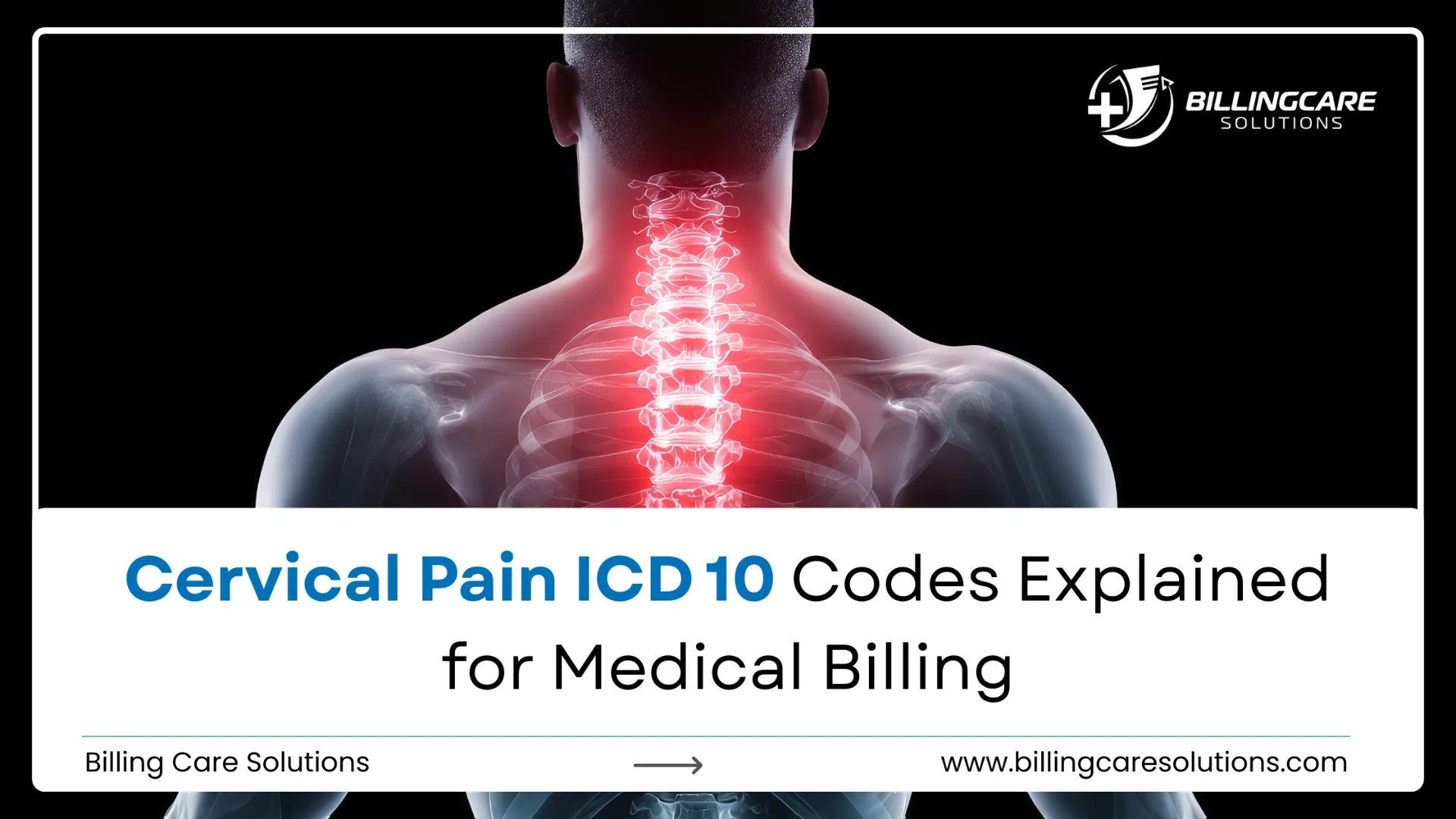
Cervical pain, also referred to as neck pain, is one of the most commonly recorded complaints due to musculoskeletal concerns. It is important for healthcare providers and medical billers to be able to identify the correct cervical pain ICD 10 codes for documentation to promote efficiency, make sure adequate reimbursement is collected, and to follow billing policy. This guide outlines the many components involved in coding cervical pain to assist in billing and coding processes, in order to promote the financial wellbeing of the practice.
Understanding Cervical Pain ICD 10 Coding
The World Health Organization, in the 10th revision of the International Statistical Classification of Diseases and Related Health Problems, offers specific coding for documentation of pain in the cervical region and disorders associated with the neck. Use of cervical pain ICD 10 codes guarantees that providers are reimbursed for the services rendered, and that the claim is processed.
Cervical pain is discomfort due to the pain that is felt in the neck, which involves the seven cervical vertebrae (C1-C7) that construct and comprise the upper part of the spine. The condition is inclusive of many diagnoses, including, but not limited to, muscle strain, poor posture, degenerative disc disease, herniated disk, arthritis, and trauma.
Primary Cervical Pain ICD 10 Codes
One primary symptom that falls within Cervical Pain ICD 10 code symptom classifications is M54.2, which falls within the scope of Cervicalgia, also referred to as neck pain. However, medical billers must take into consideration the variations of related codes that could be more applicable to the case at hand, based on the diagnosis and the clinical documentation.
Cervical Pain Main Code: M 54.2-Cervicalgia
This code is the primary coding reference for general neck pain diagnoses who do not possess further diagnoses. This is applicable for individuals who have pain within the cervical region and do not possess clear manifestations of radiculopathy, myelopathy, or any other specifics of the pathologies.
| ICD-10 Code | Description | When to Use |
|---|---|---|
| M54.2 | Cervicalgia | Use for general neck pain without a specific cause. |
| M50.20 | Other cervical disc displacement, unspecified cervical region | Use when disc displacement is present in the cervical region, but the level is not specified. |
| M50.30 | Other cervical disc degeneration, unspecified cervical region | Use for degenerative disc disease in the cervical spine when the specific level is not documented. |
| M53.0 | Cervicocranial syndrome | Use when pain affects the neck and head connection. |
| M53.1 | Cervicobrachial syndrome | Use when pain radiates from the neck to the arm. |
| M47.812 | Spondylosis without myelopathy or radiculopathy, cervical region | Use for age-related wear and tear of the cervical spine without nerve involvement. |
| M48.02 | Spinal stenosis, cervical region | Use when there is narrowing of the spinal canal in the neck. |
| M99.01 | Segmental and somatic dysfunction of cervical region | Use for biomechanical dysfunction of the neck segments. |
Specific Cervical Radiculopathy Codes
When cervical pain involves nerve root compression or radiculopathy, more specific codes should be used:
| ICD-10 Code | Description | When to Use |
|---|---|---|
| M50.10 | Cervical disc disorder with radiculopathy, unspecified cervical region | Use when a cervical disc disorder with nerve root involvement is present but the cervical level is not specified. |
| M50.11 | Cervical disc disorder with radiculopathy, high cervical region | Use when radiculopathy originates from a disc disorder in the high cervical region (C1–C2). |
| M50.12 | Cervical disc disorder with radiculopathy, mid-cervical region | Use when radiculopathy is caused by a disc disorder in the mid-cervical region (C3–C6). |
| M50.13 | Cervical disc disorder with radiculopathy, cervicothoracic region | Use when radiculopathy originates from a disc disorder in the cervicothoracic junction (C7–T1). |
Cervical Myelopathy Codes
For cases involving spinal cord compression:
| ICD-10 Code | Description | When to Use |
|---|---|---|
| M50.00 | Cervical disc disorder with myelopathy, unspecified cervical region | Use when a cervical disc disorder causes spinal cord involvement, but the cervical level is not specified. |
| M50.01 | Cervical disc disorder with myelopathy, high cervical region | Use when myelopathy originates from a disc disorder in the high cervical region (C1–C2). |
| M50.02 | Cervical disc disorder with myelopathy, mid-cervical region | Use when myelopathy is caused by a disc disorder in the mid-cervical region (C3–C6). |
| M50.03 | Cervical disc disorder with myelopathy, cervicothoracic region | Use when myelopathy originates from a disc disorder in the cervicothoracic junction (C7–T1). |
Trauma-Related Cervical Pain Codes
| ICD-10 Code | Description | When to Use |
|---|---|---|
| S13.4XXA | Sprain of ligaments of cervical spine, initial encounter | Use for the first visit or treatment of a cervical ligament sprain. |
| S13.4XXD | Sprain of ligaments of cervical spine, subsequent encounter | Use for follow-up visits or ongoing care after the initial encounter for a cervical ligament sprain. |
Coding Guidelines for Cervical Pain ICD 10
To ensure the likelihood of claims not being rejected and ensuring that bills being generated of cervical pain ICD 10 codes reflect the intended documentation, it is crucial to take into consideration the following guidelines.
1. Use the Most Specific Code Available
Selecting the correct Cervical Pain ICD 10 code requires more than defaulting to M54.2. Billers must verify whether documentation supports a more precise diagnosis, such as cervical radiculopathy (M54.12) or disc disorder (M50.10). General codes increase denial risk. Specificity ensures accurate reimbursement, supports medical necessity, and reflects the physician’s clinical findings without overstating or undercoding the condition.
2. Ensure Clinical Documentation Supports the Code Selected
The selection of Cervical Pain ICD 10 codes must be substantiated. The medical record should state:
- Pain location (cervical area)
- How long the symptoms have been present
- What symptoms are present, and are they associated? (radiculopathy, and related symptoms, stiffness, restricted motion)
- What was the cause if it is known? (e.g., trauma, degeneration, and related symptoms, strain)
- What treatments were done prior and was the treatment effective?
3. Apply Laterality and Seventh Characters When Required
The Cervical Pain ICD 10 include many codes that need to have a laterality (right, left, or bilateral) or seventh character to specify encounter type. These details are often missing from claims, which is a frequent cause for claim denials. For expample, cervical disc disorders are required to be described both in terms of level and side when present, in order to provide accurate radiculopathy. Always compare with the documentation by the physician to ensure that the code is correct for lateral and encounter status prior to finalizing the code.
4. Code All Documented Comorbidities Separately
In a diagnosis of cervical pain, the presence of other conditions such as cervical radiculopathy or cervical disc disease should be coded separately. Rarely a single Cervical Pain ICD 10 code provides a complete clinical picture. For instance, the diagnosis of cervicalgia, M54.2, does not include nerve root involvement. When documented, you need to also record M54.12 for radiculopathy. Using separate coding to ensure accurate reimbursement, minimize denials, and accurately reflect patient complexity for Cervical Pain ICD 10 claims.
5. Trauma Encounter Type (A, D, S)
For cervical trauma related pain, the seventh character extension is mandatory, along with the associated type of encounter:
A: Initially encountered
D: Encountered subsequently
S: Sequela
Common Billing Cervical Pain ICD 10 Errors to Avoid
It is important that medical billers must be cautious when using the Cervical Pain ICD 10 code as there are certain mistakes that should be avoided.
- Obscure Codes: If the medical record mentions the details of the cervical diagnosis and has not been coded to reflect the specificity of the documentation (M54.2) which is the general cervicalgia code, they will end up with the medical request clarifications, or denials based on this error.
- Improper Order: The primary diagnosis is to be followed by the secondary diagnoses. If cervical pain is the primary reason for the visit, then the diagnosis is to be cervical pain.
- Absent Added Character: The medical billers will have to be instructed that as far as the codes go, there are some that will need the seventh character added. This will be reason enough to deny a claim.
- Unsupported Clinical Documentation: The documentation that is in the physician’s notes has to support the code that is selected. If they go beyond documentation, that is considered upcoding, and it has audit consequences.
Common CPT Codes Used With Cervical Pain ICD 10
Cervical pain ICD 10 coding often supports evaluation, imaging, therapy, and interventional procedures. The CPT code depends on the service performed and documented by the provider.
| CPT Code | Service | Common Use With Cervical Pain |
|---|---|---|
| 99202-99205 | New patient E/M | Initial evaluation of cervical pain |
| 99211-99215 | Established patient E/M | Follow-up evaluation and management |
| 72040 | Cervical spine X-ray | Evaluation of cervical spine pain |
| 72125 | CT cervical spine, without contrast | Evaluation of suspected cervical pathology |
| 72126 | CT cervical spine, with contrast | Further evaluation of documented conditions |
| 72141 | MRI cervical spine, without contrast | Evaluation of disc, stenosis, or nerve-related conditions |
| 97110 | Therapeutic exercises | Treatment of cervical mobility and strength |
| 97140 | Manual therapy techniques | Soft tissue and joint treatment |
The diagnosis code should back up the medical purpose for each service. For instance, cervicalgia is coded as M54.2 and cervical radiculopathy is coded as M54.12. Avoid diagnosing a cervical pain diagnosis just because it is listed on the claim. Look at the provider’s assessment, treatment plan, imaging results and documented symptoms first. Payer policies also differ for imaging, therapy, and spinal injections. Verify coverage requirements, medical necessity criteria, authorization rules, and documentation requirements before submitting the claim.
Best Practices for Accurate Cervical Pain ICD 10 Coding
Billing practices can be improved when Cervical Pain ICD 10 codes are selected with precision and supported by complete clinical documentation.
- Ongoing Education: The ICD-10 codes and their modifications as well as their associated guidelines can be taught to the medical billing/ coding staff on a periodic basis to help them learn the modifications to the codes.
- Clinical Documentation Improvement (CDI): Documentation should be complete, and accurate, and support the codes that are chosen. If the code contains the associated diagnosis, then the documentation needs to be improved.
- Use of Coding Resources: Make use of the official coding manuals like the ICD-10-CM, coding software, and the guidelines from the professional associations.
- Pre-Claim Review: Establish a process to review claims prior to submission to identify possible errors or omissions.
- Denial Management: Monitor claim denials pertaining to coding for cervical pain to recognize trends and take corrective action.
Staying Current with Cervical Pain ICD 10 Updates
The Cervical Pain ICD 10 code set is revised annually and the changes normally become effective on October 1st every year. Medical billing specialists are expected to remain aware of:
- New codes added to the system
- Codes that were deleted or terminated
- Revised code descriptions
- Changed coding guidelines
By subscribing to updates provided by the Centers for Medicare and Medicaid Services (CMS) and the American Medical Association (AMA), you will be able to make sure that your practice is up to date with all Cervical Pain ICD 10 coding requirements.
Why Choose Billing Care Solutions for Cervical Pain ICD-10 Coding?
Correctly coding for cervical pain directly affects your practice’s revenue and compliance. Billing Care Solutions also has the expertise to navigate the details of cervical pain ICD 10 coding and documentation to ensure that each claim is as detailed as possible. Our experts don’t miss a beat, ranging from assigning the correct laterality, seventh characters and encounter types (A, D, S).
We know that claims are denied due to ambiguous or mis-matched codes. That is why we collaborate closely with your clinical staff to meet the gap between the physician documentation and billing requirements. We conduct regular audits, denial analysis and provider education specifically for cervical spine conditions.
You will minimize claim denials, speed up reimbursements, and ensure complete compliance with each payer’s guidelines by selecting Billing Care Solutions. Let us take the hassle out of Cervical Pain ICD 10 coding, so you can focus on what really matters: Your patients and your practice’s financial health.
Conclusion
Mastering Cervical Pain ICD 10 coding reduces denials. It also ensures proper reimbursement for your practice. Select specific codes like M54.12 over general M54.2. Apply laterality, seventh characters, and encounter types correctly. Vague documentation and incorrect codes cause revenue loss. Follow guidelines for specificity and supporting documentation.
Use multiple coding and trauma encounter types properly. Your practice can submit cleaner claims with confidence. Partner with Billing Care Solutions to strengthen revenue cycles. Accurate coding is not just about compliance. It is the foundation of a financially healthy practice. Prioritize precision and train your billing staff well. Watch your claim denials decline significantly over time.
Frequently Asked Questions
