


Patient Eligibility Verification: A Step-by-Step Guide to Eliminating Front-End Denials
Explore patient eligibility verification strategies for confirming coverage, benefits, payer details, and authorization requirements before services.
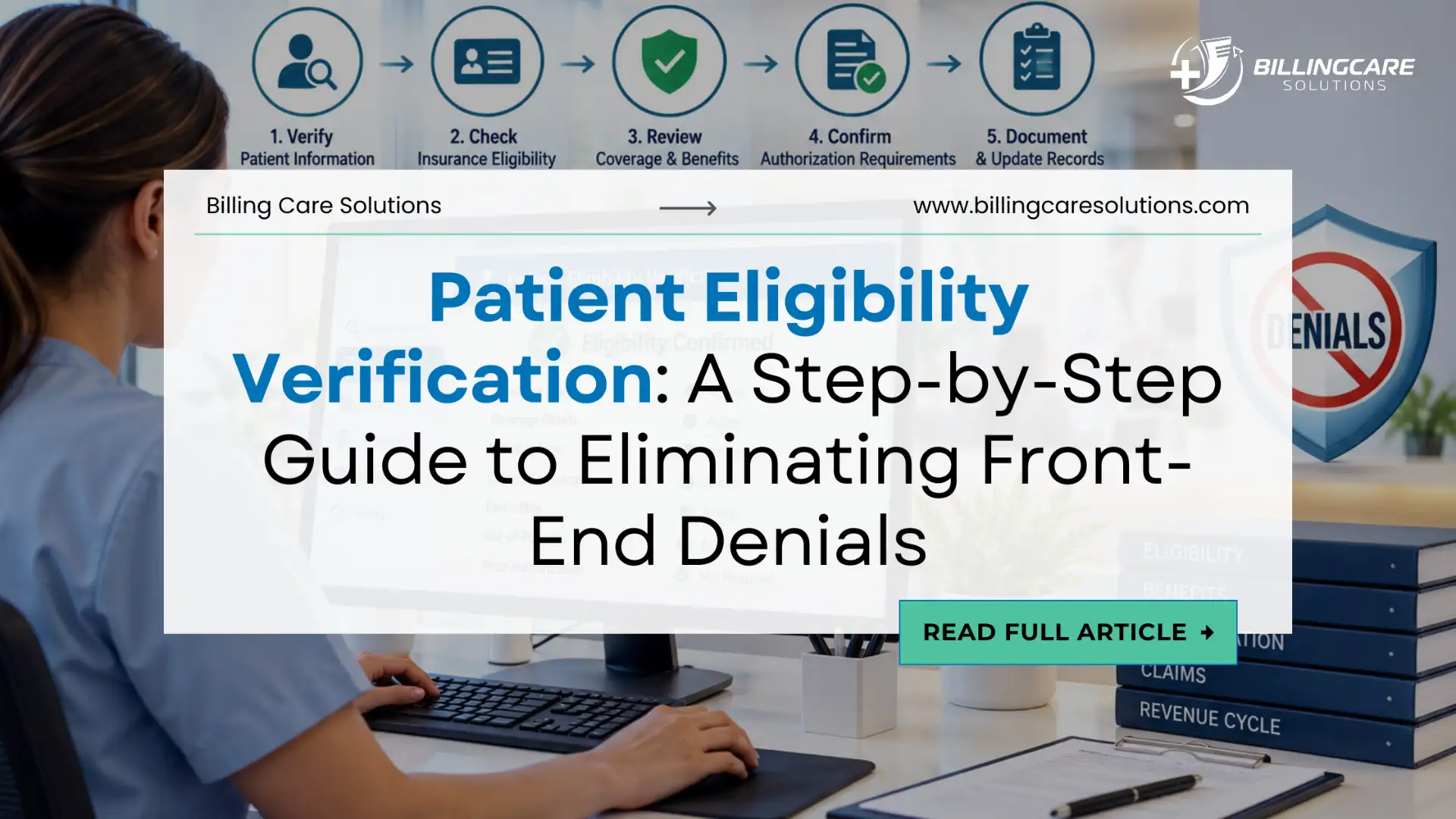
Patient eligibility verification is a key first step in the revenue cycle, but it impacts the bottom line when it comes to claims submission, payment and A/R management. Claims are introduced into the billing process with issues already in place if they don’t have details or are not accurate.
The planned service may need authorization even if the patient has active insurance. A second patient may have had other plans but not notified the practice. Invalid subscriber data, lack of coverage, benefit restrictions, and payer mismatches are also preventable “front-end” denials.
Healthcare decision makers don’t just need to find out if a patient is covered by insurance. The aim is to create a secure front-end control that detects financial and coverage threats prior to providing services. By implementing a systematic patient eligibility verification procedure, the business can reduce preventable claim denials, increase clean claims and minimize unnecessary staff rework.
Where Eligibility Errors Enter the Revenue Cycle
There are hardly any problems with patient eligibility verification that start and stop at one source. These typically occur when information is transferred from scheduling to registration, from the clinical team to the billing team, and between the billing team and the payers.
Scheduling and Registration
The initial risk is when staff gather insurance information. Patients may bring in an outdated insurance card, input a wrong member ID number or report coverage without verifying the current plan. Registration mistakes are also of concern to information of subscribers. If one of the patient’s details (such as name, date of birth, relationship to the subscriber, and so on) does not match, the payer might not be able to match the claim properly. These challenges can increase the cost when employees take wrong information into the rest of the revenue cycle.
Eligibility Checks Before the Encounter
Coverage changes over time. Patient plans may end, modify or become second plans between visits. A verification completed months earlier does not establish coverage for today’s encounter. Practices need a process based on the date of service and the specific service being provided. Healthcare organizations also need to distinguish active coverage from usable benefits. A payer response showing active coverage does not automatically confirm coverage for every procedure, treatment, or visit.
Claim Submission
The billing team can see eligibility issues when the claim is submitted to the payer. The payer may deny or reject the claim if the member ID is incorrect, coverage was either suspended or inactive, the wrong payer was billed or the claim was submitted for a service that does not meet requirements for coverage. Staff need to take some time to research an issue that they may have identified earlier before the appointment. Delayed reimbursement, and added A/R work are also issues with the practice.
What Patient Eligibility Verification Should Confirm
Patient eligibility verification is more than just a question of whether an insurance plan is in effect. Staff should have sufficient information to ascertain that the service planned has a reasonable chance of reimbursement.
A complete verification should address:
- Active coverage on the date of service
- Member identification number
- Subscriber information
- Payer and plan details
- Effective and termination dates
- Copay requirements
- Coinsurance requirements
- Deductible status
- Out-of-pocket responsibility
- Benefit limitations
- Covered services
- In-network or out-of-network status
- Referral requirements
- Prior authorization requirements
- Coordination of benefits
- Medicare secondary payer information when applicable
Specific information needed will vary based on the payer, service, specialty and patient’s coverage. Leadership’s most important challenge is consistency. Each verification should be against a set standard rather than on staff judgement.
Step-by-Step Patient Eligibility Verification Workflow
A standardized patient eligibility verification process minimizes inconsistencies between employees and aids leadership in detecting patient front-end issues.
Step 1: Capture Complete Insurance Information
Start with accurate patient and insurance information. Staff should review the patient’s insurance card and confirm the information entered into the practice management system. They should also verify subscriber details when the patient is covered under another person’s plan.
Important data includes:
- Patient name
- Date of birth
- Insurance payer
- Member ID
- Group number
- Subscriber name
- Subscriber relationship
- Policy information
- Secondary insurance information
Incomplete information creates problems before the eligibility transaction even begins.
Step 2: Run Real-Time Eligibility Verification
Use available electronic eligibility transactions, payer portals, or integrated RCM and practice management systems to verify current coverage. The verification should correspond to the patient’s upcoming date of service. For recurring appointments, practices should establish a reverification schedule rather than treating one successful check as permanent confirmation. Automation becomes useful when appointment volume makes manual verification difficult. It helps staff process larger patient volumes while directing exceptions to human review.
Step 3: Match Patient and Subscriber Data
Compare the payer response against the information stored in the practice system.
Look for differences involving:
- Patient name
- Date of birth
- Member ID
- Subscriber name
- Relationship to subscriber
- Group number
- Payer information
Do not ignore small discrepancies. A minor registration error can prevent the payer from matching the patient to active coverage. Resolving the mismatch before the encounter is usually easier than correcting a denied claim later.
Step 4: Confirm Benefits for the Planned Service
Active coverage does not equal guaranteed payment. Review the patient’s benefits in relation to the planned service. A payer might show active coverage while applying different rules to specialist visits, imaging, procedures, therapy, behavioral health services, infusion treatments, or other healthcare services. Staff should determine applicable deductibles, copayments, coinsurance, benefit limits, coverage restrictions etc. This step can help make coverage status and service-level reimbursement risk an issue apart from the practice.
Step 5: Check Authorization and Referral Requirements
Eligibility and authorization are related, but they are not the same process. A patient might have active coverage while the planned service requires prior authorization. Some plans also require referrals before specific specialist services. The verification process should therefore identify authorization and referral requirements early enough for staff to complete the necessary steps. This is especially important for high-cost services and procedures where a single authorization failure can create substantial financial exposure.
Step 6: Identify Patient Financial Responsibility
Eligibility data also helps to ensure accurate financial estimates for patients. Check the patient’s deductible status, copayment, coinsurance and any other applicable out-of-pocket information. Staff should be aware that estimates need to be explained carefully as not all payers mean to pay. Accurate front-end information helps reduce unexpected balances after insurance processes the claim. It also gives the practice an opportunity to address financial responsibility before the encounter instead of waiting until after billing.
Step 7: Document the Verification Result
A verification without documentation creates a weak audit trail. Record the verification date, payer response, relevant benefit information, authorization details, reference numbers when available, and any exceptions identified during the process. Documentation gives billing teams evidence of what was reviewed and when. It also helps supervisors investigate recurring eligibility problems.
Step 8: Reverify When Coverage Information Changes
Patient eligibility verification should become an ongoing process for patients with recurring services or changing coverage.
Reverification becomes important when:
- The patient reports a new insurance plan.
- The insurance card changes.
- The payer indicates coverage changes.
- The patient has recurring appointments.
- The service changes.
- An authorization period expires.
- A previous claim indicates an eligibility problem.
The right reverification frequency is dependent on the practice, payer mix, patient population, and type of service.
How Patient Eligibility Verification Prevents Front-End Denials
Patient eligibility verification will help to avoid claim denials by catching issues before claims reach the payer’s adjudication process.
Common front-end denial scenarios include:
- Coverage terminated before date of service
- Member not found
- Invalid member ID
- Wrong payer submitted
- Subscriber information mismatch
- Non-covered service
- Out-of-network benefit limitations
- Missing referral
- Missing prior authorization
- Secondary coverage not identified
The financial value comes from moving these issues upstream. Once a claim has denied, the practice has already incurred the cost of registration, clinical care, claim preparation, submission, and follow-up.
Patient Eligibility Verification for High-Risk Services
Not every encounter carries the same financial risk. A low-cost office visit and a high-cost procedure should not receive identical front-end scrutiny. Healthcare leaders should align verification controls with the financial exposure and payer requirements associated with each service.
High-risk areas often include:
- Infusion services
- Outpatient surgery
- Advanced imaging
- Specialty procedures
- Behavioral health services
- Recurring therapy
- High-cost medications
- Complex specialty care
For these services, patient eligibility verification should connect with benefit review and authorization workflows.
For example, confirming active insurance does not answer whether a high-cost medication requires authorization. It also does not establish whether the patient’s benefit applies to the medication, administration, site of service, or specific treatment setting. A risk-based process gives staff more time to investigate encounters where an eligibility error would create a larger financial loss.
How to Build an Eligibility Verification Exception Process
A strong verification process needs a defined response when coverage problems appear. Staff should not leave exceptions in an unassigned work queue. Each issue should have an owner, resolution step, and documented outcome.
A practical exception process includes:
- Identify the eligibility problem.
- Classify the issue by type and financial risk.
- Assign the exception to the appropriate team member.
- Contact the payer or patient when additional information is required.
- Update the registration record.
- Complete authorization or referral requirements when applicable.
- Document the resolution.
- Reverify the coverage when necessary.
- Escalate unresolved high-risk cases.
Leadership should also review exception patterns. If the same payer repeatedly produces member ID problems, registration workflows might need adjustment. If authorization exceptions remain high, the practice might need stronger scheduling controls.
Manual vs Automated Patient Eligibility Verification
Manual patient eligibility verification is suitable for lower volumes but as the number of appointments increases, staff becomes a limiting factor. Automation isn’t being used to replace employees. There are still situations where exceptions must be judged, communicated with payers, documented and followed up.
| Factor | Manual Process | Automated Process |
|---|---|---|
| Verification volume | Limited by staff capacity | Supports larger patient volumes |
| Timing | Depends on staff workflow | Supports scheduled or batch checks |
| Data entry | Higher manual exposure | Reduces repetitive entry |
| Exception handling | Staff review required | Rules can flag exceptions |
| Reporting | Often spreadsheet-based | Centralized reporting |
| Scalability | Requires additional labor | Handles volume more efficiently |
Automation does not remove the need for staff. Exceptions still require judgment, payer communication, documentation, and follow-up. The strongest approach uses technology for repetitive verification and staff for cases requiring investigation.
How Healthcare Leaders Should Measure Eligibility Performance
Healthcare leaders need measurable indicators to determine whether front-end controls are working.
Useful metrics include:
- Eligibility verification completion rate
- Eligibility-related denial rate
- Front-end denial rate
- Percentage of patients verified before service
- Verification exception rate
- Registration error rate
- Authorization-related denial rate
- Patient responsibility accuracy
- Preventable denial dollars
- Staff hours spent resolving eligibility issues
These metrics should be reviewed together.
For example, a high verification completion rate does not prove the process works if eligibility-related denials remain high. Likewise, a declining denial rate might hide rising financial exposure if the practice has shifted toward higher-value services. Leadership should connect operational metrics with dollars and staff workload.
Patient Eligibility Verification KPIs That Reveal Revenue Leakage
Patient eligibility verification KPIs help healthcare decision makers determine whether eligibility controls are preventing financial leakage.
| KPI | What It Shows | Why Leadership Should Track It |
|---|---|---|
| Pre-service verification rate | Percentage of encounters verified before service | Measures process compliance |
| Eligibility denial rate | Claims denied because of coverage issues | Shows front-end billing risk |
| Exception resolution rate | Issues resolved before the encounter | Measures follow-through |
| Eligibility-related A/R | Unpaid claims linked to eligibility problems | Shows financial exposure |
| Preventable denial dollars | Revenue delayed or lost from avoidable errors | Quantifies the business impact |
The best measure is volume, dollars and resolution time.
Leadership should be different when 200 eligibility related denials yield $20,000 in exposure versus $200,000. Financial impact tracking also supports investments in automation, staffing, training and outsourced RCM support.
How Billing Care Solutions Strengthens Front-End Revenue Controls
Billing Care Solutions provides a comprehensive revenue cycle management framework for healthcare organizations, assisting with patient eligibility. Billing Care Solutions also allows for connected front end and back end workflows. This is important because eligibility issues frequently intersect with authorization, registration, coding, claim submission, payment posting and denial management. A better RCM process provides healthcare leaders with a more comprehensive view of where revenue leakage begins rather than after it is known from claims denials. A stronger RCM process gives healthcare leaders visibility into where revenue leakage starts instead of measuring the problem only after claims are denied.
Key areas of support include:
- Patient eligibility verification
- Insurance coverage validation
- Payer-specific verification workflows
- Authorization coordination
- Exception identification
- Verification documentation
- Front-end denial prevention
- RCM reporting
- A/R and denial management
The objective is to move revenue cycle intervention closer to the point where errors originate.
A Practical Patient Eligibility Verification Checklist
Use this patient eligibility verification checklist to standardize your front-end process:
- Confirm patient demographics.
- Review current insurance information.
- Verify active coverage for the date of service.
- Match patient information with payer records.
- Confirm subscriber details.
- Confirm member and group numbers.
- Review deductible and copayment information.
- Check coinsurance requirements.
- Confirm applicable benefits.
- Review network status.
- Check referral requirements.
- Check prior authorization requirements.
- Review coordination of benefits.
- Document the verification response.
- Resolve exceptions before service when possible.
- Reverify coverage when circumstances change.
A checklist creates consistency, but leadership should also audit whether staff complete each step accurately.
Final Takeaway: Make Patient eligibility verification a Front-End Revenue Control
Patient Eligibility Verification impacts beyond registration accuracy. It impacts upon claim acceptance, claim denial numbers, A/R, patient collections, staff workload, etc. Healthcare organizations must have a clear workflow for collecting insurance details, confirming coverage, checking benefits, checking for authorizations, recording coverage results and handling exceptions.
The strongest front-end process also measures financial outcomes. Tracking eligibility-related denials, preventable denial dollars, verification completion, and exception resolution gives leadership a clearer view of revenue leakage. When patient eligibility verification becomes a controlled part of the revenue cycle, practices address coverage problems before they become billing problems. Billing Care Solutions supports this approach by connecting front-end verification with broader RCM operations and financial performance management.
