

Is Your Coding Compliance Process Putting Reimbursements at Risk? Warning Signs Medical Practices Shouldn't Ignore
Discover critical coding compliance warning signs, prevent costly errors, strengthen documentation, and protect reimbursements with more reliable workflows.
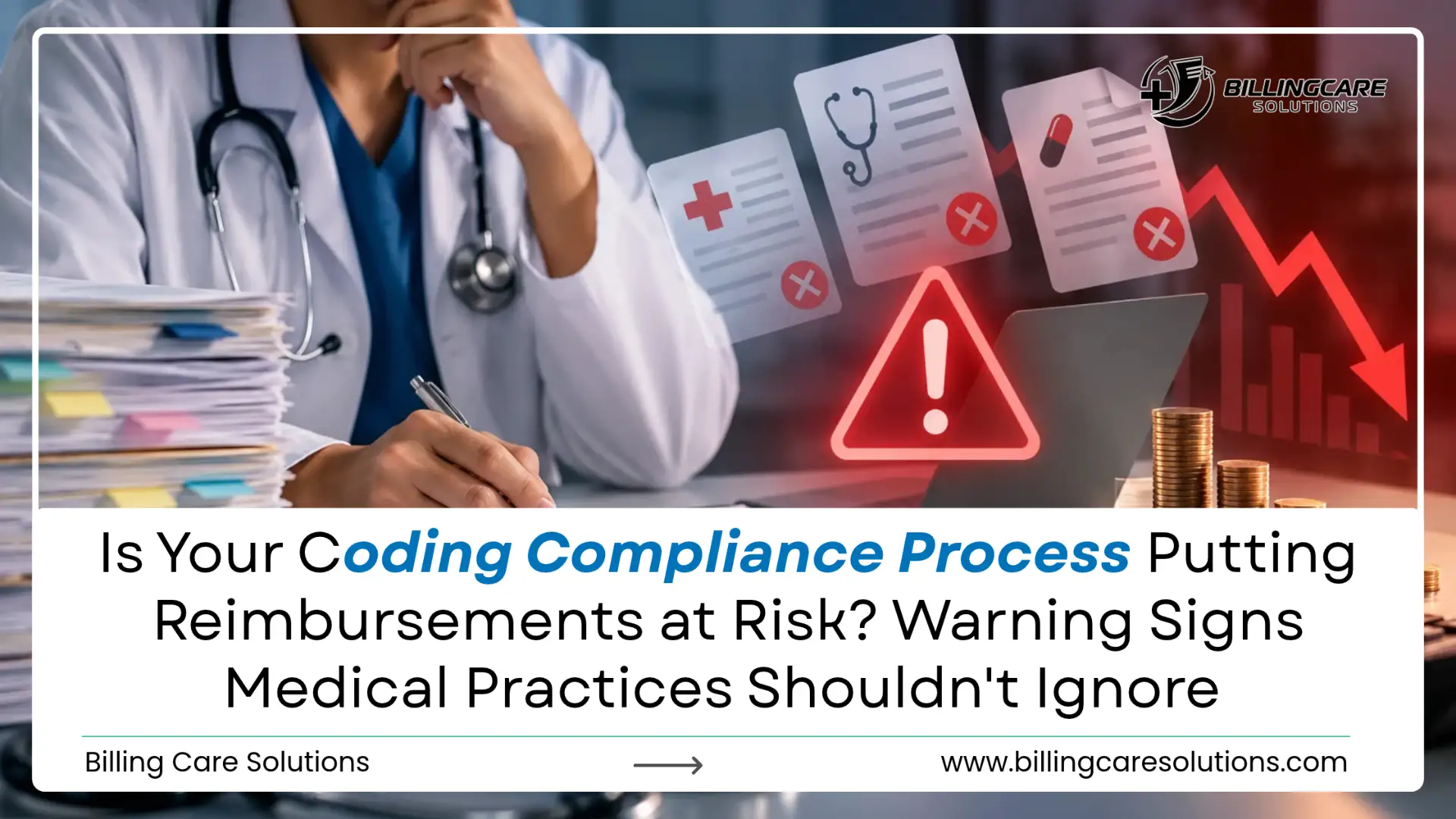
There may be more than one error in any given claim. However, the flow of money can be disrupted in a medical practice when medical staff cannot attach codes to the paperwork, enter the wrong code, doesn’t include modifiers or just doesn’t pay the proper attention to coding changes. Medical Coding Compliance empowers practices to recognize these problems; enhances the accuracy of their claims; and will help to minimize unnecessary billing issues before they impact on collections.
There are many who just do whether claims get paid or not, with no attention paid to verification or accuracy of submitted codes. Do not assume correct coding only due to a paid claim. Documentation, coding guidelines, Payer policies and claim review procedures are constantly a focus of strong Medical Coding Compliance.
Some errors may only be discovered when the medical record is reviewed by the payer, a post-payment audit is performed, or there is a billing trend the payer wants to investigate. Coding accuracy monitoring can detect issues at an earlier stage and enable appropriate decisions on correcting problems. A specifically designed Medical Coding Compliance process also enables teams to recognize exceptional errors from repeat process challenges.
Billing Care Solutions can support medical practices to enhance claim review processes, identify recurring billing issues, and develop better revenue cycle operations. Understanding the below warning signs could enable practice leaders to take an evaluation of their present Medical Coding Compliance processes and know where enhancements might be necessary.
7 Warning Signs Your Coding Compliance Process Needs Attention
These warning signs are all presentable issues that practices are able to spot during reviews of claims, documentation reviews, denial reports, and through the billing system checks.
| Warning Sign | Operational Impact | Financial Impact |
|---|---|---|
| Repeated denials for the same coding errors | Staff repeatedly correct and resubmit claims without fixing the underlying issue. | Delayed payments, additional rework costs, and possible lost revenue. |
| E/M codes exceed documentation support | Coders request clarifications and spend more time reviewing provider notes. | Payment reductions, denials, and potential repayment obligations. |
| Modifier 25 or 59 is used without sufficient support | Billing teams investigate whether services qualify for separate reporting. | Denials, incorrect payments, and potential audit findings. |
| NCCI edits are overridden without proper review | Staff bypass coding edits without confirming whether services can be reported together. | Claim adjustments, overpayments, and compliance-related costs. |
| Billed units exceed documented quantities | Teams investigate discrepancies between records, units, and submitted claims. | Reduced reimbursement, denials, and possible overpayment recovery. |
| Diagnosis codes do not match clinical documentation | Coders correct unsupported diagnoses and review medical necessity requirements. | Medical necessity denials, delayed payments, and potential repayment demands. |
| The same coding errors return after audits | Staff repeat corrective work because underlying process problems remain unresolved. | Recurring revenue disruption and continued compliance exposure. |
One error doesn’t necessarily mean compliance was lacking. Patterns to investigate, however, as they can reference some lack of training, in-process documentation, or claim edits that went askew or a lack of an internal review. Effective Medical Coding Compliance allows practices to determine whether these trends are due to individual errors or deeper problems and serves as a primer for any problems to come down the road.
How Medical Coding Errors Affect Practice Revenue
There are various ways coding mistakes can impact earnings. Some result in on-the-spot denials, others only show up when a check is done at a later date. The impact is financial, driven by the error, payment provider preference, volume of claims impacted, and whether or not the payment provider corrects the error.
| Compliance Problem | Possible Financial Consequence | What Management Should Monitor |
|---|---|---|
| Repeated coding denials | Delayed payments and additional claim handling costs | Denial reasons, correction volume, and days in accounts receivable |
| Unsupported E/M levels | Payment adjustments or potential repayment obligations | E/M audit findings and documentation support |
| Incorrect modifier use | Denials, recoupments, or claim rework | Modifier-related denials and audit results |
| Improper NCCI edit overrides | Incorrect payments or repayment exposure | Edit overrides and supporting documentation |
| Incorrect units of service | Underpayments, overpayments, or denied claims | Unit corrections, billed quantities, and payment differences |
| Unsupported diagnosis coding | Medical necessity denials and delayed reimbursement | Diagnosis-related denials and documentation gaps |
| Repeated audit findings | Recurring correction costs and ongoing compliance exposure | Repeat findings and corrective-action completion |
Not all coding mistakes result in a financial loss. Some errors impact payments, whereas others mainly heighten administrative workload or compliance risk. By using actual claims, payer responses and audit findings to gauge the financial impact and plan for Medical Coding Compliance improvements, management becomes aware of the situation.
How to Strengthen Your Medical Coding Compliance Process
The process starts with coding review then continues to claim submission, denial management and audit follow-up, and it works well. Practices should place clear controls in place to identify problems in a timely manner and assist in fixing the root cause of issues. Strong Medical Coding Compliance can’t just be reviewed and become cumbersome, it should be a consistent procedure.
1. Review Claims Before Submission
Claim scrubbing workflows can root out missing claims data, incompatible combinations of codes and other billing problems before claims are sent to the payer. But automated editing can’t stand in for a review of clinical documentation or professional coding expertise. Practices should change claim edits to align with their specialties, payer needs and to address typical claim errors. Unusual combinations of claims, modifiers that are missing or units that are unclear may require further review prior to submission.
It should be recorded too how flagged claims are resolved by staff. This helps Medical Coding Compliance because when a Medical Coding bookmark is applied and the edit is working correctly, it won’t occur again, if it does occur again, the problem will come up. Seeing some of the edits that still need to be resolved also offers insights into the strengths and weaknesses of the existing billing system settings.
2. Audit High-Risk Coding Areas
An effective coding compliance audit plan should include the services provided by the practice, the payer mix, a review of historical denials of claims for the practice and identified risks. Shortcut reviews will not uncover any issues with specific providers, procedures, modifiers or billing location. For instance, if someone is having modifiers denied repeatedly on the same codes they should review the modifier/denial category codes and supporting documentation. A practice should audit documentation and guidelines for code documentation with regard to applicable guidelines in a practice with E/M audit findings.
When auditing, both over coding and under coding should be checked. The aim is to get things right, not to dim-down or to escape accountability. Documented problems are targeted during audits eliminating the need for assuming anything, making Medical Coding Compliance more manageable. Successful practices should also document outcomes, impacted services and follow-up corrective actions. Providing this makes it easy to track the issue and educates management about Medical Coding Compliance changes that will mitigate repeat errors.
3. Separate Coding Errors From Payer Policy Issues
All denied claims are not due to coding errors. Coverage may be correct, but subject to coverage restrictions, authorization, eligibility, or payment/billing requirements for the particular payer involved. Prior to changing codes, teams should find out what is the real cause of denial. Otherwise, the unhelpful corrections by staff can be unnecessary and don’t really correct the problem. This difference is significant to Medical Coding Compliance since coding change will not resolve an unrelated authorization or coverage issue.
A service, for instance, can be correctly coded, but denied due to lack of authorization. A change in diagnosis/procedure coding would not correct that issue. The practice needs to cover the authorisation mechanism, and determine if the claim may be re-submitted in accordance with the claims rules of the payer. Deny categories help coding and billing teams to channel problems to an appropriate team. They also stop the users from using coding changes to address different management issues.
4. Improve Documentation and Provider Communication
Good documentation is essential as it supports services reported accurately. Then the coding should be done with caution, if the record is not yet complete or it is ambiguous. Practices should refer to an appropriate provider query process for clarification where needed. Questions must be documentary, non-judgmental and query what is missing. They should never suggest a diagnosis or code when that might be advantageous for reimbursement.
Issues identified in audits should be discussed during training. Decision-making documentation may require support from the provider and billing staff may require retraining on modifier requirements and/or units of service. By training the teams with consistent education, Medical Coding Compliance is supported, so they will be able to understand the needs and requirements of the correct code selection.
Training to address practices inability to review the effectiveness of the training on the basis of a follow-up audit instead of assuming that a completed session has ‘solved the problem’. This provides a real-time indicator for management to determine if Medical Coding Compliance education has resulted in changes in billing behavior.
5. Track Corrective Actions and Repeat Findings
All compliance issues that have been identified at a significant level must have a documented response. This can range from target staff training, targeted claim edits or local communication to other reviewing professionals of service levels, documentation requirements or more detailed review of specific service levels. There should be an owner for every action and the date of completion should be clearly specified. Then, a new set of a claims sample should be used to check if it has been corrected.
Some helpful metrics are repeat audit results, coding denials, modifier corrections, unit discrepancies, and unaddressed compliance issues. These measures allow practices to assess if the Medical Coding Compliance initiatives are driving and sustaining ROI.
A repeat of the same error requires re-thinking the course of corrective action. The responsibilities may still be confused, edits in the systems may not work, or review processes may vary, so more training and development won’t necessarily fix issues.
6. Establish Clear Reporting for Leadership
Practice owners and financial leaders need more than the blurb that it is reviewed. They require scrutiny of the persistent code issues and what steps are being taken to fix them. Groups of population reports can be helpful, such as denial patterns by coder; Audit results; repeat denials; not completed denials; failed corrective action, repeat; and Financial loss on associated claims. The report should highlight any confirmed losses, delayed payments, and/or any potential exposure.
Regular reporting assists leadership to make allocation of resources. Management can decide that instead of addressing claims individually, a better process review takes precedence if an issue is plaguing multiple providers or locations. Clear reporting also makes Medical Coding Compliance easier to manage as leaders can align results with specific actions that can be measured.
Medical Coding Compliance Areas That Require Ongoing Review
The requirements for coding are dependent upon service, code set, payer and applicable policy. Practices should have a review process that takes these differences into consideration rather than using a generic checklist. The Coding areas that are most applicable to the services that are provided should be reviewed consistently under the Medical Coding Compliance review.
| Review Area | What the Practice Should Verify |
|---|---|
| CPT coding | The reported service matches the documentation and applicable code requirements. |
| ICD-10-CM coding | Diagnoses accurately reflect the record and follow current coding guidelines. |
| HCPCS Level II | Supplies, drugs, and other applicable services use the correct code and billing unit. |
| Modifiers | Each modifier is supported by the circumstances of the service and applicable rules. |
| NCCI edits | Code combinations and any permitted exceptions receive appropriate review. |
| Medical necessity | Documentation and diagnoses meet relevant coverage requirements. |
| Payer policies | Claims follow applicable billing instructions, coverage rules, and documentation requirements. |
Both practices should refer to up-to-date official coding resources and payer guidance when considering these areas. Each commercial claim has its own specific Medicare policy that may differ from vendor to vendor, teams should check the policy for each claim. This way, Medical Coding Compliance remains consistent with the regulations which underpin that services being billed.
When Should Your Practice Seek External Coding Compliance Support?
When in-house staff is swamped with claim volume, the same types of errors persist and management doesn’t have the time to get to the bottom of complicated coding patterns, external help could be warranted. An independent assessment can also be advantageous to practices in situations where it is not clear why repeated denials happen through internal audits.
A content outside examiner might discover shortfalls in claim scrubbing, modifier documentation, documentation auditing, claim tracking of denials, or audit follow-up. It is hard to identify these issues when work is directed toward processing claims on a daily basis. A Medical Coding Compliance Assessment can serve as a good guide for leadership to identify areas that require more security for Medical Coding Compliance.
Practices should first check the range and level of support provided before choosing a learning partner. Inquire if the provider has access to workflows for coding, denoted workflows, application of claim edits, meaningful reporting, and tracking of corrective action.
The practice will also need to include standardisation looking at how the findings are captured and shared. Establishing responsibilities promotes action on audit recommendations instead of a report sitting in a folder or on a desk. External support should reinforce in-house oversight rather than take on the responsibility of the correctness of coding and documentation in the practice.
Strengthen Medical Coding Compliance With Billing Care Solutions
Reoccurring coding errors can take up staff time, delay reimbursement and lead to unnecessary compliance issues. A healthcare professional’s practice should be fully aware of the root cause of their issues as well as the processes that are not working well. The goal of Medical Coding Compliance is to ensure that claims are accurate, appropriately reimbursed, and the revenue cycle more reliable.
Billing Care Solutions provides medical practices with a wide range of medical billing and coding claim review services, state of the art claim scrubbing, denial follow-up services along with financial reporting services. There is a dedicated account manager involved in continuous communications regarding the accounting performance and operating issues.
Our team is ready and able to assist practices with frequent claim issues, patterns of claims being denied, and create more awareness of the revenue cycle performance. This may vary according to the specialties, policies, processes and challenges within the practice. The reviews provide information that enables practices to identify opportunities to improve Medical Coding Compliance without arbitrary changes to the coding, and general billing procedures.
If claims are being reworked over and over from your team or if you are not identifying the root cause of denials, it may be helpful to take a better look at how your team currently is processing these claims. A Medical Coding Compliance workflow analysis process can provide insight into potential areas of claim review, documentation review and follow-up for gaps.
If you have some billing problems and want to see how you can do better to increase claim accuracy, streamline work and receive the maximum reimbursement. Give Billing Care Solutions a call today for a consultation.
Final Thoughts
Just creating claims that pass basic billing edits is not enough for Medical Coding Compliance. Practices are required to assure the following: Reporting codes, modifiers, units and diagnoses must be backed by documentation, and meet applicable coding and payer requirements for reporting.
Through appropriate review procedures, audit focuses, records and follow-up practices can ensure practices are able to identify problems at an early stage before they become a recurring operational problem. Leadership reporting also helps practices to get an understanding of what factors are affecting reimbursement, and where changes need to be implemented. This allows Medical Coding Compliance to be consistent, and allows practice managers to have a more focused way to measure code accuracy, track common occurrence of coding errors, and assess if the corrective measures are effective.
Billing Care Solutions can help review billing processes, identify claim problems and areas of recurring problems, and give greater visibility into the performance of your revenue cycle if your in-house team is over-extended.
