

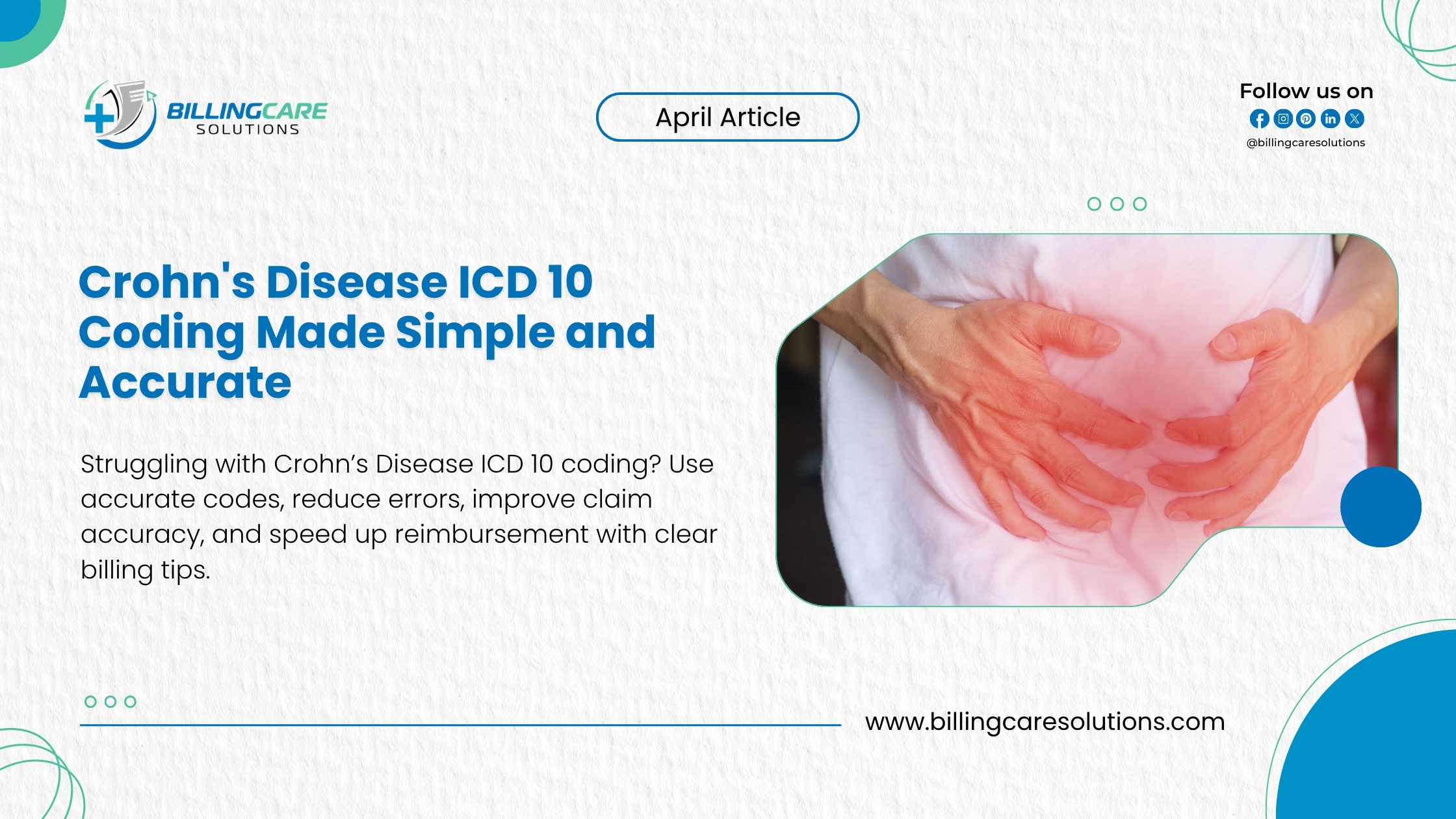
Crohn's Disease ICD 10 Coding Made Simple and Accurate
Struggling with Crohn’s Disease ICD 10 coding? Use accurate codes, reduce errors, improve claim accuracy, and speed up reimbursement with clear billing tips.
Medical billing professionals are faced with special challenges in coding Crohn disease. This is a chronic and usually progressive, condition that may have varied manifestations in the various sections of the gastrointestinal tract. Making correct coding based on Crohn’s Disease ICD 10 is necessary to ensure the appropriate reimbursement, reduce the number of claims rejected, and adhere to the guidelines of payers.
This guide makes the process easy since it dissects the Crohn’s Disease ICD 10 code structure, points out documentation requirements, and gives realistic approaches to enhance coding accuracy in your practice.
What Is the Crohn’s Disease ICD 10 Classification System?
ICD 10 CM code set brought a degree of specificity which was not available in the past versions. In the case of Crohn disease, the Crohn’s Disease ICD 10 codes are classified mainly based on the location of the inflammation on the digestive tract anatomically. Such complications as fistulas and abscesses are also considered under combination codes in the system.
Medical billers should thoroughly review the documentation of the physician that includes the operative reports, pathology results, and imaging studies to identify the right icd 10 code for crohn’s disease. This is aimed at providing the complete clinical picture with accuracy with the help of the right Crohn’s Disease ICD 10 classification.
What is the icd 10 code for crohn’s disease?
Crohn disease codes all fall under category K50. The type is further divided according to the situation of the disease. The basis of proper Crohn’s Disease ICD 10 encoding is learning about these subdivisions.
| ICD-10 Code | Description | When to Use |
|---|---|---|
| K50.0 | Crohn’s disease of small intestine | Use when disease is confined to the small bowel, including jejunitis, ileitis, and terminal ileitis. |
| K50.1 | Crohn’s disease of large intestine | Use when disease is confined to the colon, including Crohn’s colitis and granulomatous colitis. |
| K50.8 | Crohn’s disease of both small and large intestine | Use for ileocolitis when both small and large intestines are involved. |
| K50.9 | Crohn’s disease, unspecified | Use only when documentation does not specify the site, as overuse may lead to claim delays. |
The process of picking the right icd 10 code for crohn disease begins with determining the locality that is involved. The unspecified Crohn’s Disease ICD 10 code should be avoided as long as the location has been mentioned clearly in the documentation. All the icd 10 code for crohn’s disease chosen must demonstrate the utmost specificity feasible in the medical record.
Navigating Complications and Combination Codes
Combination codes are one of the most significant characteristics of Crohn’s Disease ICD 10 classification. These codes find one code to cover the disease and its complications, which means that there is no need for these codes to be used separately on the condition and the manifestation. Learning the icd 10 code for crohn’s disease is essential to proper billing.
One of the complications of Crohn disease is fistulas. As an example, a patient with the small intestine Crohn disease and an intestinal fistula must have a separate Crohn’s Disease ICD 10 which would capture both factors. This is also true in the case of abscesses. ICD 10 code for crohn’s disease combination codes are used properly to make sure that the patient has his condition recorded in a way that reflects the level of the severity of the situation.
An example is when coding crohn colitis icd 10 with a complication, the coder is to add the fourth or fifth character to show that he/she has a fistula, an abscess, or any other specified manifestation. Such specificity of the Crohn’s Disease ICD 10 system facilitates medical need regarding advanced therapies and operations.
Why Is Accurate Crohn’s Disease ICD 10 Coding Important?
Proper Crohn’s Disease ICD 10 coding means choosing the most specific code based on supported anatomical site and complications. The benefits include reimbursement integrity, fewer rejected claims, decreased audit potential from payers, adherence to ICD 10 criteria, a tool for risk adjustment models and a fair portrayal of the patient’s actual clinical burden.
When coding is not completed correctly, a practice risks both slow payment and increased effort from claim denials and audits. Not only will specific codes, like K50.011 Crohn’s disease of small intestine with fistula, tell a clearer clinical picture and avoid questions from payers but it will also bring a more accurate and complete picture of the disease’s severity. This process is vital to practices serving inflammatory bowel disease patients regularly.
The Role of Laterality in Crohn’s Disease ICD 10
The aspect of laterality is very important in recording fistulas related to Crohn disease. The icd 10 code for crohn’s disease system makes coders describe the location of the fistula concerning the affected bowel part. This especially applies in the case of small intestine involvement.
In the Crohn’s Disease ICD 10 structure, the following examples would fall under the codes of crohns colitis icd 10 and small intestine:
- K50.011: Small intestine Crohn disease with fistula, small intestine.
- K50.012: Small intestine Crohn-disease with fistula, large intestine.
- K50.013: Small intestine Crohn disease of small intestine with fistula, small and large intestine.
These differences demand close scrutiny of imaging reports and surgical results. Coders should not make assumptions; they need to use concrete documentation to make sure that the appropriate Crohn’s Disease ICD 10 code is allocated. Clinical records must support every ICD 10 code for crohn’s disease.
Documentation Best Practices for Medical Billers
The correct Crohn’s Disease ICD 10 coding starts with full documentation. Medical billers have the option of collaborating with the providers to enhance the quality of documentation. Clarity will assist in making sure that the icd 10 code for crohn’s disease chosen is corroborated by the medical record.
Specify Anatomical Location: You will be asking clinicians to record whether the disease is in the small intestine, large intestine or both. Unspecified icd 10 code for crohn’s disease are caused by vague expressions such as Crohn’s disease without specifying the location.
Detail Complications: The nature of the complication, e.g. a fistula, abscess, etc. and the precise anatomical location of the complication should be documented. This will enable the coder to apply the correct combination code of Crohn’s Disease ICD 10.
Avoid Unspecified Terminology: Even such terms as Crohn flare or active Crohn are not adequate. It should be a site-specific and complication-status record naming that will help with the correct coding of Crohn’s Disease ICD 10.
With the documentation of a diagnosis of crohn’s colitis icd 10, the coder will definitely be assured to assign the code K50.1 with the fourth character necessary to apply to any complications. This method would make the Crohn’s Disease ICD 10 code to represent the entire clinical picture.
Common Coding Pitfalls and How to Avoid Them
Coders, including the experienced ones may find difficulties in coding Crohn’s Disease ICD 10. Knowing of pitfalls would eliminate mistakes that result in denials.
Using K50.9 of All Cases: Relying on the unspecified Crohn’s Disease ICD 10 code. This occurs where documentation is not specific. The outcome is usually a refusal or a demand for medical records.
Overlooking Combination Codes: In cases where there is only one Crohn’s Disease ICD 10 combination code, there are some cases where a coder incorrectly assigns distinct codes to Crohn and a complication. This may result in wrong coding and flagging of audits.
Confusing Crohn’s Disease with Ulcerative Colitis: Despite being both inflammatory bowel diseases, these diseases have different code families. ICD 10 codes for Crohn Disease are K50 and ulcerative colitis K51. To confuse them leads to all out false statements.
In the case of specific conditions to the colon, it is important to utilize the appropriate code of crohns colitis icd 10 under the K50.1 family so as to differentiate between it and ulcerative colitis. This distinction must be properly paid attention to in Crohn’s Disease ICD 10 coding.
Key Takeaways:
The highest possible specificity which is Crohn’s Disease ICD 10 K50 by anatomical location should always be used.
Combination codes of Crohn Disease ICD 10 to include both the disease as well as complications of fistulas or abscesses.
Documentation should also contain the location and laterality to prevent unspecified Crohn Disease ICD 10 codes.
Collaborate with qualified billers to ensure compliance and maximize revenue through accurate Crohn’s Disease ICD 10 coding.
Conclusion:
Coding Crohn’s Disease ICD 10is an important skill when the medical billing professional works. The ambiguity of the condition requires attention to detail, including the accurate anatomical site, and the use of Crohn’s Disease ICD 10 combination codes of complications. With the adherence to the instructions offered in this blog and the focus on the quality of the documentation, the practices can become more accurate and financially effective.
Allow Billing Care Solutions to assist your staff with qualified Crohn’s Disease ICD 10 coding solutions that deliver.
Frequently Asked Questions
The unspecified code is K50.90. It should only be used when documentation is not site-specific. It might cause denials or audits in case of overuse and thus it is necessary to seek clarification by providers in order to bill in a compliant way.
No special code of remission. Give the code that is used to record the documented site, which in this case is K50.00, to be used to denote the underlying condition on the maintenance visits and preventive care encounters.
Combination codes of the K50 family. Likewise, K50.011 will encompass small intestine Crohn’s disease involving a fistula, and the complications do not require separate codes, and the severity is adequately represented.
Individual histories of other digestive system diseases are to be used with Z87.19 with the specific Crohn code when the circumstance is still under the active follow-up of the provider.
Small and large intestine Crohn ileocolitis K50.8. The presence of a fourth character signifies any complication thereof like fistula or abscess to be specific.
Perianal Crohn disease is normally coded to K50.1 with the fourth character, complications. In case of a perianal fistula, one will have to apply the necessary combination code belonging to the family of K50.1.
There is no special code of exacerbation. Label the affected site and any other complications involved in the flare. The site specificity is of a special concern due to the lack of a distinct exacerbation code.
Crohn disease is a chronic condition on its part. Code is based on the present anatomic location and complications. There is no single code used to signify chronic other than the currently existing standard K50 categories.
K50.10 is large intestine Crohn disease in the absence of complications. K50.90 is not a specific site and has no complications. The former helps to endorse medical necessity whereas the latter often leads to claims rejections.
Record laterality codes in the event that documentation indicates the fistula site in relation to the bowel. This is the case with K50.0 codes where the fourth characters are 11, 12 or 13 to specify anatomy.
