
EHR Systems and Patient Data Security: What Providers Should Know
Billing Care Solutions helps providers secure EHR systems, protect patient data, and maintain HIPAA compliance through threat prevention and security.
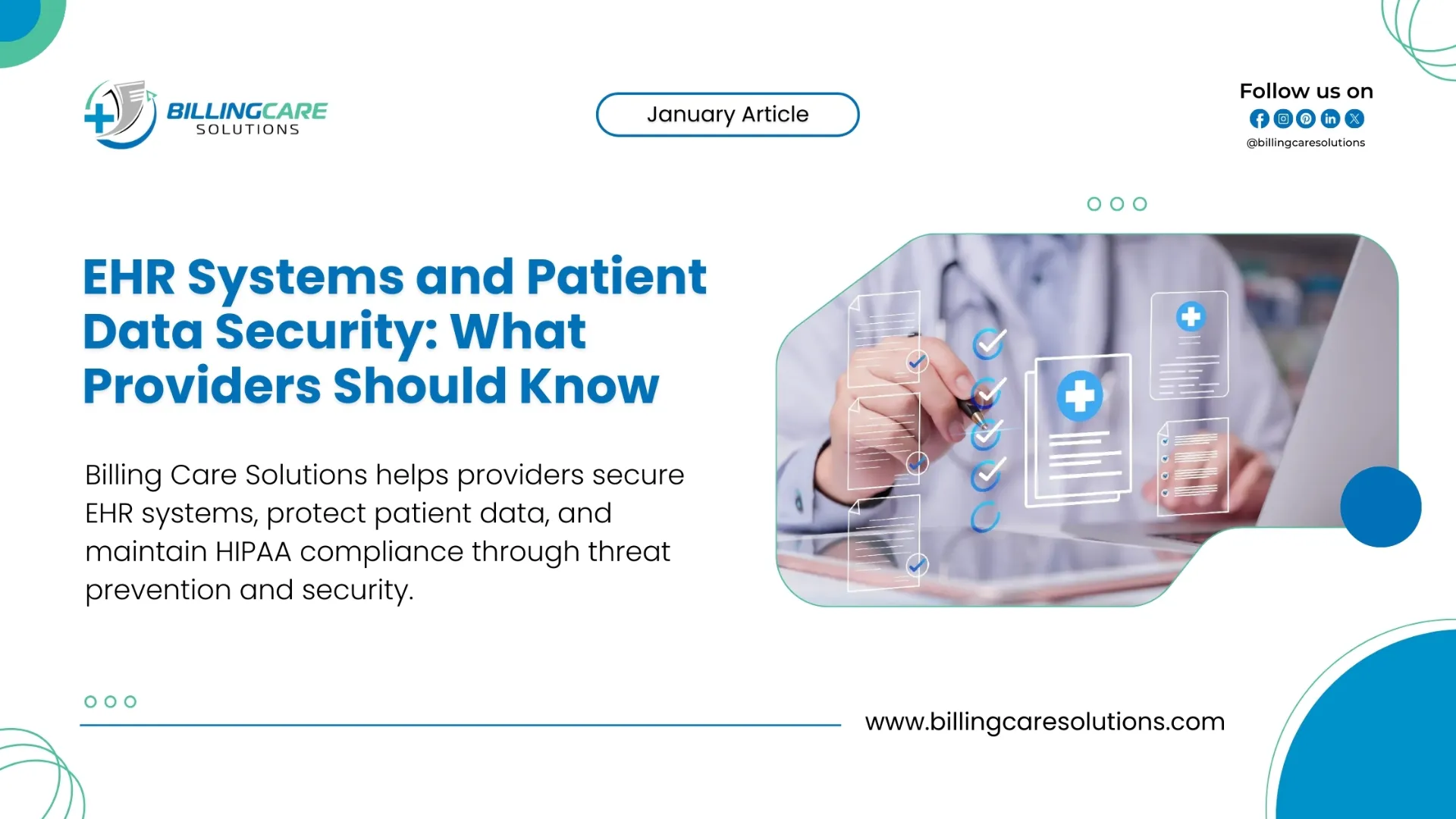
The medical industry has experienced an enormous digital transformation in the last ten years, and Electronic Health Records (EHR) systems have become the standard of contemporary medical practice. Although these systems have transformed patient care and made clinical practices easier, they have become a source of major security challenges that medical practitioners have to overcome. Knowledge of securing patient information in an EHR system is no longer optional; it's a critical responsibility that affects patient trust, regulatory compliance, and the financial health of your practice.
Understanding the Critical Role of EHR Systems
An EHR system is an all-encompassing digital storage of patient health data containing all details of medical history and diagnosis to treatment plans and prescription records. Such systems allow health providers to get patient information in real time, coordinate care among multiple providers, and make smarter clinical decisions. Nonetheless, the information stored in an EHR system is sensitive and thus is a viable target of cybercriminals.
In the last couple of years, the number of healthcare data breaches has been on a sharp rise. Industry reports indicate that there are more cyberattacks in the healthcare sector than any other industry and patient records are being sold off at a premium price in the dark web. A large amount of patient records can be compromised by a single breach and this will cause disastrous effects to the patients and the providers.
The Unique Security Challenges of EHR Systems
Healthcare providers have unique security issues with the implementation and maintenance of an EHR system. The healthcare organizations have to strike a balance between security and accessibility unlike in other industries. In an emergency situation, medical staff requires direct access to patient records, and at times this may be incompatible with serious security measures.
The complexity of the current EHR systems presents a number of possible flaws. These systems are usually combined with a variety of third-party systems, lab systems, images systems, and billing software. Every integration point is a possible point of unauthorization. Also, most healthcare institutions are operating legacy systems that might not even have been developed considering the contemporary threats to security.
One of the major security threats that healthcare faces is human error. The employees can become victims of phishing, use weak passwords, or accidentally share the login credentials. The stressful workplace conditions of healthcare facilities may create such shortcuts as exchanging passwords to improve the speed at which patients receive care or leaving workstations without properly logging out.
Essential Security Features Every EHR System Should Have
Some security features cannot be compromised when considering the evaluation or upgrading of your EHR system. It should be a requirement to use multi-factor authentication (MFA), which is an additional level of protection in comparison to mere passwords. MFA also obliges users to authentication by various methods that include a password with a fingerprint scan or a mobile device-sent code
The strength of encryption is essential to the safety of patient data. Your EHR must utilize encryption of data at rest and Data in transit. This means that despite the unscrupulous human beings accessing your system or intercepting information transmission, they will not be able to read the information unless they have the encryption keys.
Security and compliance should have detailed audit tracks. A good EHR system will automatically record all the access of patient records and record who viewed what and when and what they did. Such audit trails assist in the detection of suspicious activity, investigation of possible breaches, as well as proving that the regulations are adhered to.
Role-based access controls make sure that the staff members can only access the information they require in their respective job roles. A receptionist at a front desk should not be able to receive equal access as a physician, and the use of granular permissions helps to reduce the possibility of unauthorized access to data.
HIPAA Compliance and Your EHR System
Health Insurance Portability and Accountability Act (HIPAA) is a legislation that defines stringent standards of patient health information protection. Healthcare givers should make sure that their EHR system is in line with HIPAA rules, i.e. Privacy rule, the Security Rule and the Breach Notification Rule.
The HIPAA Security Rule mandates medical institutions to use administrative, physical, and technical measures to safeguard electronic protected health information (ePHI). Such administrative controls as regular risk assessment, security policies and procedures, and continuous staff training should be applied. Physical security measures entail regulating the physical access to ePHI facilities and workstations. Technical protections refer to those inherent in your EHR system.
As an EHR system vendor, ensure that the vendor commits to sign a Business Associate Agreement (BAA). This is a legally binding document that would guarantee that the vendor is aware of his/her obligation with HIPAA and that they will safeguard patient information by providing the right measure. In the absence of a BAA, you cannot legally receive the services of a vendor to store or process ePHI.
Best Practices for Securing Your EHR System
To have a solid security measure, a holistic approach that extends beyond buying secure software is needed. It is important to carry out regular security training to every staff member. The employees must be aware of such usual threats as phishing attacks, social engineering tricks, and the necessity to adhere to the security measures even in peak times.
System security is based on strong password policies. Use complicated passwords containing a combination of upper and lower case letters, numbers, and other special characters. Introduce the automatic expiration of passwords and do not allow users to use old passwords. The password management solutions can be considered as a way to allow the staff to keep secure credentials without using written notes and easily guessable passwords.
Patches and software upgrade your EHR system. Vendors provide updates to their products regularly to fix a vulnerability that they have identified and by failing to update your system, you expose your system to threats that are already known. Develop a streamlined system of testing and application of updates in time.
Periodically carry out security risk assessments in order to establish vulnerabilities within your systems and processes. Such tests must be directed at both technical factors about your EHR system and human factors which may pose a weakness in your security. Write up your observations and develop action plans to deal with weaknesses spotted.
Protecting Against Common Threats
Ransomware attacks are now widespread in the healthcare sector, as criminals encrypt patient information and require money to provide it. Secure your EHR system with the help of safe, isolated backup of patient information. Routine backup processes help to be sure that the information can be restored without any ransom payments. Test your backup restoration process on a regular basis to make sure that it is functional when required.
The attack is directed at employees of health facilities by using phishing emails in order to steal logins or install malware. Educate the staff at the train to be aware of fraudulent emails, check the sender of emails before clicking the links or opening attachments, and report the possible phishing activity to the IT security departments as soon as possible.
Malicious or accidental insider threats are dangerous to the safety of patient data. Install surveillance systems to identify abnormal access patterns like the employees accessing records of patients they are not attending to. Deactivate system access immediately after termination of employees and periodically review access privileges to ensure that they are reasonable.
Mobile Device Security in Healthcare
The growing adoption of mobile devices to EHR systems creates extra security concerns. Patient information is easily accessible through smartphones and tablets, which may be lost, stolen, or hacked. Use mobile device management (MDM) systems which will enable remote wiping of information in case devices are lost and will impose security measures on all the devices connecting to your EHR system.
Require the encryption of all mobile devices that have access to patient data. Communication between devices should be done using secure and encrypted channels when relaying information about the patient. Standardize policies on the use of personal devices to access work systems commonly referred to as Bring Your Own Device (BYOD) policies.
Why choose Billing Care Solutions.
Administration of the EHR system security and at the same time attending patients may be hectic. Billing Care Solutions is an organization that deals with full-fledged EHR systems and HIPAA compliance services to healthcare providers. Our professional staff performs comprehensive security tests, enforces the most effective security controls, and offers continuous monitoring to ensure that your patient information is protected. We cope with the technicalities of EHR security, and your system will be in a state of compliance with new regulations as well as be integrated with your workflow of billing. Our 24/7 support, proactive threat detection, and staff training programs ensure that your practice is not affected by data breaches and compliance violations. Collaborate with Billing Care Solutions to get a sense of relief and concentrate on providing high-quality patient services as we protect your online infrastructure.
Conclusion:
Protecting patient data in your EHR system should be on the list of priorities as the sphere of healthcare is increasingly adopting digital technology. Security is an important aspect of quality healthcare provision because of the regulatory demands, cyber threats, and patient trust. Healthcare providers can use the advantages of the EHR systems and protect the information that is entrusted to them by taking all the necessary security measures, training staff, and being cautious of the changing threats. It is important to remember that the idea of security is not a one-time project and that it should be a continuous commitment that needs constant attention, periodical updates, and continuous improvement to ensure patient protection and your practice is safe.
