

Low Back Pain ICD 10 Codes Explained for Accurate Medical Billing
Master Low Back Pain ICD 10 coding for accurate billing. Avoid denials, boost reimbursements, and streamline your process with Billing Care Solutions.
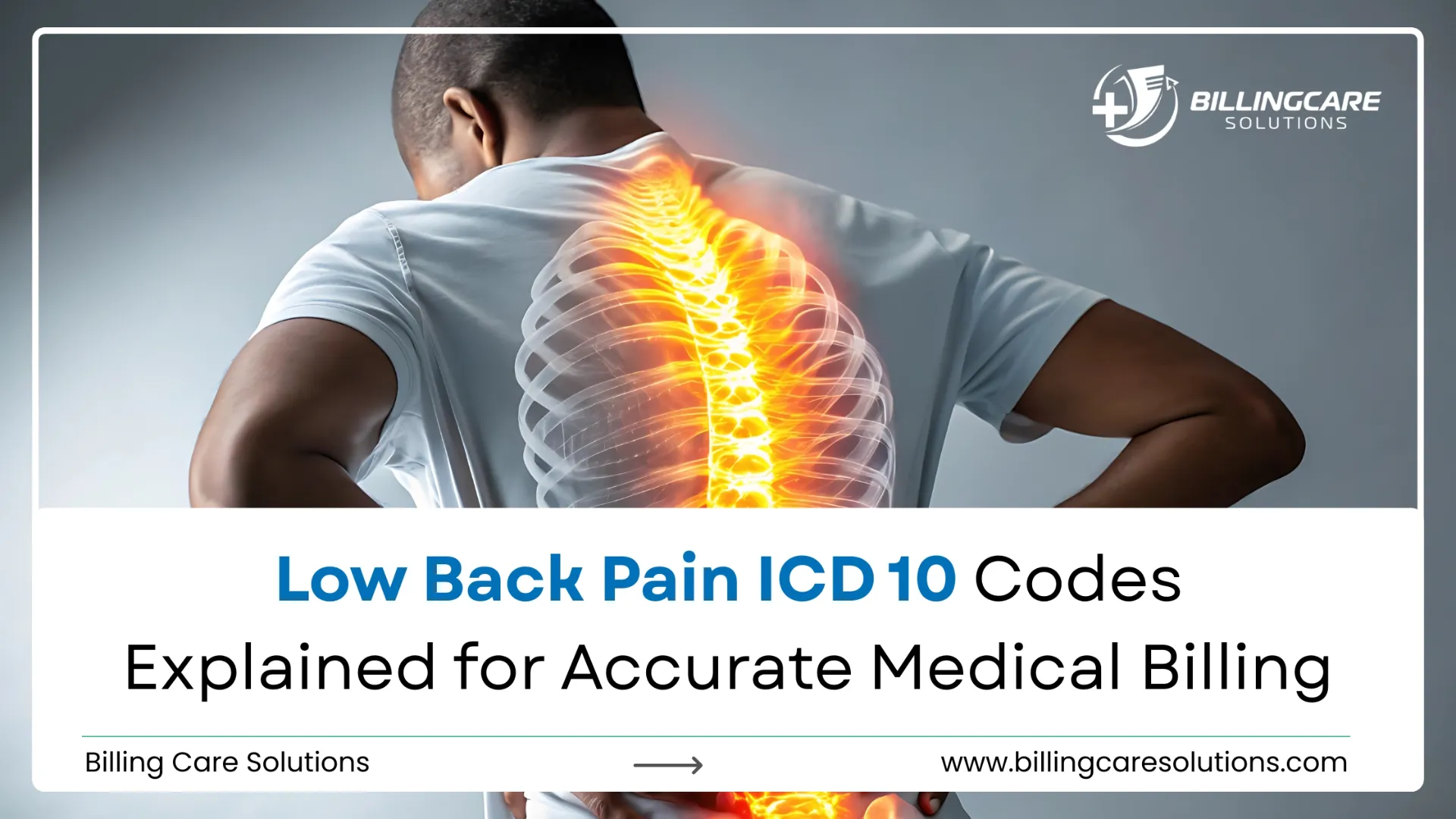
One of the most prevalent causes of patients visiting medical care in the United States is low back pain. For healthcare providers and medical billing specialists, it’s necessary to understand Low Back Pain ICD 10 codes to correctly document and inappropriate cases to ensure they get reimbursed and follow insurance rules. It is a complete guide that contains all the information you should know in order to code low back pain properly.
Understanding the Low Back Pain ICD 10 Structure
Low back pain is classified in the ICD-10 coding system, which is a hierarchy comprising up to seven alphanumeric characters. Characterization is increasingly specific with each character. The musculoskeletal system codes are generally indicated by the letter “M”, so the low back pain icd 10 codes start with this letter. This letter is followed by numeric digits which further specify the anatomical location, etiology and clinical characteristics.
The first three characters indicate the type of condition. For instance, M54 refers to back pain (dorsalgia). With the fourth and fifth characters, they provide specificity. They indicate if the pain extends down to the lower extremities or if it is due to nerve root compression. Other characters may provide information on laterality, type of encounter (initial or subsequent), or complications associated with the encounter. For billing professionals, it is crucial to know the structure of the low back pain icd 10.
When a coder begins to understand that each digit provides a more definitive diagnosis he or she can progress from a generic, deny prone code such as M54.5, for unspecified low back pain, to a specific, reimbursable code. The specificity of low back pain icd 10 codes directly affect reimbursements and claim acceptance.
Common Low Back Pain ICD 10 Codes
Here are the most commonly used ICD 10 codes for low back pain:
| ICD-10 Code | Description | Notes for Billing |
|---|---|---|
| M54.5 | Low back pain | Used for unspecified low back pain. |
| M54.4 | Lumbago with sciatica | For low back pain that radiates to the legs. |
| M54.9 | Dorsalgia, unspecified | General back pain without further specification. |
| M51.2 | Other specified intervertebral disc displacement | Low back pain caused by disc herniation or displacement. |
| M54.2 | Cervicalgia | Only used if neck pain is also involved with back conditions. |
As much specific code as possible will be used to make sure that the reimbursement is accurate and the rejection of claims is unlikely. As an example, typing M54.4 rather than the generic M54.5 will give the payers more details that will substantiate the medical necessity of the treatment.
How to Code Acute and Chronic Low Back Pain Correctly
When coding low back pain, the distinction between acute and chronic pain is essential. For accurate low back pain icd 10 code selection and claim reimbursement.
Acute Low Back Pain:
Acute pain lasts for a few days to a few weeks. It can be common in cases of an acute trauma, muscle strain or mechanical pressure. Coding for acute cases should be the main code for low back pain without chronic pain code unless documented.
Chronic Low Back Pain:
Chronic pain is present for over 12 weeks. It might be associated with chronic spine disease, arthritis or other chronic diseases. More information must be reported for ICD 10 coding of chronic low back pain. This should include documentation of previous interventions, imaging results and any functional limitations or restraints that impact daily functioning.
To accurately report ICD 10 chronic low back pain, the billers should use a primary code for low back pain, M54.5, and a secondary code for other chronic pain, G89.29. This combination makes this a medical necessity for continued medical care, physical therapy, or pain management. This guide cleared the application of more specific Low Back Pain ICD 10 codes, which will prevent claims that are denied.
Documentation Requirements for Lower Back Pain ICD 10
Correct coding for a patient with low back pain starts with good clinical documentation. Even the most experienced coder can’t choose the right low back pain icd 10 code without proper documentation. There needs to be a collaboration between medical providers and the billing teams. They have to make sure that each patient’s record includes the following key components. They are necessary to make the right choice for low back pain icd 10.
Location and Nature of Pain: The medical record shall document that it is a lower back pain or lumbar pain. It should also specify what kind of pain it is sharp, dull, burning, or radiating.
Duration and Onset: Indicate if pain is acute, subacute or chronic. Record the onset of pain (when it began) and whether it was after a specific incident such as an injury, fall, heavy lifting, etc.
Radiating Symptoms: If the pain radiates down the buttocks, thighs, legs or feet, this should be made clear. Radiating pain is a common symptom of conditions such as M54.4, lumbago with sciatica.
Associated Findings: Include any numbness, tingling, weakness, or reflex changes. These findings support more specific codes and justify advanced treatments.
Previous Treatments and Imaging: List previous physical therapy, medication, injection, and surgical procedures. When a scan (X ray, MRI, or CT) is available, include those results.
Functional Limitations: Record the effects of pain on the patient’s normal activities, work or mobility. This is to facilitate a continuing or intensive treatment.
Following these documentation requirements for lower back pain ICD 10 coding reduces claim denials, supports audit readiness, and ensures appropriate reimbursement.
Guidelines on Low Back Pain ICD 10 Coding
- Document Everything: Enter the medical record on the exact place, severity, and duration of pain. Record any radiating pains, numbness, or weakness.
- Use Specific Codes: Certain codes such as M54.4 or M51.2 are more effective than general codes and increase the acceptance of the claim.
- Review Patient History: Psychological memory of past events or therapies aids in the choice of the appropriate code when it comes to chronic or recurrent ailments.
- Stay Updated on ICD 10 Changes: ICD 10 codes are revised on an annual basis. Applying old codes will lead to rejection of claims or late payment.
- Avoid Common Errors: Examples of common errors are the utilization of general code in the face of a specific code, inability to record related symptoms or just coding of low back pain without showing underlying conditions.
Why Accurate low back pain icd 10 Coding Matters?
Correct Low Back Pain ICD 10 code influences a number of medical billing important domains:
- Accuracy of reimbursement: Correct coding guarantees that the providers obtain the right remuneration of the services provided.
- Compliance: Standardized codes keep the practices within CMS and payer provisions.
- Data Quality: Correct coding helps in the improved reporting, research, and patient care strategies.
- Less Audit risks: When documentation and coding are done properly, the probability of audit and penalties is reduced.
Not only does the incorrect coding cause a delay or denial of the claims but also can impact the financial stability of a practice. Of particular importance is the high-volume clinics in which low back pain diagnosis is common.
Best Practices for Billing Teams
Small errors in medical billing, like wrong Low Back Pain ICD 10 codes, can cause rejections or audits. These easy tips help teams work more accurately, get paid faster, avoid penalties, and keep the practice safe.
- Set up a coding workflow: A clear workflow stops you from missing key details. First, read the provider’s notes fully. Then pick the right low back pain code. Finally, double-check documentation before sending the claim to avoid rejections.
- Offer regular training: Rules for medical coding change often. Regular training teaches staff the latest updates and common low back pain coding mistakes. This helps the team stay correct and avoid problems that could lead to audits.
- Use coding reference tools: Coding lists and checklists help you pick the right code every time. Keep the most current ICD-10 tools nearby. They act as a safety net to catch errors before you submit a claim.
- Audit and review claims: Regular audits find small errors before they become big problems. Checking past claims helps your team learn from mistakes. This improves accuracy over time and leads to fewer denied or rejected claims.
- Work closely with providers: Good talk between doctors and billers prevents confusion. Billers can explain what details they need in notes. Providers can then write clearly. This teamwork leads to correct codes and faster payments.
How Billing Care Solutions Simplifies Low Back Pain ICD 10?
We offer medical billing and coding services at Billing Care Solutions. Our team will make sure that your cases of low back pain are accurately coded using the correct low back pain icd 10 codes. Claims are submitted effectively and reimbursements are fully achieved. Working with us, healthcare providers can focus on patient care without committing administrative mistakes or facing claim denials.
Our Pain Management Billing Services include:
- Accurate low back pain icd 10 code selection
- Extensive billing review and audit of compliance
- Denial management and follow up of claims
- Employee training in proper documentation and low back pain icd 10 coding
Your practice will enjoy a smooth running revenue cycle and high quality patient care with the help of our experienced Pain Management Billing Services team.
Conclusion
Proper Low Back Pain ICD 10 will be critical to effective medical billing and effective reimbursement. On the one hand, by applying thorough documentation, specific codes, keeping abreast of the coding standards, and best practices, healthcare professionals and billing departments can prevent claim denials and enhance financial performance. To additionally guarantee accuracy, compliance, and efficiency, a professional billing service, such as Billing Care Solutions, is also a good choice.
Accurate coding will not only help in the financial well-being of your practice but also in getting the necessary care to the patients with administrative wastages. Today, you should start prioritizing proper Low Back Pain ICD 10 coding to improve your operations in terms of billing and maximizing the reimbursement.
