


GERD ICD 10 Code K21.9: Complete Billing Guide for Healthcare Providers
Learn how to accurately use GERD ICD-10 code K21.9 for claims, documentation requirements, common billing errors, and best practices to prevent denials.
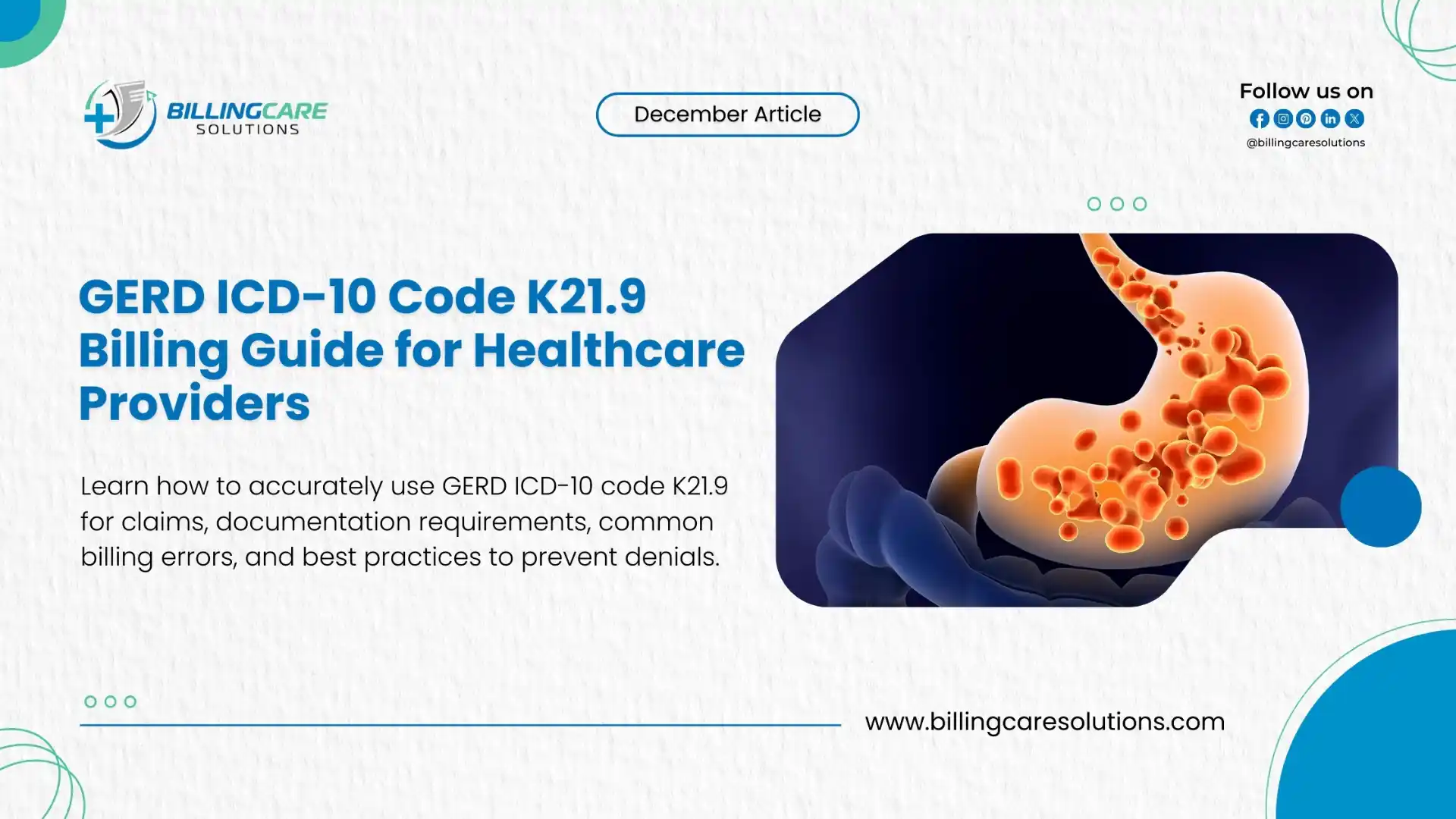
Accurate GERD ICD 10 is the key to getting the correct payment, claim acceptance, and maintaining clinical clarity. Among the top 10 most commonly used digestive system disorder codes is the GERD ICD-10 Code K21.9, which stands for gastroesophageal reflux disease without esophagitis. Doctors usually report this code for patients with a history of acid reflux symptoms in which no inflamed or damaged esophagus has been found.
This article clarifies the usage of K21.9, describes the documentation features necessary to support it, lists typical billing errors, and provides the most effective practices for issuing the right claim.
What Is the GERD ICD 10 K21.9?
The GERD ICD 10 code K21.9 is an abbreviation that means gastroesophageal reflux disease without esophagitis. This code is applied in the case of a patient with common reflux symptoms. But there is no inflammation or destruction of the esophagus. The K21.9 code belongs to the chapter of the digestive system.
This code is applicable in outpatient and inpatient visits by medical coders. It does not resemble K21.0 that contains esophagitis. The icd 10 code for gerd is used to record the prevalence of diseases. In absence of this code, billing of reflux treatment will be a challenge. The providers need to ensure that there is no injury to the esophagus initially.
The code is applicable to both children and adults with GERD. To submit claims properly, it is necessary to understand the k21.9 diagnosis code. Reflux in newborns is temporarily not covered in this code. K21.9 should not be assigned without first verifying the clinical documentation. The wrong code may be used due to the missed diagnosis. Hence the k21.9 diagnosis code is a cornerstone code in gastroenterology.
Why Accurate GERD ICD 10 Coding Matters for Reimbursement
Proper coding of GERD ICD 10 will have a direct impact on your practice income. The code is not matched to symptoms and this leads to insurance companies denying claims. The incorrect use of k21.9 diagnosis code may result in a delay of payment by weeks. The code demonstrates that there is medical necessity to prescribed treatments.
As an example, proton pump inhibitors should have a valid icd 10 code for gerd. In the absence of the k21.9 diagnosis code, reflux medication claims can be denied. Proper coding will also minimize the chances of a payer audit. Practices whose ICD 10 GERD mismatches are common are often the subject of audit. Good coding will save you the trouble of refund requests by insurers. It also helps guard against your practice being accused of upcoding. Upcoding occurs when you code K21.0 rather than K21.9.
The reimbursement rates and the level of severity differ in the two codes. Thus, learning to code GERD ICD 10 enhances your revenue cycle. It establishes trust between itself and patients and insurance companies. Correct claims translate to quicker payment and less administrative hassles. Concisely the right icd 10 code for gerd maintains your cash healthy.
Key Clinical Criteria for Assigning GERD ICD 10 K21.9
There are certain symptoms that physicians should record prior to the utilization of GERD ICD 10. Common symptoms are heartburn, regurgitation and chest discomfort. The symptoms are to be experienced at least twice a week. The patient should not exhibit any esophageal inflammation. The absence of esophagitis can be commonly confirmed in an endoscopy report. Without endoscopy, the GERD ICD 10 code K21.9 still applies. But tissue damage should be obviously excluded in the clinical notes.
Other supportive symptoms are the chronic cough or laryngitis. These additional symptoms support the use of icd 10 code for gerd. The criteria also entail that symptoms cannot be due to some other cause. As an example, GERD symptoms can be resembled by gallstones or ulcers. Omission of these conditions enhances the employment of K21.9.
A patient history should reflect the improvement of the symptoms when the acid is reduced. This is a good clinical indicator of treatment response. The criteria of GERD ICD 10 code is slightly different in pediatric patients. Frequent spitting up and irritability may be a qualification in infants. Use the most recent ICD 10 guidelines to use as an official rule.
How to Differentiate K21.9 From Other GERD Codes
The GERD ICD 10 family encompasses a number of related codes of reflux. K21.0 applies to GERD that has esophagitis that is confirmed by biopsy or endoscopy. K21.9 is in case of GERD and no damage to the esophageal lining. There is another code K22.7 which is Barrett esophagus without dysplasia. Barrett esophagus is a complication of long term reflux disease. The GERD ICD 10 code of K21.9 is not as serious as K21.0. K21.9 patients do not require surveillance endoscopy after every three years. K21.0 needs closer attention and alternative treatment strategies.
K21.9 should not be confused with P92.1 of infant regurgitation. P92.1 is a rumination disorder specific code at birth. Differentiate also between K21.9 and R12 in heartburn alone. Heartburn is symptomatic and GERD is a definitive diagnosis. In case there is no formal diagnosis of GERD, R12 should be used instead. To use k21.9 diagnosis code, documentation should indicate GERD. Otherwise use symptom codes until a definite diagnosis is made. Adequate differentiation will eliminate denial of claims and non-compliance.
ICD-10 Table for GERD-Related Codes
| ICD-10 Code | Description | When to Use This Code |
|---|---|---|
| K21.9 | Gastroesophageal reflux disease without esophagitis | Use when GERD is diagnosed, and no inflammation or tissue damage is present. Symptoms such as heartburn and regurgitation may be present, but diagnostic evaluation shows no esophagitis. |
| K21.0 | Gastroesophageal reflux disease with esophagitis | Use when GERD symptoms are accompanied by esophageal inflammation. This diagnosis must be confirmed through clinical notes or diagnostic testing. |
| K21.00 | Gastroesophageal reflux disease with esophagitis without bleeding | Use when esophagitis is present, but there is no bleeding. Confirm this through provider documentation. |
| K21.01 | Gastroesophageal reflux disease with esophagitis and bleeding | Use when GERD results in esophagitis that includes documented bleeding. |
| R12 | Heartburn | Use only if the provider documents heartburn as a symptom rather than a confirmed GERD diagnosis. This code should not replace a GERD code when GERD is diagnosed. |
| K44.9 | Diaphragmatic hernia without obstruction or gangrene | Use when reflux symptoms are related to a diaphragmatic or hiatal hernia, but no obstruction or gangrene is present. |
| K31.84 | Functional dyspepsia | Use when symptoms resemble GERD, but the diagnosis is functional dyspepsia rather than reflux disease. |
Common Billing Errors With GERD ICD 10 Coding
The k21.9 diagnosis code has many errors on the part of billers. The use of K21.9 in patients with esophagitis is one of the major mistakes. k21.9 diagnosis code does not entail esophageal damage. The other error is the use of K21.9 without the frequency of symptoms recorded. Other billers do not remember to attach K21.9 with the procedure being billed. Payers reject the whole claim without linking. It is also wrong to use K21.9 to reflux in infants. Newborns do not fall in the k21.9 diagnosis code. Another mistake is to neglect medical necessity checks of tests. A pH experiment should be justified in the notes with K21.9. Educate your employees to prevent such expensive GERD ICD-10 K21.9 errors.
Best Documentation practices of GERD ICD 10 Claims
The first step of good documentation is to have a clear diagnosis statement by the physician. In the assessment, the doctor needs to write GERD without esophagitis. Never use symptom lists to determine the icd 10 code for gerd. The rate of reflux symptoms should be mentioned in the medical record. Record any previous endoscopy findings of a normal esophagus. In case there was no endoscopy, explain why.
Record that other causes such as ulcers are eliminated. Treatment plan must be according to K21.9 severity. Such as lifestyle changes and antacids are suitable first line. These conservative treatments can be justified by the k21.9 diagnosis code. Responses to therapy in terms of symptoms should be included in progress notes. This follow up documentation is in favor of further use of the code. Make sure that the coder is able to locate the diagnosis on the first page. An unspoken diagnosis will result in incorrect assignment of GERD ICD 10 code.
Clear use of a problem list in electronic health records. Check all outpatient records, and complete the claim. Good documentation decreases the rate of denial and accelerates payment.
GERD ICD 10 and Its Impact on Medical Necessity
Medical necessity is the service should be reasonable to the diagnosis. The medical necessity of some tests is determined by the GERD ICD 10 code K21.9.
An example of this is that K21.9 alone may not be justifiable to warrant an upper endoscopy. However, a pH probe study is regarded to be required in case of K21.9. This test helps to establish acid exposure in undamaged symptomatic patients. Prescription drugs such as omeprazole will have GERD ICD 10 code covered. The insurer may refuse to pay the pharmacy claim without K21.9. K21.9 is not commonly approved of surgical procedures such as fundoplication. K21.0 or complicated cases of reflux are typically treated by surgery. Thus the GERD ICD 10 code has a direct influence on the approval of treatment.
In case of uncertainty, the payer will reject the service in case it is not clear that medical necessity exists. The coder should make sure that the documentation will support every billed service. Another reason given in common denials is absence of medical necessity of an EGD. In the case of K21.9, failed medical therapy can be requested by the insurers. Local coverage determinations are always recommended to be checked. These policies specify the GERD ICD 10 codes that include the services. Your practice is safeguarded against recoupment demands by proper coding.
How Billing Care Solutions Simplifies GERD ICD 10 Workflows
Billing Care Solutions is a provider of GERD ICD 10 coding accuracy tools. Our software verifies automatic documentation against necessary clinical requirements. It alerts about instances in which K21.9 might not be consistent with the physician notes. The system also proposes the appropriate GERD ICD 10 code on the basis of key words. e.g. in finding esophagitis it prescribes K21.0 instead. This minimizes human error and enhances first pass claim acceptance. The Billing Care Solutions offers real time medical necessity validation. Our site verifies whether a procedure is eligible on K21.9.
We also provide denial management specifically to the digestive disease codes. Our team reviews denied claims and rectifies GERD ICD 10 errors in a short period. We conduct monthly coding audits to identify pattern error whilst it is early. Your staff is trained on the finer points of K21.9 as opposed to K21.0. Coding questions may be asked during the business hours to our support team. Our system is updated whenever the ICD 10 guidelines are amended. This will make sure your GERD ICD 10 coding is in compliance all year round. Billing Care Solutions will assist you to cut down denials and maximize income. We can deal with the complicated regulations as you work on patients.
Conclusion: Streamlining Your Revenue Cycle
An efficient revenue cycle relies on proper diagnosis coding at the beginning. Billing Care Solutions will be integrated with your current electronic health record. Our system puts the GERD ICD 10 code choice on your workflow. We minimize the time coders spend in searching K21.9 rules. We have real time denial rates on our dashboard of digestive diagnoses. It is possible to see where icd 10 code for gerd errors occur most frequently. Reports will be tailored to individual providers in your practice.
Such reports help to identify the physicians who require additional training in coding. Billing Care Solutions is also automated in submitting claims. Each procedure is given the appropriate icd 10 code for gerd by our system. We follow up all claims until we get money back in the hands of the insurer. In case of claim denial, we submit it within days with the corrected coding. Our group tracks payer specific GERD ICD 10 coverage. We inform you of any change in your reimbursement rates.
Through outsourcing to Billing Care Solutions, you save on administrative workload. Your practice receives quicker payments and fewer claims rejected. Contact Billing Care Solutions to simplify your GERD ICD 10 billing.
Frequently Asked Questions About GERD ICD-10 Code K21.9
