


Complete Breakdown of Vitiligo ICD 10 Codes for Clinical Documentation
Complete Vitiligo ICD 10 code breakdown for clinical documentation. Improve dermatology medical billing accuracy with Billing Care Solutions.
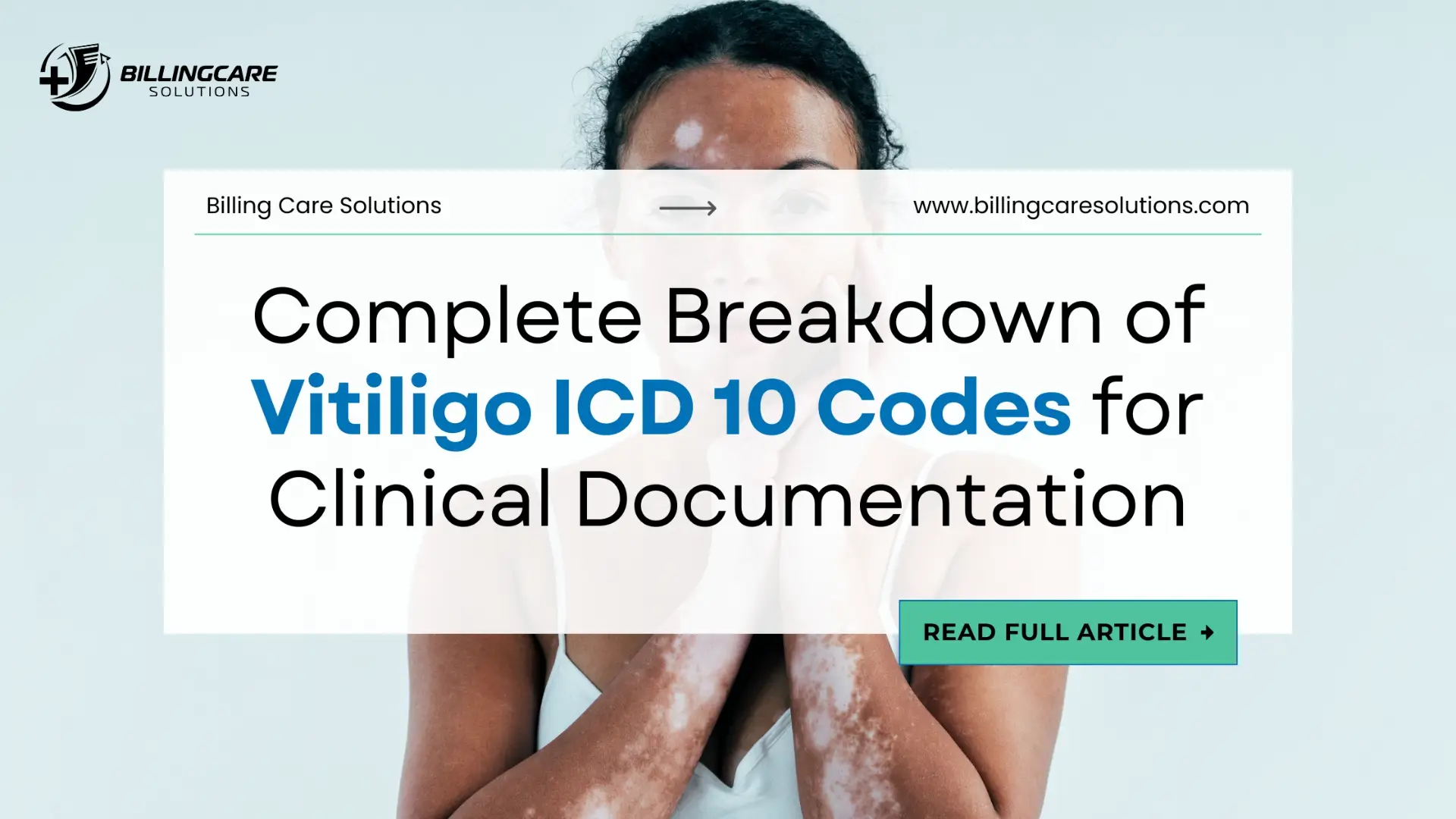
Accurate Medical coding is essential to a thriving dermatology billing. Vitiligo Awareness Month is celebrated in the month of June which is an ideal time for medical billers/coders to refresh and have a better understanding of Vitiligo ICD 10 coding practices. This month is the time when there is a spike in patient visits and insurance inquiries, which means it is all the more crucial for coding accuracy during this period to handle any claims relating to vitiligo.
Furthermore, effective dermatology medical billing requires more than just diagnosis codes. The correct procedure codes need to be linked as well as documented and common errors need to be avoided. This guide offers an exhaustive, practical and comprehensive overview of all information required for clinical documentation in the context of Vitiligo ICD 10 coding.
What is Vitiligo in Clinical Practice?
Vitiligo is an acquired, chronic autoimmune disease of the skin resulting from immune mediated destruction of the skin melanocytes that produce skin pigment. In some parts of the body such as face, hands, arms and openings, depigmented white areas on the skin.
Vitiligo affects 1-2% of the world population. It is neither contagious nor fatal but affects the quality of life and self esteem to the patient to a great extent. Two types are broadly classified in Vitiligo on clinical grounds:
- Non-segmental vitiligo (also called generalized vitiligo): The most common, symmetrical on both sides of the body.
- Segmental vitiligo: Involves only one side or segment of the body and is likely to grow rapidly and then level off.
This distinction in clinical presentations is significant for coders as the documentation by the doctor must provide clear supporting evidence to assign a code related to the type and severity of the condition being treated (vitiligo).
Understanding the Vitiligo ICD 10 Coding Structure
The ICD 10 CM classification for skin diseases and disorders is grouped in the chapter, “Diseases of the skin and subcutaneous tissue”. Vitiligo is classified as one of the other disorders of skin pigmentation.
Vitiligo ICD 10 code starts with letter “L” which indicates “skin and subcutaneous tissue disorders”. Vitiligo is coded L80: Other disorders of the skin, and is part of the range of codes L80 to L99.
Why Accurate Vitiligo ICD 10 Coding Matters?
Properly coding Vitiligo ICD 10 has a multi-faceted impact on a dermatology practice:
- Claim approval rates: Payers need to see certain and well substantiated diagnosis codes. Inaccurate/ambiguous codes result in claim denials.
- Reimbursement accuracy: The correct ICD 10 code for Vitiligo correctly maps to the correct CPT codes, ensuring that the practice gets reimbursed for the service.
- Audit defense: If the practice is audited by a payer, the codes of the condition will be well documented on the claim with supporting clinical notes, and the practice will not be subject to compliance penalties.
- Patient records integrity: Accurate coding enables seamless care and patient history across providers.
Even minor coding mistakes in a claim for Vitiligo ICD 10 can result in a claim denial, delayed reimbursement and potentially investigations for upcoding or even fraud.
Complete List of Vitiligo ICD 10 Codes
Here below are all the ICD 10 codes for Vitiligo. These codes are for identifying the site or type of disease. This is a handy list to have on hand as you go over dermatology notes.
| ICD-10 Code | Description | Affected Area / Type |
|---|---|---|
| L80.0 | Vitiligo of face and neck | Depigmentation affecting the face and neck regions |
| L80.1 | Vitiligo of upper extremities | Affects the arms, hands, and fingers |
| L80.2 | Vitiligo of lower extremities | Affects the legs, feet, and toes |
| L80.3 | Vitiligo of trunk | Involves the chest, abdomen, and back |
| L80.4 | Vitiligo of scalp | Includes scalp depigmentation and poliosis (white hair patches) |
| L80.5 | Vitiligo of eyelid and periocular area | Affects the eyelids and surrounding eye area |
| L80.6 | Vitiligo of mucous membranes | Involves mucosal surfaces such as the inside of the mouth or nose |
| L80.7 | Generalized vitiligo | Universal or near-complete depigmentation of the body |
| L80.8 | Other vitiligo | Includes acrofacial, focal, or segmental vitiligo types |
Coders should always refer to the most current ICD 10 CM code book or approved coding software to confirm active codes before submission, as updates occur annually.
Types of Vitiligo and Coding Considerations
While ICD 10 CM uses one primary code for vitiligo, the clinical documentation must still reflect the specific type of vitiligo the patient has. This is important for medical necessity justification and treatment planning.
- Non-segmental vitiligo: The most common type, coded, is non-segmental vitiligo. It is seen both on the right and on the left and is related to other autoimmune diseases. If the patient has non-segmental vitiligo in addition to a thyroid condition or alopecia, then ALL associated diagnosis codes should be assigned to provide a complete clinical picture.
- Segmental vitiligo: Segmental vitiligo occurs on one body segment and usually occurs at an early age. Although the same L80 code is used, the physician’s notes should include a description of the area affected, course of the condition and any previous treatments tried.
- Localized vitiligo: If the vitiligo is localized (e.g., face, hands, around the eyes) then it may be necessary to be more specific in the documentation. However, there are certain codes that are not combined in the H02 category such as that for vitiligo of the eyelid area.
The overriding principle for coding any type of vitiligo is that the documentation must be sufficient to support the code, treatment and any procedure done on the visit. A Vitiligo ICD10 code should never be given without supporting language in the clinical notes.
Documenting Accurately Vitiligo ICD 10 Coding
Documentation is key to correct Vitiligo ICD 10 . Always include in the clinical record:
- Confirmed diagnosis: The physician should make a diagnosis, not only describe symptoms, as a diagnosis of vitiligo.
- Indicate type/location: Document whether it is segmental or non-segmental and body regions involved.
- The extent of the disease: Notes should indicate the percentage of the body surface area affected, especially for treatment planning and medical necessity.
- Co-existing conditions: Any co-existing conditions that may have occurred, e.g. thyroid disorders, autoimmune disorders, diabetes, etc. should be indicated with codes.
- Treatment history: Treatment history and the results of previous treatments should be documented to support medical necessity of procedures billed.
- Follow-up visits: Notes should document changes in condition, patient response to treatment and any changes to the care plan for follow-up visits.
One of the major reasons for incorrect ICD 10 codes and claim denials in dermatology is due to incomplete or vague documentation.
Vitiligo CPT Codes Commonly Used Alongside ICD 10
The treatment for vitiligo requires various treatments, which are coded using CPT codes. It is important to assign the appropriate Vitiligo ICD 10 code with these CPT codes to facilitate reimbursement. The following are some commonly used CPT codes:
| CPT Code | Procedure | When to Use |
|---|---|---|
| 96900 | Phototherapy (Narrowband UVB) | Use for patients with localized or widespread vitiligo requiring light therapy to stimulate repigmentation. |
| 96920 | Excimer Laser Treatment (First 100 cm²) | Use for localized vitiligo lesions when treating the first 100 square centimeters with an excimer laser. |
| 96921 | Excimer Laser Treatment (Each Additional 100 cm²) | Use in addition to CPT 96920 when the treated area exceeds 100 square centimeters. |
| 15780 | Dermabrasion for Epidermal Grafting | Use for stable vitiligo when preparing depigmented skin for epidermal graft transplantation. |
| 15004 | Surgical Skin Graft – Recipient Site Preparation | Use when preparing the recipient site before performing a skin graft procedure for stable vitiligo. |
| 15005 | Surgical Skin Graft – Donor Site Harvest | Use when harvesting donor skin for grafting procedures in patients with stable vitiligo. |
The connection between the CPT code and the Vitiligo ICD 10 code must be medically supported. Payers will review whether the procedure matches the diagnosis and whether the documentation justifies the level of service billed.
Common Billing Errors with Vitiligo ICD 10 Coding
Even more experienced computer programmers make errors when claiming for vitiligo. The most frequent billing mistakes are:
- Using unspecified codes when specificity is available: This is a common error with the code L81.9, which is used when the diagnosis is clearly one of vitiligo, and can lead to denials.
- Codes for associated autoimmunities are not coded: In the absence of codes for associated autoimmunities, a full clinical picture cannot be obtained.
- Mis-matching CPT and ICD codes: Attaching the wrong diagnosis code with a phototherapy CPT code can lead to claim denials or claim follow-up.
- Obsolete codes: If codes are revised or deleted in the current ICD 10 CM update, it will be automatically rejected.
- Insufficient clinical notes: If a claim is submitted with a valid Vitiligo ICD 10 , but not enough clinical notes to support the claim, there is an audit risk.
These costly mistakes can be avoided through routine coder training and documentation audits. Understanding the financial implications of using Vitiligo ICD 10 Codes.The financial impact of using Vitiligo ICD 10 Codes.
How Vitiligo ICD 10 Codes Affect Reimbursement
Vitiligo is considered a cosmetic disorder by some payers. They may refuse to pay for certain treatments such as laser or phototherapy unless you can establish “medical necessity. What do you do to establish medical necessity? Use a particular code and robust documentation. For instance, face (L80.0) can be approved for excimer laser since the appearance and psychological health of the face is affected by vitiligo. Additionally, L80.1 (hands) is potentially eligible for approval due to disability of the hands interfering with work and daily activities. A lesion of the L80.3 (trunk) that is not functional is more likely to be denied.
Local coverage determinations are different in different regions of Medicare. Some states will reimburse for narrowband UVB phototherapy for vitiligo (codes L80.0-L80.8). In other states, coverage is only up to L80.7 (generalized). Please refer to your local Medicare administrative contractor’s policy. There are also inconsistencies among private insurers. One of the large payers may cover the excimer lasers for any L80 code. The other may refuse to accept all the treatments for vitiligo as cosmetic. If a denial occurs, check the code that was denied. Sometimes simply reducing from L80.9 to L80.0 or L80.7 may suffice for winning an appeal.
How Billing Care Solutions Supports Accurate Coding
Billing Care Solutions specializes in dermatology medical billing and coding services across the country. Our expert coder team is well-versed in the intricacies of Vitiligo ICD 10 and collaborates closely with clinical teams to guarantee that all claims are accurate, compliant, and optimized for reimbursement.
Claim submission, denial management, coding audits and continuous documentation training are some of our services that will help your practice to minimize errors and enhance cash flow. From challenging vitiligo cases to everyday dermatology appointments, Billing Care Solutions has the expertise to support your billing needs.
Conclusion
Correct coding of Vitiligo ICD 10 is crucial for accurate reimbursement and documentation compliance. The codes are L80.0 to L80.9 and include face and neck vitiligo, and unspecified cases. Specific clinical documentation is key to success! It is essential that doctors document the precise location, size and nature of the vitiligo. The next step is for the billers to select the most specific code and correctly assign it to the appropriate CPT code for phototherapy, laser or surgical treatment.
Be sure to avoid common pitfalls, such as excessive use of L80.9 or misidentifying the skin disease vitiligo. Keep in mind that various payers may be covering the treatment of vitiligo in different ways. A more specific code such as L80.0 or L80.7 might result in a higher reimbursement rate than an unspecified code. Billing Care Solutions is here to help you if you are having trouble with coding denials for your practice when it comes to vitiligo complications. Coding audits, documentation improvement and denial management are available and are tailored to dermatology. Call us today at billingcaresolutions.com to get a free consultation.
