


Understanding CHF ICD 10 Codes for Proper Reimbursement
Learn how accurate CHF ICD 10 coding improves reimbursement, reduces claim denials, and ensures compliant, error-free medical billing.
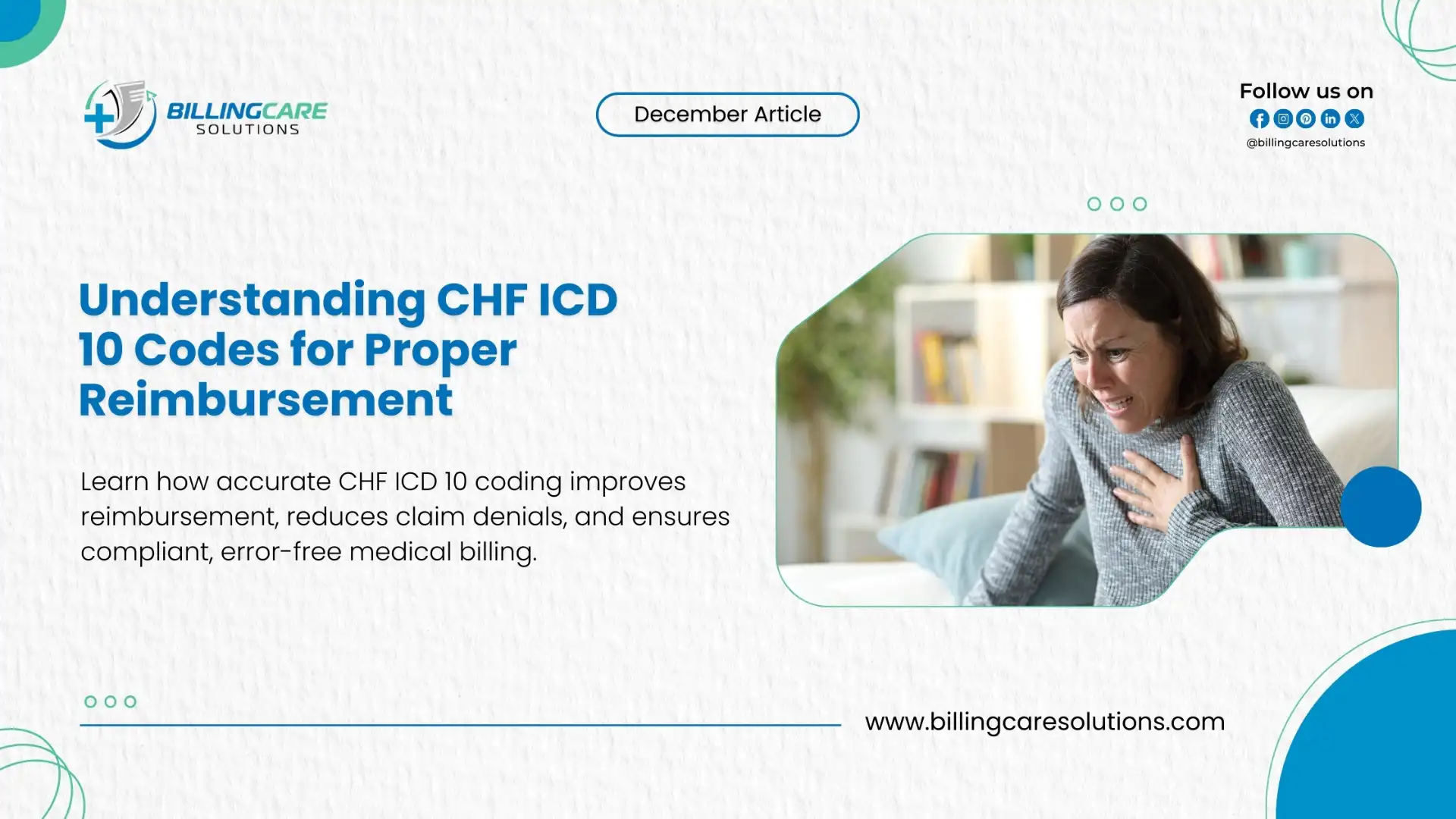
Congestive heart failure is among the top chronic conditions that require frequent treatments in healthcare facilities. Due to its complicated nature and the high cost of the treatment, accurate coding is very significant for the return of money. Employing the right CHF ICD 10 codes is merely not a coding requirement. It influences very much the cases of approvals, payments, and payer guidelines compliance.
This article explicitly describes the coding of CHF in the International Classification of Diseases, 10th revision, thus, the providers and the billing teams can stay away from making errors.
What Is CHF and Why CHF ICD 10 Coding Matters
Congestive heart failure, or simply CHF, is a situation when the heart is not able to pump blood required by the body efficiently. The condition is gradual and usually comes as a complication in a chain of diseases like high blood pressure, diabetes, and coronary artery disease.
In terms of billing, CHF demands thorough and precise documentation. The importance of CHF ICD 10 coding lies in the fact that these codes are used by the payers to decide the medical necessity, the severity of the condition, and the amount of money to be paid. The inaccuracies or vagueness in the coding may result in a rejection of claims, issuance of underpayments, or problems with compliance during the time of audits.
The correct use of CHF ICD 10 coding is the one that guarantees the representation of the patient's condition in the clearest way and also ensures that the healthcare providers are given back the right amount of money for the care they have delivered.
Overview of CHF ICD 10 Codes
The ICD 10 classification system provides a more elaborate framework than earlier versions, particularly for heart failure related diagnoses. Congestive heart failure (CHF) ICD 10 codes are mainly categorized under I50 that deals with heart failure.
Additionally, CHF ICD 10 codes demand detailed information as opposed to general diagnosis codes. The type of heart failure, its acuity, and in some cases whether it is acute, chronic, or acute on chronic conditions have to be specified by the coders. Such a degree of detail is instrumental in helping the payers to evaluate the complexity of care and decide the correct reimbursement.
Most Commonly Used CHF ICD 10 Codes
Various CHF ICD 10 codes are often referred to in medical billing as a result of numerous heart failure cases. Among the frequently used codes are:
- I50.9 for unspecified heart failure
- I50.20 for unspecified systolic heart failure
- I50.30 for unspecified diastolic heart failure
- I50.40 for unspecified combined systolic and diastolic heart failure
Although these codes are acceptable, a high number of unspecified codes may lead to a payer check. Coders should always try to use the most detailed CHF ICD 10 code that is in line with the clinical documentation.
CHF ICD 10 Codes Based on Type of Heart Failure
CHF ICD 10 coding necessitates first understanding and specifying the type of heart failure as per the doctor's diagnosis. Some of the common categorizations are:
Systolic heart failure:
Systolic failure is a condition when the heart muscle is incapable of a strong and effective contraction. The cases of this kind are recorded through CHF ICD 10 codes that start with I50.2.
Diastolic heart failure:
Diastolic failure happens when the heart is stiff and therefore difficult to fill with blood. The coding of these diagnoses is done via CHF ICD 10 codes that initiate with I50.3.
Combined systolic and diastolic heart failure:
It stands for the patients who suffer from both conditions and thus the coding falls into the category of I50.4.
Unspecified heart failure:
It is a reserve category employed only when no documentation is available to support a different specific classification. Although it is sometimes necessary, its overuse may lead to reimbursement reduction.
Moreover, pinpointing the exact kind of CHF is a must if the CHF ICD 10 coding is to be done correctly and the claim is to be processed properly.
CHF ICD 10 Codes Table for Accurate Billing
A structured CHF ICD 10 codes table helps billing teams quickly identify the appropriate diagnosis code based on provider documentation.
| ICD-10 Code | Description |
|---|---|
| I50.9 | Heart failure, unspecified |
| I50.20 | Unspecified systolic heart failure |
| I50.21 | Acute systolic heart failure |
| I50.22 | Chronic systolic heart failure |
| I50.30 | Unspecified diastolic heart failure |
| I50.31 | Acute diastolic heart failure |
| I50.32 | Chronic diastolic heart failure |
| I50.40 | Unspecified combined systolic and diastolic heart failure |
| I50.41 | Acute combined systolic and diastolic heart failure |
| I50.42 | Chronic combined systolic and diastolic heart failure |
Using a CHF ICD 10 table ensures consistency and reduces the risk of selecting incorrect or outdated codes.
Importance of Clinical Documentation for CHF ICD 10 Accuracy
Accurate CHF ICD 10 coding is largely dependent on proper clinical documentation. It is necessary for the medical staff to indicate the kind of heart failure, the severity, and also if the disease is new, old, or both.
Inadequate documentation frequently impairs the use of CHF ICD 10 codes specifying that coders must guess which results in a lower revenue flow. Therefore, capping clarity in diagnostic testing, patient symptoms, and treatment plans facilitates more specific coding.
Good teamwork between medical staff and the billing department leads to better documentation and more accurate codes.
Common CHF ICD 10 Coding Mistakes That Affect Reimbursement
Billing teams, even those that are highly experienced, almost always make errors when they report CHF ICD 10 codes. Some of the common mistakes that are made include:
- Using unspecified CHF ICD 10 codes when documentation supports greater specificity
- Failing to capture acute versus chronic status
- Coding CHF without linking it to documented clinical findings
- Missing secondary diagnoses that impact risk adjustment
These mistakes can cause the business to have its claims rejected, the payments to be lowered, and the audit risk to be increased. Frequent coding reviews and training sessions act as a barrier against such problems.
Role of Medical Billers in CHF ICD 10 Coding Accuracy
Medical billers are the main contributors to the achievement of coding accuracy of CHF in ICD 10. They examine the documentation of the providers, select the correct diagnosis codes, and ensure that claims conform to the requirements of payers.
Qualified billing staff recognize insufficient documentation from the very beginning and communicate with providers to get it clarified. Their positive attitude towards work eliminates the occurrence of denials and is a guarantee that CHF ICD 10 codes correctly depict the provided care.
Efficient billing procedures are a prerequisite for sustained revenue management.
Why Choose Billing Care Solutions for CHF ICD 10 Coding Support
Billing Care Solutions (BCS) specializes in specific aspects of Medical Billing and Coding and is particularly adept with the complexities of heart failure under ICD 10. Our team is trained to understand the intricacies in documentation of heart failure and specific payer requirements.
With BCS healthcare providers and their teams can code with closer to accurate levels with claim denials eliminated and faster reimbursement. Their strengths in compliance and revenue cycle management allows them to shift their focus to improved patient care rather than billing and collections.
BCS has sophisticated and experienced teams in CHF ICD 10 Billing. They provide their clients with increased dependability and efficiency in their billing and collections.
How Regular Audits Improve CHF ICD 10 Coding Accuracy
Coding audits on a routine schedule help to find inaccurate patterns with respect to CHF ICD 10 reporting. The audits help identify problem areas for billing teams, such as overutilization of unspecified codes, absence of acuity, or documentation gaps which may lead to a denial in the future from the payer.
Audits also assist with the post-education for providers and coders. Using actual claim data in a meaningful way helps organizations to enhance documentation practices and stay compliant with the latest changes in CHF ICD 10 coding. This strategy helps to mitigate financial risk.
Conclusion
CHF ICD 10 coding must be done correctly to ensure reimbursement, compliance, and the facility's financial viability, and to maximize the financial health of health care organizations. Documentation, specificity of ICD 10 codes, and detail regarding the Heart Failure diagnosis must be updated and knowledge must be current.
CHF ICD 10 codes knowledge, avoid common mistakes, and work with reputable billing placeholders such as Billing Care Solutions, health care institutions can mitigate their financial loss and improve health care services.
Legislation with regards to coding is focused on reimbursement, billing organization, and oversight compliance. This is due to the quality of health care delivered. Care that is quality requires documentation and coding that demonstrates the coding done is clear and accurate.
