
CHF ICD 10 Coding Guide: Avoid Claim Denials & Maximize Cardiology Reimbursement
Learn how accurate CHF ICD 10 coding improves reimbursement, reduces claim denials, and ensures compliant, error-free medical billing.
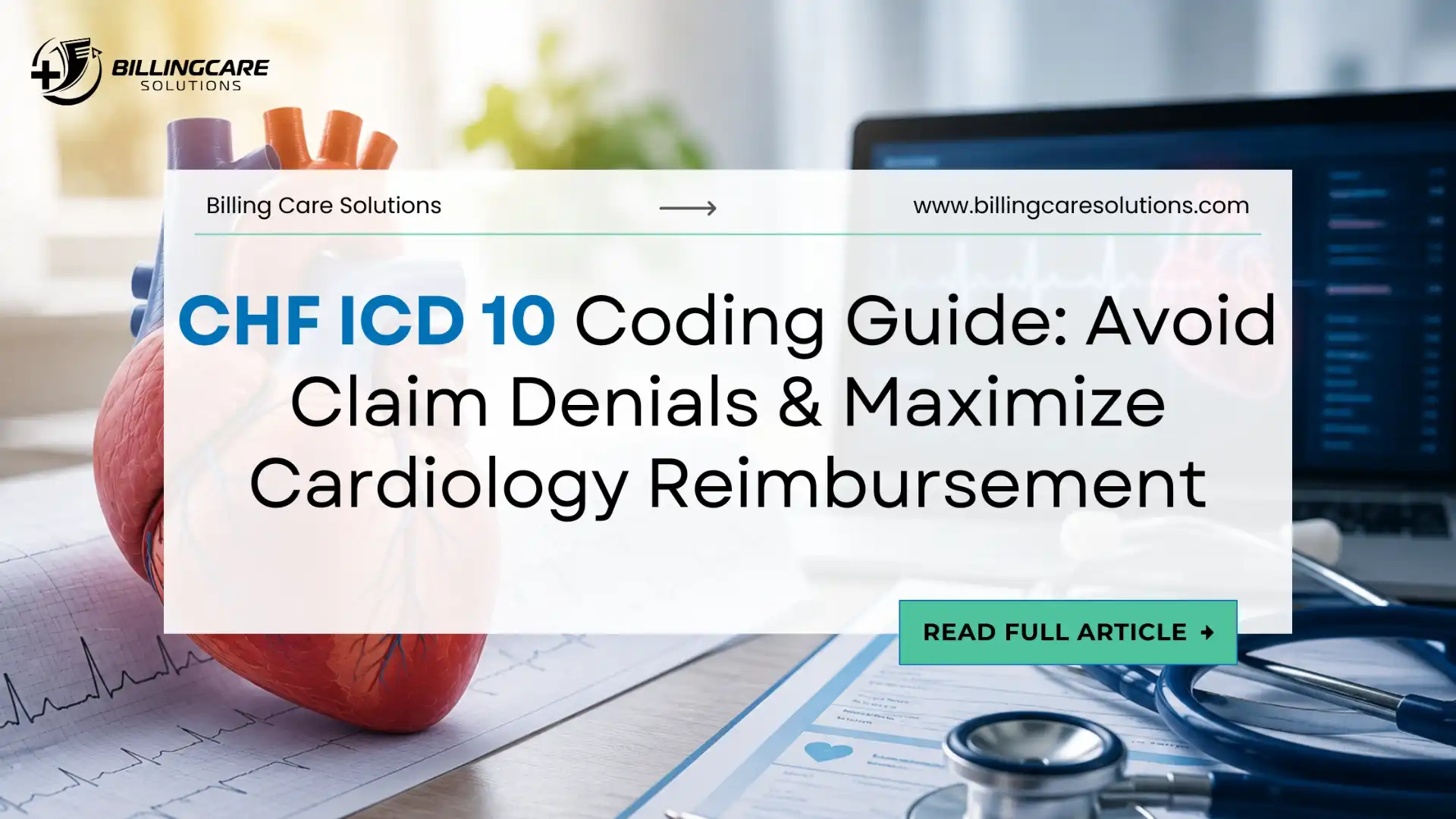
Congestive heart failure is among the top chronic conditions that require frequent treatments in healthcare facilities. As it is a difficult and costly treatment, it is highly important to code it correctly to get money back. Employing the right CHF ICD 10 codes is merely not a coding requirement. It has a significant impact on approvals, payments and payer guidelines compliance. This article specifically spells out the coding of CHF in the ICD-10 diagnosis codes, so that the providers and the billing teams won’t make any mistake.
Understanding CHF ICD 10 Coding Guidelines
To ensure proper claim submission and reimbursement, CHF ICD 10 coding relies on precise diagnosis information. Heart failure conditions are categorized in the ICD 10 CM code system under the code category I50. It is the coder’s responsibility to choose the most specific code given that documentation by the provider.
The correct code selection depends on three key factors:
- Type of heart failure
- Acuity status
- Provider documentation details
Heart failure types: systolic, diastolic and combined systolic and diastolic. There are different CHF ICD 10 codes for each category which enables the billing team to report the patient’s condition accurately. Acuity also has a significant role to play in coding. Providers need to clearly record if the condition is acute, chronic or acute on chronic. Reporting only “CHF” for instance, could result in an un-specific code even if the medical record shows it is a more specific code.
Correctly coded CHF ICD 10 supports medical necessity, severity of the patient, and the complexity of treatment. It also minimizes the delay for claims due to lack of information or mis-usage of codes. Billing teams should thoroughly check clinical notes and collaborate with providers if documentation does not provide the highest degree of specificity. Regular coding review process ensures adherence to coding standards and safeguards reimbursement.
Most Commonly Used CHF ICD 10 Codes
| CHF ICD 10 Code | Description | Coding Focus |
|---|---|---|
| I50.9 | Heart failure, unspecified | Use when no further details are documented |
| I50.20 | Unspecified systolic heart failure | Systolic type without acuity |
| I50.21 | Acute systolic heart failure | Requires acute status |
| I50.22 | Chronic systolic heart failure | Requires chronic status |
| I50.23 | Acute on chronic systolic heart failure | Requires acute and chronic details |
| I50.30 | Unspecified diastolic heart failure | Diastolic type without acuity |
| I50.31 | Acute diastolic heart failure | Requires acute documentation |
| I50.32 | Chronic diastolic heart failure | Requires chronic documentation |
| I50.33 | Acute on chronic diastolic heart failure | Requires both statuses |
| I50.40 | Unspecified combined heart failure | Combined type without acuity |
| I50.41 | Acute combined heart failure | Requires acute status |
| I50.42 | Chronic combined heart failure | Requires chronic status |
| I50.43 | Acute on chronic combined heart failure | Requires complete acuity details |
Acute, Chronic, and Acute on Chronic CHF Coding Differences
It is critical to clearly identify the level of acuity in CHF ICD 10 coding. The type of heart failure can be acute, chronic, or acute on chronic. The accurate choice of category enables coders to provide appropriate diagnosis codes, facilitate medical necessity and minimize reimbursement problems.
| CHF Type | Coding Details |
|---|---|
| Acute CHF | Reports sudden worsening of heart failure. Codes include I50.21, I50.31, and I50.41. |
| Chronic CHF | Represents ongoing heart failure management. Codes include I50.22, I50.32, and I50.42. |
| Acute on Chronic CHF | Indicates a chronic condition with acute worsening. Codes include I50.23, I50.33, and I50.43. |
If you use any code that isn’t specified, this can lead to billing issues if there is more detail in the documentation. Frequent documentation reviews and provider education ensure that coding teams have the most specific documentation and practice compliant reimbursement.
Documentation Requirements for CHF ICD 10 claims Accuracy
Correct claim denials are prevented with accurate documentation, which enables accurate CHF ICD 10 code selection. Medical Records are used by payers to verify details of diagnosis, medical necessity, and treatment complexity. Providers are expected to document all the information regarding heart failure in order to ensure proper billing.
Document Heart Failure Type: The providers need to indicate if the patient is suffering from Systolic Heart Failure or Diastolic Heart Failure or Systolic and Diastolic Heart Failure. It is important for the coders to choose the right ICD 10 code for CHF and not resort to using general codes.
Include Acuity Status: Documentation should include if the condition is acute, chronic or acute on chronic. Specificities about acuity may be omitted, which could lead to less specific coding and incorrect reimbursement.
Support Diagnosis With Clinical Findings: When there are associated conditions/complications, record these. Full diagnosis reporting enables accurate diagnosis levels and risk adjustment.
Capture Related Conditions: Associated conditions and complications should be documented when applicable. Complete diagnosis reporting helps reflect patient severity and supports accurate risk adjustment.
Maintain Clear Provider Documentation: Keep documentation consistent across providers to help assign consistent and specific ICD 10 codes for CHF. Coding reviews and provider education lower coding mistakes, enhances compliance and lowers unnecessary claim denials.
Common CHF ICD 10 Coding Errors Causing Denials
If claims are denied, payments are delayed and compliance issues arise due to incorrect CHF ICD 10 coding. Most denials are due to lack of documentation to support the selected code or missing key diagnosis information.
Using Unspecified CHF Codes: Using unspecified codes, e.g. I50.9, instead of a more specific diagnosis may decrease coding accuracy if documentation indicates a more specific diagnosis. Providers should record the type and the acuity of the heart failure, to help code selection.
Missing Acute or Chronic Status: If not acute, chronic or acute on chronic is not identified, coding gaps occur. Having complete acuity documentation allows the coder to complete the report with detail without being challenged by the payer.
Incomplete Clinical Documentation: If the documentation contains missing information, such as the missing symptoms, diagnostic information, or treatment details, payers may not be able to validate the medical necessity. Accurate claim processing and clear documentation for accurate CHF ICD 10 coding.
Incorrect Code Selection: Choosing a code that does not match the provider’s documentation can result in claim denials and audit risks. Coding teams should verify diagnosis details before submitting claims.
Ignoring Related Conditions: A mismatch with the provider’s documentation can lead to claim denials and audit risks. Coding teams to check diagnosis before claiming.
Recurring errors, CHF ICD 10 accuracy and claim denials can be avoided through regular coding audits and provider education.
The Revenue Impact of CHF Coding Denials
Denials of coding are not a one-way street. They have a direct impact on the practice’s financial health, cash flow and revenue. Knowing what financial implications arise supports practices to focus on coding accuracy and denials.
| Revenue Impact Area | How It Affects Revenue | Estimated Annual Cost |
|---|---|---|
| Denied claim value | Reimbursement is delayed or lost entirely | $100,000 |
| Administrative rework | Staff time spent reviewing and resubmitting claims | $3,750 |
| Appeal costs | Resources used to challenge incorrect denials | $10,000 |
| Unspecified code penalty | Lower DRG assignment reduces payment | $170,000 |
| Write-offs | Claims that are never recovered | $25,000 |
| Audit recoupments | Retroactive claim adjustments requiring repayment | $15,000 |
| Compliance penalties | Fines for systemic coding errors | Varies |
| Provider productivity loss | Time spent on payer inquiries instead of patient care | $5,000 |
| Estimated Total Revenue Impact | $328,750+ |
The Solution: CHF ICD 10 Workflow for Claim Accuracy
A streamlined CHF ICD 10 workflow helps providers, coders, and billing teams, thereby minimizing claim denials and improving accuracy. A consistent process ensures that the diagnosis will be backed up with documentation and reported as most specifically as possible.
Step 1: Review Provider Documentation
Begin with a detailed review of the patient’s medical record. Confirm the documented heart failure type, including systolic, diastolic, or combined heart failure. Check whether the provider has identified the condition as acute, chronic, or acute on chronic.
Step 2: Validate CHF Diagnosis Details
Coding teams should compare the selected CHF ICD 10 code with the provider’s documentation and clinical findings. This step helps identify missing details that may require provider clarification before claim submission.
Step 3: Assign the Most Specific Code
Avoid using unspecified CHF codes when the medical record supports a more detailed diagnosis. Selecting the correct code improves claim accuracy and supports proper reimbursement.
Step 4: Perform Claim Review Before Submission
A final claim review helps identify coding inconsistencies, missing documentation, and potential payer concerns. Early correction reduces delays, denials, and unnecessary rework.
Step 5: Monitor Denial Trends
Regular denial analysis helps providers identify recurring CHF coding issues. Reviewing rejected claims provides insights into documentation gaps and improves future coding practices.
A reliable CHF ICD 10 workflow strengthens compliance, improves reimbursement accuracy, and helps providers submit cleaner claims. Billing teams that follow a structured review process can reduce financial losses caused by coding errors and documentation issues.
Why Choose Billing Care Solutions for CHF ICD 10 Coding Support
Accurate CHF ICD 10 coding requires strong documentation review, coding expertise, and an understanding of payer requirements. Billing Care Solutions works as a trusted cardiology medical billing company helping practices improve claim accuracy, reduce denials, and maintain compliant billing workflows. Our cardiology billing services support providers with detailed claim reviews, diagnosis validation, and documentation checks. The team ensures CHF diagnoses are reported with the correct specificity, including heart failure type and acuity status.
Billing Care Solutions helps cardiology practices manage common challenges such as unspecified CHF coding, missing documentation details, and payer claim delays. By combining coding knowledge with revenue cycle expertise, practices can improve reimbursement outcomes and focus more on patient care. From CHF ICD 10 code selection to denial prevention, our cardiology billing services provide a structured approach to cleaner claims, stronger compliance, and improved financial performance.
Reducing Revenue Leakage Through CHF ICD 10 Audits
| Audit Metric | Expected Benchmark | Audit Purpose |
|---|---|---|
| CHF Code Accuracy | 95% or higher | Verify correct ICD 10 code selection |
| Unspecified Code Usage | Less than 5% | Identify missed coding specificity |
| Documentation Match Rate | 95% or higher | Ensure codes reflect provider notes |
| Acuity Documentation | 90% or higher | Confirm acute, chronic, or acute on chronic status |
| Coding Error Recurrence | Below 5% | Measure improvement after corrections |
These benchmarks help billing teams evaluate CHF ICD 10 coding performance, identify documentation gaps, and create targeted improvement plans after each audit cycle.
Conclusion
CHF ICD 10 coding must be done correctly to ensure reimbursement, compliance, and the facility’s financial viability, and to maximize the financial health of health care organizations. Documentation, specificity of ICD 10 codes, and detail regarding the Heart Failure diagnosis must be updated and knowledge must be current. CHF ICD 10 codes knowledge, avoid common mistakes, and work with reputable billing placeholders such as Billing Care Solutions, health care institutions can mitigate their financial loss and improve health care services.
Legislation with regards to coding is focused on reimbursement, billing organization, and oversight compliance. This is due to the quality of health care delivered. Care that is quality requires documentation and coding that demonstrates the coding done is clear and accurate.
Frequently Asked Questions
The ICD 10 code for CHF is I50.9 for Unspecified heart failure. Specific codes are dependent on a documented heart failure condition with either systolic or diastolic failure or combined failure.
There is no specific ICD 10 code for CHF exacerbation. The code for heart failure will be selected based on the documented type of heart failure, failure acuity and whether it is acute or chronic.
Unspecified CHF is ICD 10 CM code I50.9. It is to be used when no documentation is provided to identify the type of heart failure or acuity status.
The ICD 10 code for acute systolic CHF is I50.21. This is the code for acute systolic heart failure identified by the healthcare provider.
Correct ICD 10 coding ensures that the healthcare services are reimbursed correctly. Cardiology practices can minimize claim denials and ensure the accuracy of payments with detailed documentation.
The most frequent ICD 10 coding mistakes that will be found by common CHF coding mistakes are missing acuity information and choosing the wrong codes. Many times, these errors are made because the documentation from the provider is not complete.
The documentation of the type and acuity of heart failure must be included with CHF ICD 10 codes. Treatment plans and clinical findings, as well as diagnosis information, enable accurate claims to be submitted.
Codes for CHF other than “unspecified” are not used when there is supporting documentation for specific codes. Detailed coding increases the accuracy of the reimbursement, and reduces the risk of claim denials or payer reviews.
CHF coding audits reveal documentation deficiencies and erroneous coding. Periodic audits enhance coding practices and minimize risk of claim denials for the business.
Providers ensure that coding for CHF is accurate with proper documentation and periodic reviews. Accurate diagnostics information enables coders to use the right codes and ensures claims are submitted with no errors.
