


Losing Revenue to Eligibility & Prior Auth Gaps? Discover an FQHC RCM Solution That Recovers Every Dollar
See how an FQHC RCM solution helps close eligibility and prior authorization gaps, reduce claim delays, and recover revenue from preventable billing issues.
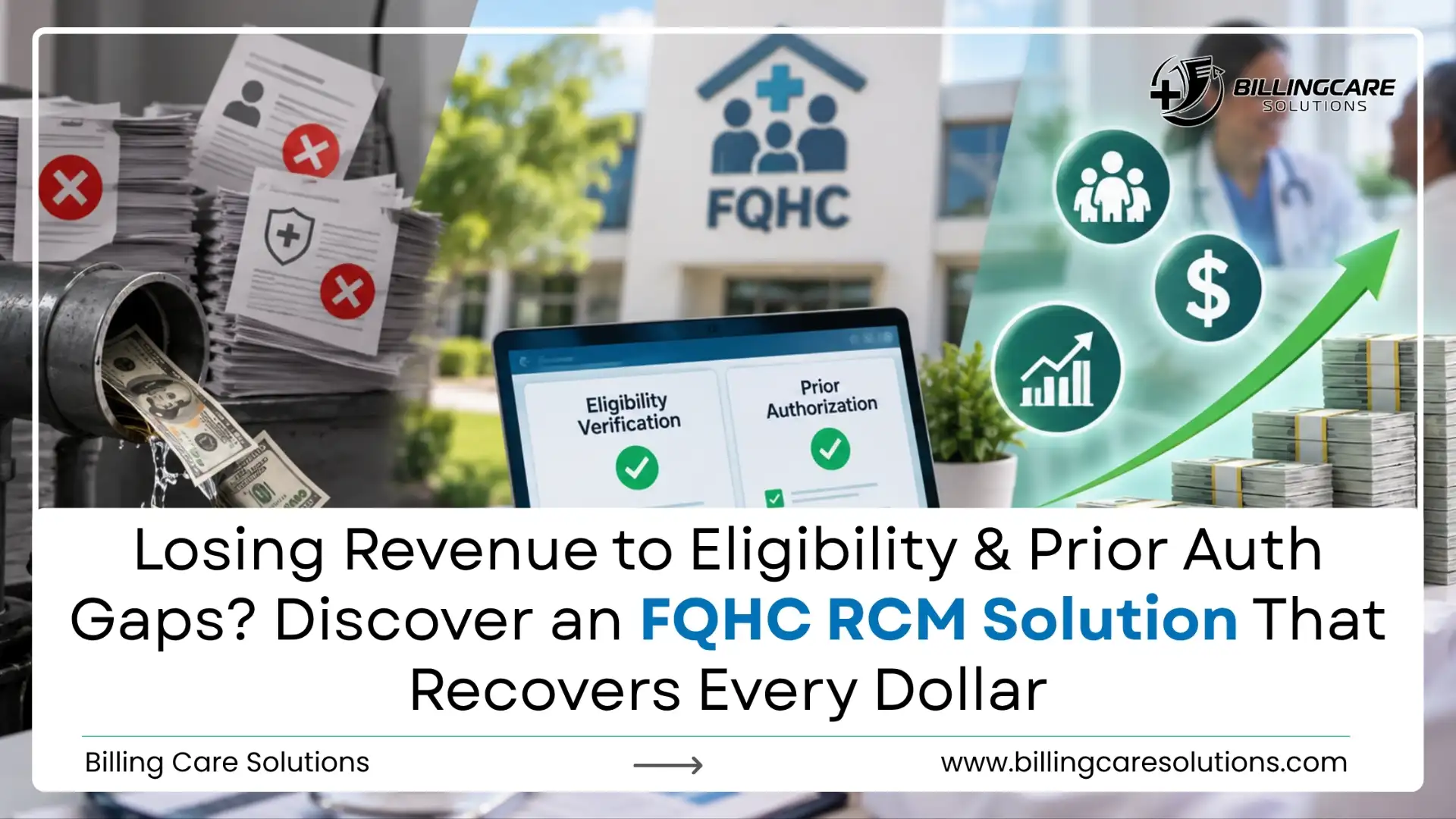
A single billing error isn’t the end of the world for community health centers. Sometimes the losses start with smaller gaps that show up between the scheduling, eligibility verification, authorization, claim submission and payment. A Medicaid patient may exhaust coverage prior to the appointment, and a referral may need to be authorized which the staff only learns about after denial. Household income or eligibility information may also change and a sliding fee determination may not be modified.
The workflow needs to address these gaps within the actual financial structure of federally qualified health centers. PPS or APM reimbursement, Medicaid managed care, sliding fee requirements, 340B revenue, and UDS reporting create risks that standard physician billing workflows may miss. This blog examines where revenue leakage starts, why internal workflows can leave recurring gaps, and what an effective FQHC RCM solution should control.
The 2026 Operating Reality for FQHCs
FQHC financial performance depends on more than claim volume and collection totals. Health centers manage multiple reimbursement models, patient assistance requirements, government program obligations, and payer rules at the same time. Small workflow failures can therefore affect both cash flow and the accuracy of financial reporting.
| Operating reality | Financial effect |
|---|---|
| Compressed operating margins | Small revenue leaks can materially affect available cash. |
| Claim denials and underpayments | Unresolved claims keep expected reimbursement out of working capital. |
| Denial rework costs | Staff time increases when preventable claims require repeated follow-up. |
| Billing staff turnover | Payer knowledge and workflow experience can leave with employees. |
| Payer and program audits | Weak documentation and inconsistent processes increase compliance exposure. |
| Multiple revenue streams | Billing, 340B, grants, and patient payments require separate financial visibility. |
The revenue cycle must reflect how health centers actually operate. It should connect front-end registration data with claim requirements and payment outcomes. Leadership also needs reporting that separates billing performance from other revenue sources.
Why FQHC Revenue Leaks Differ From Standard Medical Billing
FQHCs operate under reimbursement structures that differ from ordinary physician practices. Many encounters are reimbursed through prospective payment system methodology or an alternative payment methodology, depending on the health center and payer arrangement. This makes encounter configuration, qualifying services, documentation, and payer-specific billing rules important to reimbursement accuracy.
Sliding fee requirements add another financial layer. Patient charges may depend on household income, family size, documentation, and the applicable discount schedule. Medicaid coverage can also change independently from a patient’s managed care plan assignment, creating different verification needs before the claim reaches the payer. Effective revenue cycle management must understand these relationships before measuring claim performance. It should identify whether a problem began with coverage, authorization, encounter configuration, coding, documentation, or payer processing. That distinction gives revenue leaders a clearer view of where money is being lost.
The Eligibility Gap: Where FQHC Revenue Quietly Disappears
Claim errors may not be visible until the claim goes to adjudication. Patients can be seen as active in an older system record even if the coverage is over or changed. The claim then progresses through billing until the staff realize that the claim will not be paid back by the payer. Eligibility should be treated as a financial control, not only a registration task. Verification should occur at defined points throughout the patient journey. The workflow should also capture payer changes and coverage details that affect downstream claim submission.
Real-Time Versus Batch Eligibility Verification
Batch verification can confirm coverage for a defined patient list, but it may miss changes between the verification date and the appointment. This creates risk when Medicaid eligibility changes during a redetermination period. Real-time verification closer to the encounter gives staff a more current coverage status. A more effective eligibility workflow should establish when coverage is checked and what happens when it changes. Scheduling-time verification can identify problems before services are delivered. A second check before claim submission can catch changes that occurred after the visit.
Medicaid Redetermination and Coverage Changes
There are three types of changes that can occur when Medicaid redeterminations are provided: patient coverage status, payer assignment, or enrollment information. These changes may impact the claim’s submission to a particular payer or the information needed to be included in the claim. Checking eligibility only at registration results in a gap in coverage when there is a change in eligibility. An FQHC RCM solution should distinguish Medicaid eligibility from managed care enrollment when the payer workflow requires it. Staff need actionable alerts when coverage information changes. The system should also document verification results so unresolved coverage issues have an accountable owner.
Sliding Fee Scale Determination Errors
Sliding fee discounts depend on current patient information and the health center’s approved policy. Household size, income documentation, and eligibility periods can affect the patient’s financial responsibility. Outdated information can create inconsistent charges or patient balances. The workflow should connect patient financial information with the applicable sliding fee requirements. Staff should know when documentation needs renewal or review. This helps reduce avoidable patient balance corrections and protects consistency across encounters.
The Prior Authorization Gap: Denials You Never See Coming
Eligibility failures can delay payment, but authorization failures often create denials after services have already been provided. The problem may involve the service, payer, ordering provider, diagnosis, authorization period, or approved units. Correcting the claim later can require clinical documentation, payer communication, and additional billing work. Authorization should therefore be managed as its own workflow. Authorization status needs to remain visible from referral or scheduling through claim submission. The process should also identify expiration dates, approved services, and remaining units before staff release the claim.
Why FQHCs Face Unique Prior Auth Exposure
FQHCs coordinate primary care with behavioral health, specialty referrals, diagnostic services, and other community-based care. Authorization rules can differ across Medicaid managed care plans, Medicare, and commercial payers. A requirement that applies to one payer may not apply to another. An FQHC RCM solution should maintain payer-specific authorization requirements instead of relying on general billing knowledge. Referral staff, authorization teams, and billers should work from the same information. This reduces the chance that an approved service becomes a denied claim because the authorization details were incomplete.
True Cost of Unworked Prior Authorization
The cost of an authorization failure extends beyond the denied amount. Staff must research the denial, locate documentation, contact the payer, correct the claim, and monitor the response. Clinical and front-office staff may also become involved when missing information must be obtained. A strong FQHC RCM solution should measure these downstream costs by denial category. Leadership can then compare preventable authorization failures against staff time and recovered reimbursement. This makes authorization performance a financial metric instead of an isolated billing task.
Tracking Authorizations Across the Full Episode of Care
An authorization can exist while the submitted claim still fails. The claim may contain the wrong service code, modifier, units, provider information, or authorization reference. An approved authorization therefore does not automatically mean the claim is ready for payment. A strong FQHC RCM solution should connect authorization details with the final claim configuration. Staff should be able to verify approved services and limits before submission. This creates a control between authorization approval and clean claim release.
Why Eligibility and Prior Auth Gaps Keep Reopening
Many FQHCs already have billing staff, practice management systems, clearinghouse reports, and denial work queues. Yet the same eligibility and authorization issues can continue appearing each month. The problem often sits in ownership, timing, data classification, and payer knowledge rather than effort.
Reason 1: Nobody Truly Owns Clean Claim Rate
Coders, billers, registration staff, and denial specialists may each own part of the claim process. Without one accountable owner, no team owns the final clean claim outcome. Problems can therefore move between departments without a clear performance target. A useful FQHC RCM solution should assign ownership for clean claim performance. The target should be measurable and tied to defined reporting periods. Leadership can then identify whether performance changes are coming from registration, authorization, coding, or billing.
Reason 2: Denials Get Worked, Not Learned From
A denial can be corrected and closed without giving reasons for a denial. Consistent categorization is essential to leadership to know if the same payer rule continues to generate new work. The billing staff then dedicates their time to resolving individual claims rather than identifying the underlying cause of the recurring claims. An RCM solution for data-driven FQHC should convert denial categories into regular reports. Each of the eligibility, authorization, coding, documentation, timely filing, and payer processing should be monitored independently. This represents the opportunity for financial impact from process changes.
Reason 3: Coverage Gets Verified at the Wrong Moment
Checking coverage only at check-in leaves the scheduling period exposed. A patient’s coverage can change after the appointment is created but before the encounter occurs. Staff may then discover the problem after services have already been delivered. An FQHC RCM solution should define verification points around the patient journey. Scheduling, pre-visit review, and pre-submission checks can serve different purposes. Each check should produce an action when coverage information does not match the expected payer.
Reason 4: Payer Authorization Rules Live in People’s Heads
Experienced employees often carry detailed knowledge about payer requirements. That knowledge becomes difficult to replace when staff leave or payer rules change. New employees may follow outdated instructions because the organization lacks a central source of truth. A reliable FQHC RCM solution should maintain payer-specific requirements in a controlled workflow. Updates should reach the teams that schedule, authorize, code, and bill services. This reduces dependence on individual employee memory.
What a Working FQHC RCM Solution Must Include
The right FQHC RCM solution should satisfy specific operational requirements. These requirements should be visible in workflows, contracts, reporting, and performance reviews. They should also reflect FQHC reimbursement structures rather than standard physician billing alone.
1. Named Owner for Clean Claim Rate
A specific person or team should own the clean claim target. The responsibility should be measurable and reviewed regularly.
2. Mandatory Root Cause Tagging
Every denial should receive a consistent category before closure. Reports should show recurring causes by payer, service, location, and period. A useful FQHC RCM solution turns denial data into operational decisions. Leadership can identify which problems need workflow changes instead of additional claim rework.
3. Eligibility Verification at Scheduling
Coverage should be checked when appointments are created and again when needed before submission. The process should flag changes instead of relying on manual discovery. An FQHC RCM solution should define these verification points within the workflow. Each exception should have an owner and documented resolution status.
4. Payer Rule Library
Authorization and billing requirements should be maintained centrally. Staff should have access to current payer rules without depending on informal instructions. An FQHC RCM solution should have a controlled payer rule library. It should support updates when Medicaid managed care plans and commercial payer requirements change.
5. PPS and 340B Fluency
The team should understand FQHC reimbursement structures and the relationship between clinical services and 340B pharmacy operations. General billing experience does not automatically provide this knowledge. This is where an FQHC RCM solution should demonstrate specialized FQHC expertise. The workflow should account for encounter billing, payer requirements, and revenue reporting without treating every claim like a standard office visit.
6. Grant-Aware Financial Reporting
Reports should distinguish billing revenue from grants, 340B revenue, patient payments, and other funding sources. This gives leadership cleaner visibility into the performance of the billing operation.
| Requirement | What it prevents | How to verify it |
|---|---|---|
| Named clean claim owner | Unclear accountability | Review assigned owner and monthly target. |
| Root cause denial tagging | Recurring unexplained denials | Review category reports by payer. |
| Scheduling-time eligibility | Coverage changes before visits | Audit verification timestamps. |
| Payer rule library | Knowledge loss after turnover | Review, update history and access. |
| PPS and 340B knowledge | FQHC-specific billing errors | Test workflows and staff competency. |
| Grant-aware reporting | Mixed revenue visibility | Review revenue categories in reports. |
How Billing Care Solutions Meets These Requirements
Billing Care Solutions positions its FQHC RCM solution around the operating model of community health centers. Its approach combines billing operations, eligibility workflows, denial analysis, payer requirements, and financial reporting. The goal is to give FQHC leadership one accountable view of revenue cycle performance.
| Requirement | Billing Care Solutions approach |
|---|---|
| Named clean claim owner | Dedicated account ownership with defined performance reporting. |
| Root cause tagging | Denials categorized by cause for recurring pattern analysis. |
| Scheduling-time eligibility | Eligibility checks integrated into front-end and pre-submission workflows. |
| Payer rule library | Centralized payer requirements for authorization and billing workflows. |
| PPS and 340B fluency | FQHC-focused billing knowledge and claim review controls. |
| Grant-aware reporting | Financial reporting separates billing activity from other revenue sources. |
The strongest FQHC RCM solution is the one whose performance can be measured. Billing Care Solutions can use operational reporting to show where claims fail and how those failures affect collections. FQHC leaders should request client-specific proof before accepting any recovery claim.
Measuring ROI: What Recovery Actually Looks Like
Healthcare leaders should evaluate an FQHC RCM solution using financial outcomes, not activity counts alone. The review should connect preventable denials, clean claim performance, A/R, and staff rework to actual dollars. Baseline figures should come from the health center’s own billing data.
| Metric | Illustrative baseline | Illustrative target |
|---|---|---|
| Eligibility-related write-offs | $180,000 annually | 40% to 60% reduction |
| Prior authorization denial rate | 12% of referrals | Below 5% |
| Denial rework cost | $141,600 annually | 30% to 50% reduction |
| Clean claim rate | 78% | 95% or higher |
| A/R days | 48 days | Below 35 days |
These figures should be treated as planning examples, not universal FQHC benchmarks. A health center should calculate its own leakage from remittance data, denial reports, eligibility failures, and staff labor costs. The value of an FQHC RCM solution becomes clearer when leadership can compare baseline performance with post-implementation results.
Choosing the Right FQHC RCM Partner
An FQHC RCM solution must align with the reimbursement model, payer mix, staffing and reporting requirements of the health center. Executives should first try out how the company manages the workflows that have the highest financial risks before choosing a partner. Rushing to provide general assurances of quicker billing will not solve those issues.
Ask these questions before signing:
- How do you handle PPS wrap-around billing and 340B pharmacy claims?
- How do you track authorization through the full episode of care?
- Can your reporting separate grant revenue from billing revenue?
- What is your escalation path for recurring payer denials?
- Who owns the clean claim rate under the contract?
Watch for these red flags:
- No demonstrated PPS knowledge.
- No understanding of 340B revenue workflows.
- Reporting that combines unrelated revenue streams.
- No documented denial root cause process.
- No accountable owner for clean claim performance.
- No clear payer escalation process.
Eligibility failures, authorization denials, clean claim performance, A/R and payer mix, should be reviewed as a baseline and served as the starting point for implementation. The migration should also clearly outline the ownership, frequency of reporting, escalation procedures, and workflow changes prior to the new process’s implementation. FQHC RCM solutions should allow for the tracking of performance from the initial reporting cycle.
Is Your FQHC Losing Revenue Before Billing Even Starts?
Leadership can identify front-end leakage by reviewing a few operational questions. How many scheduled patients lose coverage before the visit? How many authorization denials involve requirements that staff could have identified earlier? How often do payer rules change without a documented workflow update? An FQHC RCM solution should give leadership the data needed to answer these questions. The review should connect front-end failures with downstream denials and write-offs. This creates a financial view of revenue leakage instead of treating each issue as an isolated billing task.
Turn FQHC Revenue Leakage Into Measurable Recovery
Before a claim gets adjudicated, there can be revenue leakage due to gaps in eligibility and prior authorization. All of these gaps are complex by the implementation of the PPS, sliding fee, Medicaid managed care, 340B, UDS, and reporting requirements FQHCs must deal with. The proper controls then need to tie front-end verification to authorization, claim quality, denial analysis, and financial reporting.
Ownership should be easily known and performance easily measurable in a qualified FQHC RCM solution. It should indicate loss of revenue, why the loss occurs and which workflow should be corrected. If you are considering Billing Care Solutions, a comprehensive FQHC billing evaluation can provide an existing level of leakage baseline and determine the priority opportunities for recovery.
