


5 Dental Billing and Coding Denial Reasons and How to Reduce Them by 80%
Find out why Dental Billing and Coding claims get denied and how dental practices prevent errors, reduce denials, and improve revenue cycle performance.
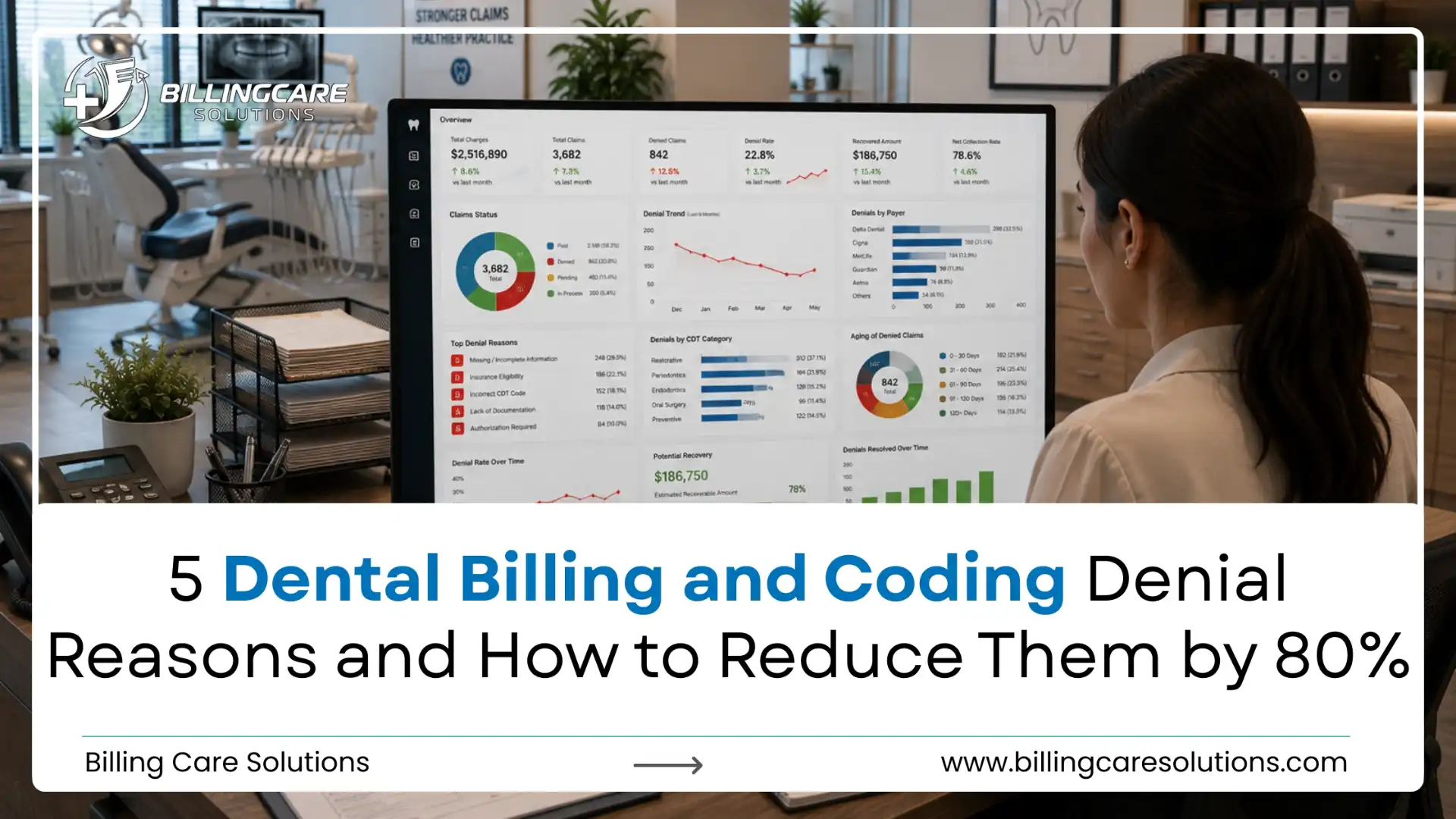
The dental revenue cycle is a problem that is increasingly challenging for practices in the United States. Denied claims, growing administrative burdens, and inaccurate dental billing and coding are costing money. An estimated loss of $15 billion to the U.S. dental industry occurs each year from claim denials, claim documentation failures, and inefficient claims billing.
It impacts dental practices of every scale, from individual providers to huge Dental Service Organizations. Proper dental billing and coding practices can help practices avoid claims errors, late payments, and more administrative strain. The denial issue keeps getting worse, as 78 percent of dental offices say denials have increased or payers are being more vigilant about them in the last year.
Why Nearly One in Five Dental Claims Gets Denied
Recent statistics reveal that about 15% of dental claims end up being denied by insurance providers, and 19.3% are denied upon initial submission. Almost one in five claims is delayed right from the start. This rejection rate has been rising in recent years. Increased claim rejection rates from dental practices are caused by coding, under documentation, eligibility, and evolving payer requirements. To avoid these lost revenues, it is necessary to employ effective dental billing and coding practices.
How Denials Create a Domino Effect on Your Revenue Cycle
Each denied and delayed claim adds to the dental revenue cycle. Staff spend time correcting claims, chasing up payers and dealing with resubmissions instead of patient care and growth activities. Also, insurance processing delays and incorrect balances can lead to billing issues for patients. In the meantime, practices are subject to random cash flow and rising admin costs.
An average of 9% of collectible revenue is lost in practices using inefficient revenue cycle processes because of a variety of denied claims, delayed follow-up work and missing communication. Having a good dental billing and coding workflow can help you identify mistakes sooner, ensure claims are accurate, and helps to receive reimbursements faster.
Financial losses from dental claims aren’t just from unpaid claims. Every claim that is rejected must be reviewed, corrected, and then go through the administration process again before claims can be recovered. These expenses can be hundreds of thousands of dollars per year for medium-sized practices.
The $280K Revenue Loss From Dental Denials
Around $280,800 can be lost from a medium-sized dental practice each year because of claim denials. The losses can come from billing problems, missing documentation and the needs of the payers that affect dental billing and coding accuracy.
Financial effects increase if practices take into account the cost of denial follow-up. Rejected claims require several hours a week of review, error correction and communication by staff members with payers. The more steps involved, the higher the administrative cost and the longer the reimbursement takes. Whenever possible, eliminate preventable denials so dental practices can capture the income that has already been earned due to patient services rendered.
The Hidden Operational Costs of Denied Claims
Dental claim denials come at a price. For each deny, dental billing and coding services will have to follow-up with claim investigation, documentation review, claim corrections and resubmissions.
| Hidden Cost | Impact on Dental Practices |
|---|---|
| Staff time | Reduces focus on patient support and revenue activities |
| Claim rework | Increases administrative expenses |
| Delayed payments | Slows cash flow and collections |
| Staff burnout | Creates workflow pressure and turnover risks |
| Patient confusion | Increases billing complaints |
Patient experience is also impacted by high denial volumes. When wrong dental billing and coding or delayed insurance processing, or even an unexpected balance occurs, it decreases patient satisfaction and trust.
Why Most Denied Claims Never Recover Revenue
Following up on denied claims is one of the greatest monetary issues dental practices face. Limited staff resources, complicated payers’ requirements, or workflow inefficiencies are among the factors that prevent many practices from resubmitting and appealing rejected claims. If there is an absence of good dental billing and coding, denied claims may not be resolved. Without documentation, paperwork errors, or missed follow-ups, practices can lose out on monetizing earned revenue.
Industry statistics reveal that many denied claims are never reworked, resulting in huge revenue loss opportunities. Structured denial management can help uncover why claims are denied, prioritize high dollar claims and increase recovery. When properly dental billing and coding to patients, along with being able to monitor denials proactively, practices can recover more payments, reduce revenue leakage, and have a healthier revenue cycle.
The 5 Dental Claim Denial Reasons and Solutions
Dental billing and coding are a crucial part of the dental practice and depend on the accuracy of patient details, proper procedure coding, and documentation. Simple billing mistakes can result in late payments and in loss of revenue. By comprehending common denial reasons, practices can enhance claim accuracy and have better revenue cycle management.
Denial Reason 1: Missing Insurance Verification
One of the most frequently occurring problems in dental billing and coding is that it will not be verified as complete. Claims are frequently denied before being processed due to expired policies, inaccurate coverage information, or lack of authorizations.
Solution:
Confirm insurance coverage prior to scheduled visits. Verify coverage, benefit limits, deductibles, and authorization. This proper verification can eliminate unnecessary claim rejection.
Denial Reason 2: Incorrect Patient Information
If there are incorrect patient details this can delay the claim. It’s common for names, policy numbers, addresses or member information to be incorrect, which leads to rejection by the payer.
Solution:
Check the patient’s details at each appointment. Keep insurance records up to date and verify information before treatment to increase the accuracy of claims.
Denial Reason 3: Incorrect CDT Code Selection
One of the biggest issues that arise in dental billing and coding is the selection of the appropriate CDT code. If the procedure is performed with a code that is not the one used, the claim may be rejected or reimbursement may be delayed. For instance, an intraoral complete series (D0210) could be confused with a panoramic radiographic image (D0330) and thus cause coding errors.
Solution:
Be sure to read the CDT codes carefully for the procedure that is documented. Frequent coding education assists to preserve accuracy.
Denial Reason 4: Outdated CDT Codes
New, revised and deleted codes are incorporated into the ADA every year. Older codes cause compliance problems and raise the likelihood of denials from payers.
Solution:
Make sure billing software, coding reference and employee training materials are updated for each CDT revision. The knowledge of the current coding aids in claim accuracy.
Denial Reason 5: Insufficient Documentation
Payers’ claim supporting documentation is weakened by incomplete documentation. It can be difficult to get procedures approved when X-rays, periodontal charts, or clinical notes are missing.
Solution:
Ensure that all claims have full clinical documentation. Supporting documentation should be clear and could provide adequate rationale for the billed procedure and follow coding guidelines.
How Professional Dental Billing and Coding Services Reduce Denials by 80 Percent
To avoid dental claim errors on submission, professional dental billing and coding can assist practices. Claim accuracy and revenue protection is achieved through the expertise of teams that bring together coding skills, verification of insurance, documentation review and denial management.
Preventing Eligibility and Authorization Errors
Many dentals are denied because of the wrong insurance information or lack of authorizations. Deductibles, copays, and insurance policy requirements are verified by professional billing teams to avoid unnecessary claims denial before treatment.
Improving CDT Coding Accuracy
Properly coded CDT is a crucial part of claim processing. Dental billing and coding professionals who have experience in the field know the latest CDT updates and payer rules, helping them to choose the right codes and avoid coding-related denials.
Strengthening Documentation Support
Properly documented procedures result in quicker claim processing. Billing teams review clinical notes, X-rays, and treatment records to ensure that these claims have the necessary information for their medical necessity and for the payers’ review.
Managing Denials and Appeals
Denials are monitored by professional billing teams, root causes are identified, and denials are corrected in a timely manner. This is a steps-by-steps process that will help recover lost revenue and avoid re-claiming claims.
Using Technology for Cleaner Claims
Today’s dental billing services leverage automation and analytics to pinpoint claim risks before they are even submitted. AI-powered tools identify missing information, coding problems, and documentation deficiencies to enhance the percentage of clean claims.
Dental Billing and Coding Workflow From Claim to Payment
Billing Care Solutions has a structured dental billing and coding workflow that enhances claim accuracy, expedites reimbursement and fortifies financial outcomes. Each of the phases is dedicated to enhancing the billing efficiencies and minimizing issues with revenue cycles.
Phase 1: Billing Performance Assessment
It all starts with a comprehensive examination of existing billing outcomes. Trends in claims, payer patterns, reasons for denials, and revenue gaps are examined for opportunities to improve.
Phase 2: Insurance and Patient Data Verification
Prior to a claim being submitted, eligibility for insurance is determined, as are claim details, coverage limits and authorization requirements. Ensuring that patient details are accurate can avoid unnecessary billing problems.
Phase 3: Coding and Claim Preparation
This is the final phase, in which students will learn how to code and prepare their claims. Dental procedures, CDT codes and documentation are reviewed to guarantee that the claim is accurate. Effective dental billing and coding processes ensure claims meet the expectations of payers.
Phase 4: Claim Submission and Follow-Up
Claims are submitted electronically and tracked during claim payment. Follow-up can help to identify issues that are on the horizon and facilitate timely reimbursement.
Phase 5: Denial Resolution and Revenue Recovery
Denied claims are looked at to see what went wrong and what can be done to recover. Proper documentation is followed to recover lost revenue for corrective actions, appeals.
Phase 6: Performance Reporting and Optimization
Reporting is done on key metrics such as clean claim rate, days in A/R, denial trends etc. Data-driven insights for a better billing future.
The Numbers That Prove Dental Billing Services Work
Professional dental billing and coding services can have a tangible effect on the dental business with specific revenue cycle enhancements. Specialized billing support practices can yield cleaner claims, quicker reimbursements, and improved financial visibility.
Before and After: The Denial Reduction Impact
| Metric | In-House Management | With Dental Billing Services | Improvement |
|---|---|---|---|
| First-pass denial rate | 15-25% | Less than 5% | 80% reduction |
| Clean claim rate | 70-80% | 95%+ | 15-25% improvement |
| Days in AR | 45-60 days | Less than 25 days | 20-35 days faster |
| Denied claims resubmitted | 35% | 95%+ | 60% improvement |
Case Study: Multi-Location Practice Reduces Denials from 22 Percent to 4 Percent
A multi location dental practice with 5 offices was having a 22 percent denial rate. Staff’s hours in denial management were 10 hours per week. Denials cost the practice $180,000 a year. The denial rate decreased to 4 percent in six months after hiring a professional dental billing service. Total staff time on denials was cut in half. The practice was able to recover $150,000 previously denied revenue.
Case Study: Solo Practice Recovers 45 Thousand in Denied Claims
A practice with one dentist was having a 28 percent denial rate. The practice owner was working 15 hours a week doing billing instead of caring for patients. Unresolved denials totaled $45,000. All denied claims were reviewed and appealed, following a partnership with a dental billing service. The practice was able to recover $42,000 of the $45,000 in denied claims. The denial rate decreased to 6 %.
Why Billing Care Solutions Is Your Dental Billing Partner
Billing Care Solutions offers comprehensive dental revenue cycle management for your dental practice, featuring dental billing and coding expertise. The team optimizes CDT codes for more accurate reimbursement and minimizes avoidable denials through claim submission and pre-authorizations. CDT updates, payer requirements and coding guidelines are tracked to ensure claims are accurately prepared. Insurance verification, claim submission and denial tracking processes can help to uncover opportunities for revenue and to ensure adherence with insurance regulations.
These dental billing and coding services offer comprehensive support to dental practices all the way from CDT code review to claim preparation, as well as for managing authorization for complex treatments. This organized system ensures a more streamlined billing process and enhances the financial results.
Conclusion
Dental claim denials don’t have to be a business expense. 80% of denials can be prevented with proper systems, checks and communication. Denials cost the average practice hundreds of thousands of dollars per year and these issues are easily preventable. Now is the time to redesign your dental billing process. Today is the second best day. The dental billers and coders provide professional billers and coders to eliminate the errors that lead to denials, speed up reimbursement, and allow your team to concentrate on patient care.
Dental billing and coding is not a cost of administration. It’s a revenue protection investment. The return on investment for using professional dental billing services is $5-$10 for every dollar invested in avoiding revenue loss. It is a quick and significant ROI.
Frequently Asked Questions
The average rate for dental claims to be denied is 19.3 percent. Almost 20% of the initial claims are denied. This growth is much greater than in 2022.
The average denial cost to a medium-sized dental practice is $280,800 a year. This excludes staff time to re-submit and appeal. The overall costs are significantly larger.
Dental claims denial statistics indicate that as many as 80 percent of dental claims are preventable. The majority of denials are due to a process failure that can be corrected by having the proper systems and training in place.
No insurance verification is the top reason for dental claims to be denied. Other common reasons are that the wrong CDT codes are used, an outdated code is used, or there is inadequate documentation of the medical necessity.
Dentists can cut down on denials by confirming coverage 48 hours prior to care. They should be using current CDT codes and they should be fully documented. With the help of professional billing services, one can get an 80 percent cut.
Only 1 percent of dental claims that are denied are appealed. This is even though research indicates that as many as 75 percent of all appeals are accepted. In most practices, recoverable revenue is just a cost of doing business.
There are 10 new codes, 8 revised codes and 2 deleted codes in the 2025 CDT code set. Outdated codes will be automatically denied. It is important to keep up on annual updates for clean claims.
Dental billing services use up-to-date CDT codes and ensure they’re charging insurance correctly. They are accompanied by appropriate documentation for all their claims. They monitor and pursue systematically denied revenues.
Administratively denied dental claims are never resubmitted by the patient about 65 percent of the time. This represents lost income forever as a result of no follow-up.
Dental claims should be made within 24-48 hours of treatment. Each payer has a “timely filing”. All claims submitted past the deadline are automatically denied, no matter how accurate.
