

Diverticulitis ICD 10 Coding Guide for Accurate Medical Claims
Clear Diverticulitis ICD 10 coding guide helps assign accurate diagnosis codes, improve documentation, and reduce errors for smoother claim approvals.
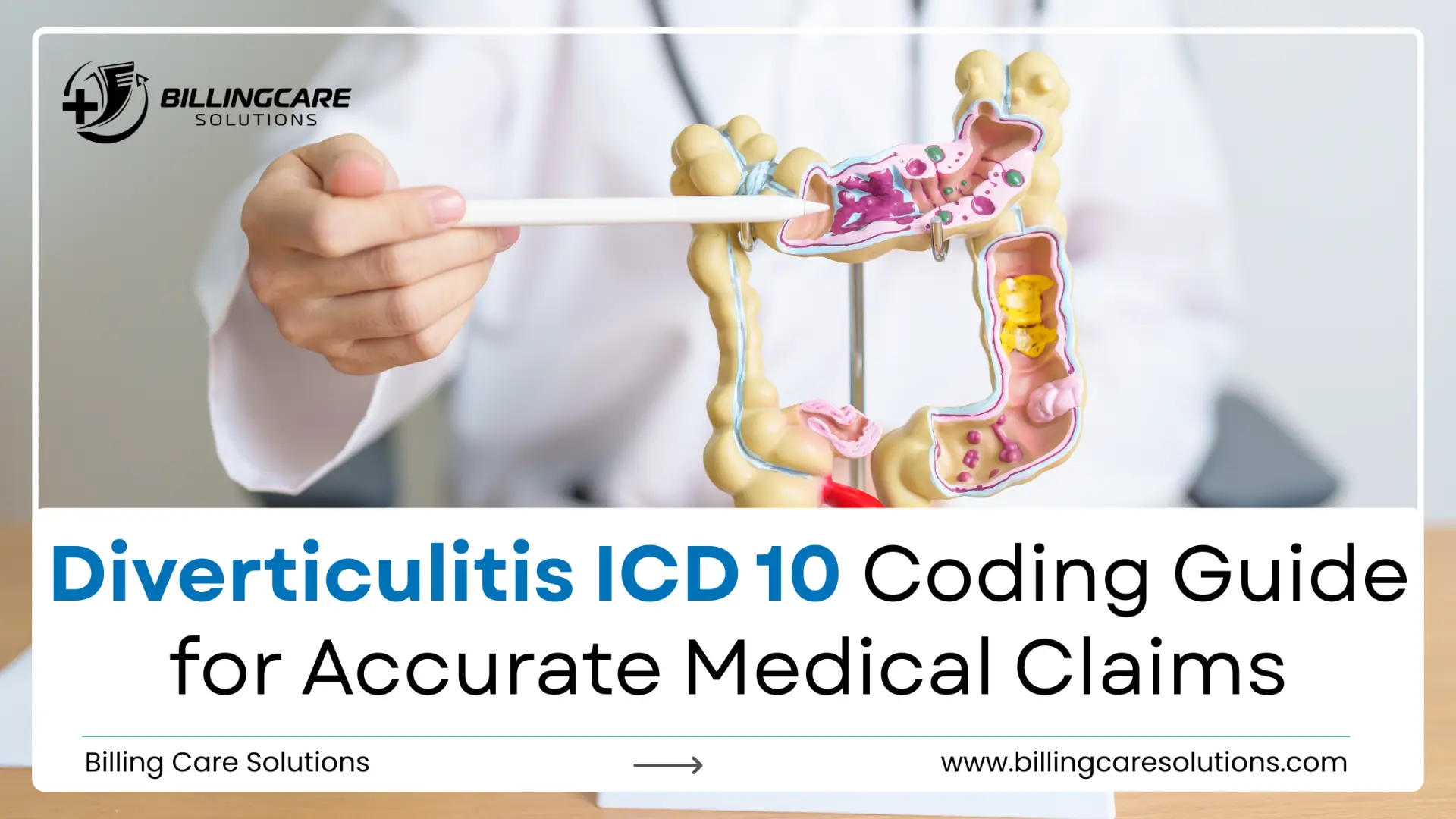
Diverticulitis is a prevalent gastrointestinal disorder among many patients, particularly the elderly. Accurate coding for medical billers and coders is crucial. Even minor coding errors can cause claims to be denied, payments delayed, and risks of compliance issues. In this article, we’ll cover everything you need to know about the Diverticulitis ICD 10 code. We’ll explain when to use diverticulitis versus diverticulosis, how to avoid coding mistakes and enhance the accuracy of medical claims. At Billing Care Solutions, we help providers improve their revenue cycle and deny rate. Our expert Gastroenterology Billing services will ensure your diverticulitis claims are accurately coded and billed.
What Is the Correct Diverticulitis ICD 10 Code
The Diverticulitis ICD 10 code is dependent on a number of factors. These include the site of the disease, whether there is a complication, and if so, whether it is with or without perforation or abscess. Diverticulitis falls under category K57. Coders should not rely on the first three characters. The fourth and fifth characters offer more information on complications and severity. Claims will be denied if you use an unspecified code. So, it’s important that you review the medical record before you code.
Differentiating Diverticulitis from Diverticulosis Using ICD 10
Diverticulosis is not diverticulitis. Diverticulosis is the presence of small pockets in the colon wall. The pouches are diverticula. The condition isn’t inflamed. The Diverticulosis ICD 10 code is K57.3. But, when the pouches become inflamed or infected, this is known as diverticulitis. The ICD 10 code for Diverticulitis will be K57.2 or K57.3 with further characters to indicate complications. Diverticulitis should never be coded as diverticulosis. This will result in errors in payment or an audit.
How to Code Diverticulitis Without Perforation or Abscess
If a patient has diverticulitis but not a perforation, abscess or bleeding, you will code the condition using a code from the K57.3 series. K57.30 is used to code diverticulitis of large intestine without perforation or abscess, without bleeding. This is the simplest form of the disease. The medical record should indicate that there is no evidence of a tear in the colon wall or an abscess. If the doctor mentions uncomplicated diverticulitis, this code should be used. Be sure to ask about placement as it can, in some rare instances, involve the small intestine.
Understanding the Diverticulitis ICD 10 Code Subcategories
The Diverticulitis ICD 10 code has a number of subcategories. These subcategories will indicate different levels of severity or complications. You need to look at the documentation and code the right subcategory. Coding a condition that is not accurate for the patient is known as upcoding or downcoding. These are never acceptable.
K57.3: Diverticulitis of Large Intestine Without Complications
K57.3 is the code for diverticulitis of the large intestine without perforation or abscess. K57.3 also branches off into two possibilities: with or without bleeding present. For example, K57.31 is for diverticulitis without perforation or abscess but with bleeding. K57.32 is for diverticulitis without perforation or abscess but without bleeding. These differences are based on medical necessity. The patient with bleeding may require more aggressive care. So, the insurance company wants a different code.
K57.2: Diverticulitis of Large Intestine With Perforation
The code for diverticulitis of the large intestine with perforation or abscess is K57.2. Perforation is when there is a hole in the wall of the intestine. An abscess is a collection of pus. Both are serious complications. The K57.2 codes are K57.20 for diverticulitis with perforation and abscess without bleeding. K57.21 is for diverticulitis with perforation and abscess with bleeding. These will often result in higher payments because the management is more complicated. But you need proper documentation from the doctor. Don’t make assumptions if it is not documented.
K57.4: Diverticulitis of Both Small and Large Intestines
Some patients will have diverticulitis in both the small and large intestine. This is rare but can happen. The Diverticulitis ICD 10 code for this is K57.4. As with the other groups, K57.4 may be subdivided to indicate with and without perforation, abscess and/or bleeding. For instance, K57.40 is for diverticulitis of both small and large intestines with perforation and abscess without bleeding. K57.42 is for diverticulitis of both small and large intestines without perforation and abscess without bleeding. Be certain to refer to the operative and progress notes for confirmation of both sites.
Using Additional Codes for Diverticulitis Related Complications
Diverticulitis can progress to involve other parts of the body. It can spread to other issues such as peritonitis or sepsis. If this is the case, you need to use more than one code. The Diverticulitis ICD 10 code will not completely explain the patient’s condition. Insurers need to know the full situation to authorise higher level care.
Coding for Diverticulitis With Bleeding or Abscess
Diverticulitis with bleeding should include a code for gastrointestinal bleeding. The code is K92.2, gastrointestinal bleeding unspecified. But, if the bleeding is related to the diverticulitis, the combination code K57.21 or K57.31 does include it. As for the abscess, the K57.2 series codes have abscess in the description. You do not need an additional code for abscess then, unless the abscess is elsewhere. You can use L02.91 for a skin abscess, or other site specific codes.
Assigning Codes for Peritonitis or Sepsis Link
Peritonitis is an inflammation of the lining of the abdominal cavity. It may be caused by a ruptured diverticulitis. In this situation code both diagnoses. The main code should be the code for Diverticulitis ICD 10 with perforation (K57.20). And code K65.9 for unspecified peritonitis or a more specific code if available. If the patient has sepsis, the codes are more complicated. Sepsis needs to be sequenced first, and then the diverticulitis code as the cause. This is called A41.9 or a more specific code. This is essential for the MS DRG code and payment.
Common Diverticulitis ICD 10 Coding Mistakes to Avoid
There are many mistakes in medical coding due to poor documentation or lack of understanding of the rules. Here are the common errors related to Diverticulitis ICD 10 code.
Unspecified Codes Leading to Claim Denials
The use of unspecified codes, such as K57.92. It does not specify whether it’s diverticulitis or diverticulosis. It also does not tell the payer where the diverticula are and if there are complications. Insurance claims with unspecified codes are sometimes rejected. They want to see medical records. This slows down payment and requires more work. Use a more specific code, if possible. If the information is missing, request additional information from the provider.
Missing Laterality or Chronicity in Diverticulitis
Diverticulitis is usually not coded by laterality since it affects the colon. But coders can overlook chronicity. Diverticulitis can be acute or chronic. Acute diverticulitis is a severe, sudden attack. Chronic diverticulitis refers to several episodes. The diverticulitis icd 10 code is not always specific to acute or chronic. Other codes use the word both acute and chronic. Pay attention to the description. For instance, K57.32 is for both acute and chronic diverticulitis without perforation or abscess. An incorrect code will be entered if you don’t notice the chronic quality.
Best Practices for Diverticulitis ICD 10 Medical Claims
There are some best practices you should follow to clear the claim and get reimbursement quickly. This will minimise denials and enhance compliance.
Documenting Severity and Location for Reimbursement
A key component of coding is the physician’s documentation. The chart should clearly identify the diagnosis of diverticulitis. It must mention the location (large intestine or small and large). It should also indicate complications such as perforation, abscess, bleed, peritonitis or sepsis. This is required to get an accurate Diverticulitis ICD 10 code. Create templates for your providers. These will prompt them to include all of the required elements.
Linking Diverticulitis ICD 10 to Procedures Correctly
Along with the diagnosis code, you will have procedure codes. This could be a colonoscopy, CT scan or surgery. The procedure will need to be medically necessary, which is supported by the diagnosis code. If the procedure is complicated, like a laparoscopic lavage or bowel resection, the Diverticulitis ICD 10 code needs to be for a complicated diagnosis. K57.30 justifies a surgical procedure less than K57.20 with perforation. Be sure to check the diagnosis and procedure match to prevent a medical necessity denial.
How Billing Care Solutions Simplifies Diverticulitis Coding
Diverticulitis coding can be complicated. That’s where Billing Care Solutions comes in to help. We assist with ICD 10 coding for gastroenterology diseases. Our Gastroenterology Billing services cover diseases such as diverticulitis, Crohn’s disease and ulcerative colitis. We’re familiar with the specific documentation needs of gastroenterology claims. When you work with us, you have a team that understands how to convert notes to codes. This will ease your administrative workload and increase your revenue. Our expertise with the Diverticulitis ICD 10 code family guarantees that each claim accurately reflects the severity and complications of the patient’s diverticulitis.
Expert Audit Support for Diverticulitis ICD 10 Codes
We conduct periodic coding audits by reviewing claims with the Diverticulitis ICD 10 code. This audit examines error trends such as excessive use of unspecified codes, or failure to use the appropriate complication codes. We then give you a report with recommendations. This avoids denials in the first place. The Diverticulitis ICD 10 codes are tricky and our audits help keep your team on track.
Reducing Denials With Our Coding Compliance Tools
Billing Care Solutions also offers user-friendly compliance tools. These include code references, documentation guides and denial trackers. Our tools can help you get your claims right the first time. Good coding and specificity speed up payments from payers. This can help you get paid faster.
Conclusion
Understanding the Diverticulitis ICD 10 code is vital to coding and claims processing, and a steady cash flow. This blog has demonstrated that detail is important. You need to differentiate diverticulitis from diverticulosis. You must record complications such as perforation, abscess, bleeding or sepsis. Using non-specific codes will lead to denials and delays. The K57 code series has specific codes for every situation. It’s up to you to translate the documentation. With the right coding, you avoid audits and compliance issues. And you get quicker reimbursements for your services.
Billing Care Solutions can help you code correctly. We offer audits, compliance software and direct support for gastro diagnoses. Don’t let coding mistakes cost you. We can help you clean up and improve your bottom line. To ensure you’re coding Diverticulitis ICD 10 properly and avoid costing yourself money on rejected claims, call Billing Care Solutions today.
