

More Patients, More Paperwork? How Healthcare RCM Solutions Reduce Administrative Burden Without Compromising Care Quality
See how healthcare RCM solutions reduce administrative workloads, improve billing efficiency, protect revenue, and give clinical teams more time for patients.
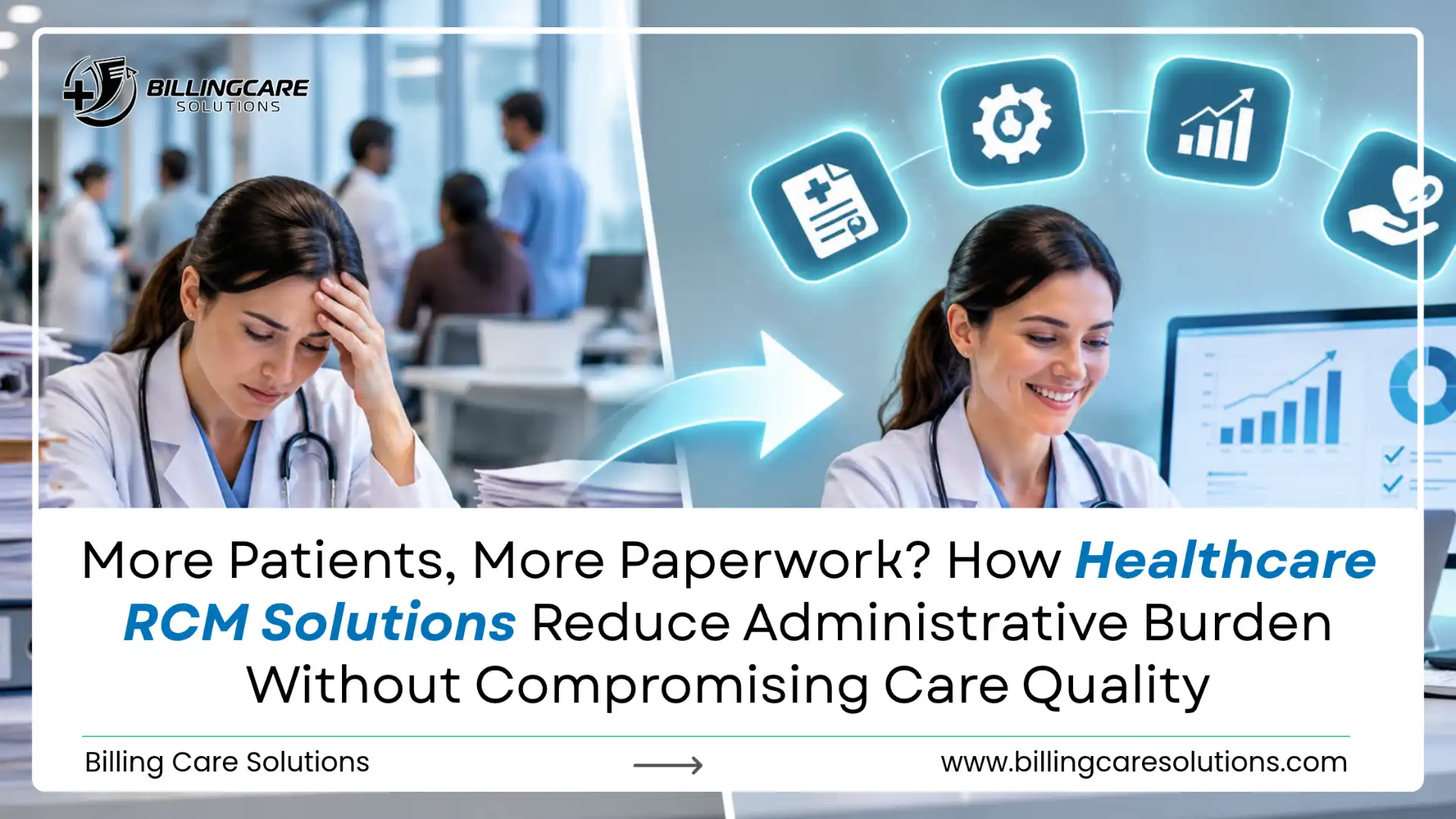
Healthcare organizations are required to handle more administrative work as the number of patients in the healthcare system increases. Billing departments deal with insurance verification, prior authorization, claim submission, coding, and payment follow-s. Sustaining these is time consuming, requires greater operating expenses and imposes additional burden on staff.
But billing doesn’t impact the world. Delayed claims have an impact on cash flow, documentation issues result in denial, and missed claims result in lost revenue. Clinicians also dedicate time for the enquiries for missing information relating to billing. Healthcare RCM Solutions offer the much-needed structure in billing and admin, which can help healthcare practices overcome such obstacles.
Healthcare RCM Solutions increase billing performance and provide better automation, accurate coding and organized claim management process, which decrease repetitive work. This means more time for admin to attend to pressing administrative matters and more time for clinical staff to attend to their duties caring for patients.
To cut costs, enhance reimbursement, and ensure that day-to-day business functions are successful is the mission of the healthcare executive. These goals can be achieved by the right Healthcare RCM Solutions, without pushing clinical teams to the brink.
Why Healthcare Practices Face Increasing Administrative Overload
Administrative costs continue to be a headache for health care offices. These activities require a lot of time and resources to manage payer requirements, patient records and billing. When more claims are being filed, the teams usually find it hard to manage the things that they have to do. Healthcare RCM Solutions can solve this burden by streamlining coordination within administrative functions.
There are four problems which cause this increasing pressure.
1. Increasing Billing and Documentation Workloads
Administrative and billing staff have extra time commitments for each patient visit. Staff members have to check insurance, look at medical records, enter charges and submit claims as well as follow-up payments.
If they rely on manual tasks, a minor delay or delay in processing and sending these works can delay the entire billing system. In addition, bills will go choking on information because of missing information, leading to more interaction between provider and billers before bills can be paid.
This causes backlogs to slim, and may lessen the amount of time staff has for other duties in busy practices. Healthcare RCM Solutions ensure that these activities are part of more structured billing workflows, which in turn can help to minimize repetitive tasks.
2. Complex Insurance and Authorization Requirements
There are different insurance requirements for each of the payers. Billing staff need to verify that a service is covered, paperwork is in order, benefit categories are aware of, and prior authorization is required.
Claim denials frequently result from failure to authorize or from failing to cover a requirement for a claim. Also, it adds more work for staff and clinical teams to be able to schedule their team, as they may have to review the information again.
With healthcare RCM Solutions, practices can verify payer requirements sooner in the process. This provides staff the opportunity to identify gaps in certain information, as well as dealing with authorization issues, before services are provided.
3. Rising Staffing and Operational Expenses
There are additional costs to consider when you have an in-house billing team to deal with. Practices also cover the cost of the recruitment, the training of employees, software, employee benefits, and continued supervision of employees.
Practices may also be impacted in terms of losses due to staff turnover as the days will be taken up by induction and training of new employees. Once the volume of claims becomes more than they are used to dealing with, smaller companies can have a difficult time finding staff that have the experience to handle the volume of claims.
Otherwise, health care RCM Solutions are available. Practices now have access to the talent to staff billing positions without maintaining all of the billing work and its costs on their own.
4. Limited Time for Patient-Facing Responsibilities
There are sometimes stalled clinical and administrative discussions where clinical discussion is affected by billing questions. Providers can receive multiple requests from the provider asking for clarification on missing information, coding documentation, and additional medical necessity documentation. These requests take staff time from other tasks and increase workload of clinical staff.
In healthcare RCM Solutions are used to coordinate communication flow between billers and the departments involved in treatment. Standard documentation requests and workflows eliminate the need for the back and forth and improve team workflow.
Where Administrative Inefficiencies Hurt Healthcare Revenue
The revenue cycle will usually suffer from administration issues before practice leaders realise they even have them. Delays in reimbursement come from claims that are not submitted, incorrect claims and claims that are incorrectly denied.
Healthcare RCM Solutions can assist in recognizing these issues via periodic reporting, claim reviews, and also monitoring the revenue cycle. Being able to recognize where these issues lie allows healthcare executives to determine the order in which processes should be addressed.
Claim Submission Delays Increase Revenue Leakage
Reimbursement may be delayed when claims are not submitted in a timely manner, resulting in continued accrual of accounts receivable balances. For instance, if a practice makes $500,000 in claims a month, they should verify that they meet the criteria to receive insurance reimbursement as a government claim. Then when part of that claim goes missing for many weeks, it puts more pressure on the cash flow of the practice.
Wrong documentation or payer decisions of the problem aren’t always. In some instances charges just sit in the system without being processed for a large part because employee workload makes processing difficult. Healthcare RCM Solutions can transform the way that claims are submitted by entering them in an orderly fashion and integrating electronic claim processing.
Authorization Errors Create Avoidable Denials
Prior authorization issues result in reimbursement issues for healthcare practices. The other services have different requirements, such as requiring payer approval before treatment is provided; otherwise, there is a risk of payment.
Staff may find themselves having to spend extra time investigating denial if authorization is not checked at an appropriate time for all required items, and if an appeal or correction can be made following a denial.
Preventing these problems by checking requirements before services. Healthcare RCM Solutions can help with this by streamlining patient eligibility verification, tracking authorizations and facilitating communication between departments to ensure more effective time management.
Coding Errors Increase Rework and Compliance Risks
The use of wrong CPT, ICD-10-CM or HCPCS codes contaminates the accuracy of claims. Incomplete claims, missing modifiers, and lack in documentation also have the potential of extending claim rejections, denials, and extra-payer reviews.
Correcting each correction will take longer for the billing staff. Having to code problems more than once also costs the administrators more and also slows down payments. The lack of supported coding practices leads to extra compliance issues, which could mean possible audits and recovery of payments. Healthcare RCM Solutions can actually get rid of these risks when educated coding and record maintenance are carried out ahead of time before claims are dispatched.
Poor A/R Follow-Up Delays Collections
There are claims that aren’t paying and must be handled regularly. As no one takes ownership for follow-ups, then there will be outstanding balances appearing on aging reports, and the practice will stand the chance of not following-up on payable balances.
Billing teams should pay attention to caring about the high value claims, filing deadlines, and cycles of payment issues with the payers. The longer one delays in meeting the claims on these accounts the more complex it becomes to collect the revenue.
Early follow-up of unpaid claim is vital in a consistent process. Healthcare RCM Solutions offer structured A/R monitoring and follow up which helps to ensure that unpaid amounts are not forgotten.
How Healthcare RCM Solutions Reduce Administrative Work
Healthcare RCM Solutions integrate multiple billing processes and minimize manual efforts of internal processes. Stresses early detection and resolution of errors, keeping claims moving, and freeing up time for staff to deal with tasks requiring their expertise.
Automating Repetitive Billing Activities
A lot of the processes involved in billing a claim for patient care are similar for each one. With the assistance of automation, billing professionals can free up time, eliminating repetitive tasks, and will have the time necessary to attend to problems that require personalized statements.
Technology, which is a component of some Healthcare RCM Solutions include the following activities:
- Routine insurance qualification verification.
- Electronic claim submission.
- Error Identification and Claim Scrubbing.
- Automatized claim status tracking.
- Payment posting assistance.
- A/R monitoring/reporting.
For instance, scrubbing software verifies the information submitted to a claim with claims for inaccuracies before it is sent to the payer. If the system identifies missing information, billing personnel have the ability to look at it and make prior corrections before submitting.
It lowers the amount of work that has to be done to look at every claim and enables the teams to work on exceptions that require additional review.
Improving Coding and Documentation Accuracy
Good coding begins with proper documentation and understanding of coding needs. Professional coding reviews will assist you to identify the wrong diagnosis codes, modifiers and information that doesn’t support the billed services. These procedures are also important for a practice to meet any applicable requirement of the payers and coding requirements.
Clinical providers continue to bear the responsibility of knowing what services to provide and for making treatment decisions. Billing professionals aid in the process by examining documentation and ensure that claims are accurate, without disrupting clinical judgment. Healthcare RCM Solutions have the power to link documentation needs to correct coding and claim preparation.
Centralizing Prior Authorization and Insurance Verification
A lack of a standard verification process by different departments means that essential information is lost. It’s easier to follow up on eligibility screenings, coverage information, and authorizations when it’s done more centrally. Staff can check what benefits a patient has, what services they need to be authorised for and check on outstanding authorisations prior to an appointment.
This will lower the number of requests made within the last minute and avoid unnecessary authorizations. Healthcare RCM Solutions enable standardized verification processes to give departments insights into each patient’s billing demands.
Strengthening Denial Management
Dealing with them denial by denial does not always resolve issues. When the same thing comes up multiple times, practices must know the reason for and what should be changed.
If, for instance, multiple times a person keeps being denied authorisation, it means that there is a loophole in the verification process. The practice should audit the way authorisation is processed rather than fixing each point that is raised.
Billing teams must monitor both the reasons claims are being denied and the time they have for appeal, and they must also tally the number of claims recovered and the amount of unpaid claim value. Reviewing these allows patterns to be recognized and a determination can be made on where corrective action is required.
Denial reports are a powerful tool for healthcare RCM Solutions, as they streamline billing processes and limit reimbursement risks and duplications.
Financial Impact of Healthcare RCM Solutions
When the financial benefits of reducing administrative tasks are on board, it’s a bonus. So how is it that healthcare executives need to be aware whether collections processes are benefiting their business or costing them unnecessarily? RCM Solutions in Healthcare needs to be assessed using real, quantifiable financial measurements, instead of the common assertion that it’ll make processes more efficient.
These KPIs will give practice leaders insight into billing performance and things that need to be corrected.
| Financial KPI | What It Measures | Expected Operational Benefit |
|---|---|---|
| Clean Claim Rate | Claims submitted without identified errors | Less claim rework |
| First-Pass Acceptance Rate | Claims accepted on initial submission | Faster claim processing |
| Denial Rate | Percentage of claims denied | Lower reimbursement risk |
| A/R Days | Average time required to collect receivables | Improved cash flow |
| Net Collection Rate | Percentage of collectible revenue collected | Better revenue recovery |
| Cost to Collect | Expense required to collect revenue | Lower administrative costs |
Lower Operating Costs Through Better Resource Allocation
In-house billers must continually invest in billing people, software, training and management. Healthcare RCM Solutions can assist practice leaders in analyzing those costs and with outsourcing. Outsourced Support for RCM means practices have access to skilled billing professionals without recruiting them, training them, or having to oversee their staffing.
By using outsourced billing care, Billing Care Solutions claims that they can save as much as 40% to 50% in operating costs. The actual savings will vary according to practice size, costs, number of claims and services required.
Healthcare executives must analyze and gain insight on their company’s current billing costs, and factor in the total costs of outsourcing to make the decision. This provides them with a better idea of the monetary worth.
Faster Reimbursement and Improved Cash Flow
When claims are submitted correctly and regularly checked, they often receive an unacceptable delay in the reimbursement period. Having lower balances of A/R increases healthcare’s flexibility in payroll, daily operating costs and future investments. Healthcare RCM Solutions can optimize collections by streamlining claim submission, monitoring continuing with consistent follow-up.
This of course should not be an adequate criterion of success, however. A/R practice leaders should also check the revenue cycle for A/R ageing and payment reconciliation, which will help to determine if the revenue cycle is working as expected.
Reduced Denials and Preventable Revenue Losses
Each claim that is denied needs extra effort from billers. There are a few claims that need corrected information, others that need appeals or additional documentation.
Minimizing Denial can enable practices to increase time spent collecting payments and less time correcting their claims.
Identifying practices’ denial trends by payer, service category, provider and denial reason help to determine problem areas.
Healthcare RCM Solutions allows leadership to uncover common problems and focus their efforts and resources on processes that will increase revenue recovery.
In-House Billing vs. Outsourced Healthcare RCM Solutions
Healthcare organizations frequently have to consider whether their existing, internal billing department still makes sense or if they should outsource their billing. The decision is not just a wage vs a payment to the outsourcing firm. Leaders ought to also take into account the billing skill level, the level of technology costs, the number of claims, and the capacity to adjust to switches in workload.
The advantages of Healthcare RCM Solutions vary according to the size and configuration of the organization, the number of staff and the nature of the billing.
| Comparison Factor | In-House Billing | Outsourced RCM |
|---|---|---|
| Staffing | Internal recruitment and payroll | External billing specialists |
| Training | Practice-managed | Provider-managed |
| Technology | Internal software expenses | Provider-supported systems |
| Claim Processing | Internal team capacity | Dedicated RCM resources |
| Denial Management | Depends on available staff | Structured follow-up |
| Scalability | Additional hiring often required | Flexible service capacity |
| Reporting | Depends on internal resources | Defined KPI reporting |
Outsourcing may be considered due to increasing employee hiring costs, back log of claims, high rate of claim denials, and inability to maintain balance in A/R. However, outsourcing isn’t necessarily more affordable. The total cost of the contracts should be compared to their internal costs and the financial gains they hope to reap.
Healthcare RCM Solutions should also live up to certain expectations regarding the service quality, the frequency of reporting, data security, and communication. These details enable the organizations to understand what they are paying for and how this service will help them run the organization.
How to Choose Healthcare RCM Solutions Without Compromising Patient Care
When selecting Healthcare RCM Solutions, it’s not just about a price-cutting race. A lower price is no guarantee of high billing accuracy, quick reimbursements, or a quick response to administrative needs.
There are four critical areas that healthcare executives need to consider when choosing an RCM partner.
Specialty-Specific Billing Expertise
There are different coding and reimbursement considerations for each of the medical specialties. A billing partner needs to know what services your practice offers, and who the other parties are that govern those services.
Consult its experience with appropriate CPT, ICD-10-CM codes and HCPCS application in addition to policies and guidelines from Medicare, Medicaid and various commercial payers. Having a partner with the specialty experience necessary to address coding-related questions, documentation needs and payer-specific billing concerns.
Automation and Technology
Inquire what tools the RCM provider provides for the handling of eligibility checks, claim scrubbing, submission of claims electronically, electronic payments and financial reporting.
Technology should eliminate repetitive tasks, and assist in identifying errors early. But that’s not all automation can do. Well seasoned billing experts should get their hands dirty by analyzing claims flagged for review and by solving problems which demand judgment. Useful technology and professional drop-in workmanship are the keys to the right Healthcare RCM Solutions.
Financial Reporting and Accountability
Up to date information is essential to see if you are driving your revenue cycle in the right direction or precipitating a decline in performance. Your RCM partner should be able to furnish claim acceptance, claim denial metrics, A/R aging metrics, collections activity and unresolved billing activity metrics.
Each week commitments are reported through the Weekly KPIs and monthly through an Executive Review which facilitates the leadership to monitor the performance and to discover potential issues before they impact on financial results.
HIPAA Compliance and Data Security
When the external firm is handling the billing deal with the patients, the patients’ information ought to be protected properly. Review Business Associate Agreements, system access controls, secure information exchange, employee training and documented security procedures before signing an agreement. Patient information protection is a critical task for outsourcing administrative and billing tasks.
How Billing Care Solutions Helps Reduce Administrative Overload
In-house billing is time consuming, labor intensive, and requires constant supervision. Billing becomes more difficult within the practice that sees more patients. This can then leave time for administration departments to be less effective at what they do.
Billing Care Solutions can assist with these and more via comprehensive revenue cycle management. Services involve insurance verification, medical billing and coding, claims submission, account posting, claims denial follow-up and accounts receivable management. This is also because the same team would be dealing with these aspects, which would reduce the time taken in coordinating different billing services.
The claim scrubbing technology preemptively performs correctness checks before claims go out. The billing professionals check flagged claims and fix billing problems before submitting the claims. Billing Care Solutions say there was an acceptance rate of over 98% for first passes, and less than 5% for denials. In addition to this, there are operating cost savings that the practice can gain from outsourcing by as much as 40% each year, depending on the practice’s requirements.
Weekly KPI reports, monthly financial reports, dedicated account management and USA based teams of support are also scheduled to ensure practices have the reports they need. Billing Care Solutions has 17+ years of experience in the industry to bring powerful solutions to healthcare organizations to ensure your billing stays on track and gives you an insight into your financial performance.
If hiring tasks is consuming a lot of time from your staff, give Billing Care Solutions a call for a no-cost consultation. Talk about your current challenges and make sure its RCM support is a fit to your practice.
Improving Healthcare Operations Through Better RCM Management
The billing department is not the only department burdened by administrative overload. It ups staffing costs, adds time to claim processing and impacts reimbursement and takes time away from patient-facing responsibilities.
Healthcare RCM Solutions can address these issues by streamlining processes, automating billing, providing coding assistance and performing regular denying follow-up.
But for execs in the healthcare industry, the key is to track results. Analyse the operating expenses, denial rates, A/R days and collection performance to get an understanding of areas that require work.
Billing Care Solutions supports your healthcare organization with comprehensive RCM solutions, dedicated account management and frequent financial reporting. More control over billing activities means practices have more time to send cash and care for day-to-day operations, while maintaining a well-organized revenue cycle.
