
Closing the Healthcare Revenue Integrity Gap: How Hospitals Can Prevent Revenue Loss from Clinical Documentation to Reimbursement
Improve healthcare revenue integrity by closing documentation gaps, preventing revenue leakage, and strengthening hospital reimbursement accuracy.
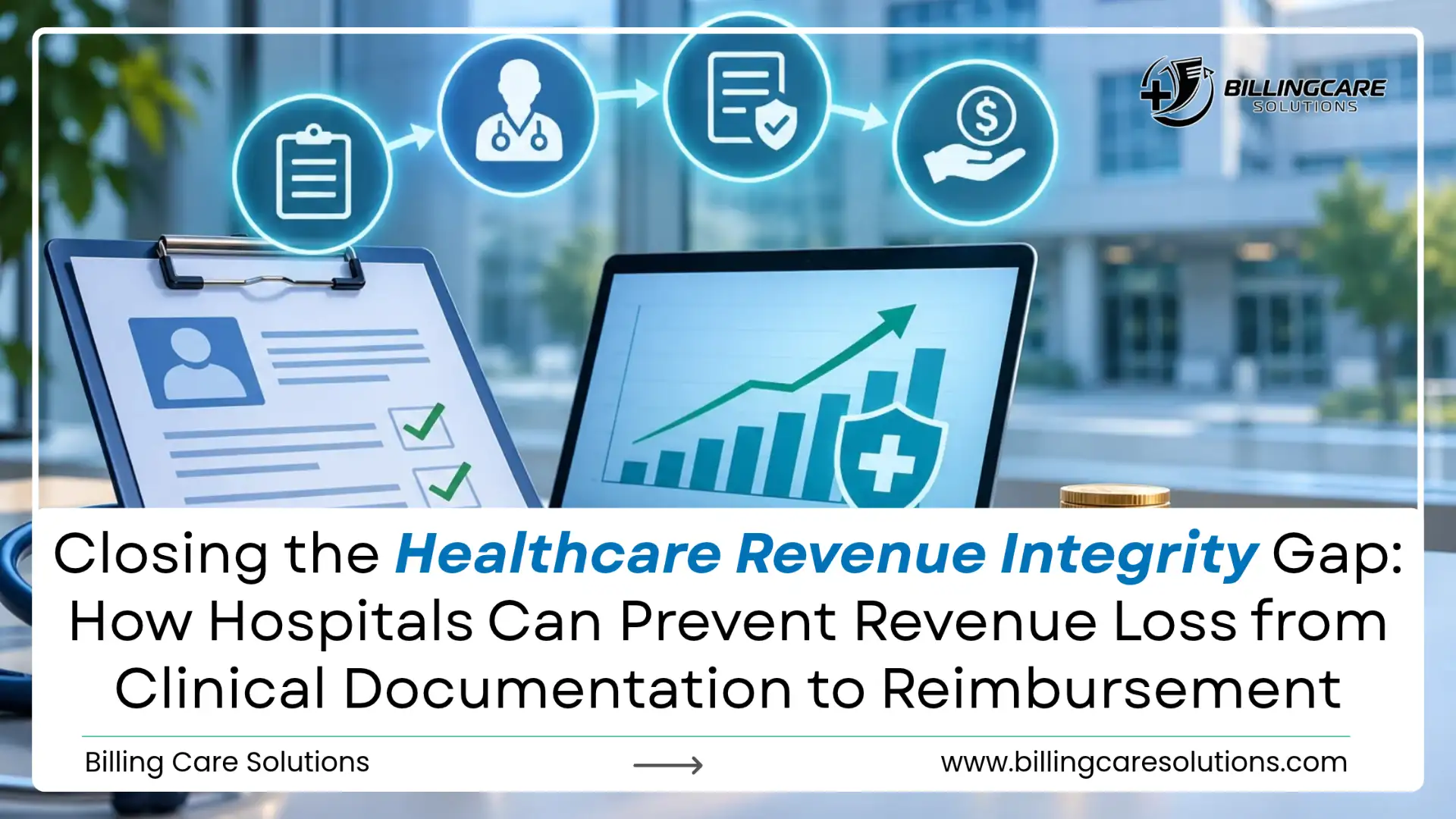
In 2024, initial claims denial rates were 11.8% and net revenue leakage from denials rose 25% year over year, to the detriment of providers with a price tag of $48.4 billion. But, many companies have concluded that their revenue cycle is in order because claims are getting turned in and the rate of getting it right the first time appears to be good.
This is the problem that beats on the healthcare revenue integrity side of things but it’s no hushed secret. Having a claim paid does not mean it is correct. Can be coded at a lower complexity, paid at lower rates, or never paid at all. Revenue Integrity is the field designed to identify those “lost” revenues before they add up.
This is not the next definition post. It’s a practical approach to identifying key areas of healthcare revenue integrity leakage within healthcare organizations, determining the true impact of revenue, and establishing an operating model that helps prevent revenue leakage before it ever leaves the door. It is a guidance to select a partner which works on accuracy and compliance layer, and not just billing layer.
Revenue Integrity Is Not Revenue Cycle Management: The Distinction That Changes Your Bottom Line
Most healthcare leaders equate revenue integrity and revenue cycle management as synonymous. That’s a costly mistake since it causes organizations to invest in more RCM technology. Then they actually need it, when the truth is that the lack of accuracy and compliance is upstream.
The pipeline is the revenue cycle management. It encompasses scheduling, eligibility, verification, authorization, coding and billing, collecting denied claims, payment posting and collections. Controlling revenue quality is the control quality layer within that pipeline. It poses a question it doesn’t ask too: did the organization honestly and conscientiously record, encode, bill and get reimbursed for what it had done?
RCM queries if there was a move. Revenue Integrity: Did the money that was recorded on the revenue report in the business match the actual revenue? An under-coded claim or claim paid less than the amount of a contract, or those that should never have been paid to that specific payer is still an experience in revenue integrity failure. The first step towards improving healthcare revenue integrity is to not add the terms revenue cycle management to the equation.
| Dimension | Revenue Cycle Management | Revenue Integrity |
|---|---|---|
| Focus | Moving claims through the pipeline | Ensuring accuracy and compliance at every step |
| Core question | Did the claim get paid? | Was the claim paid correctly for what was delivered? |
| Ownership | Operations and billing teams | Collaboration across clinical, coding, compliance, and finance |
| What breaks without it | Cash flow slows | Revenue leaks silently while claims appear paid |
If RCM and healthcare revenue integrity are one and the same, then there is only one way to make it more automated amid a process that is fundamentally flawed.
The more successful way is to look at healthcare revenue integrity as the operating discipline, the art, science and process of making sure RCM is actually getting you the results you deserve, not just the results you are looking for.
The Five Silent Leakage Points That Most Healthcare Revenue Integrity Programs Miss
Denial reports can only tell a part of the story. One surprising result is that the worst revenue integrity issues go unreported as Disagree reports, so it’s common to experience first pass rates that seem ok despite the number of revenue integrity problems.
- Unbilled services: Procedures that are performed but never made it through the billing system, which is caused by workflow gaps, delays in documentation, or handoffs. These types of services never produce a claim or deny any claims. They just vanish off the books. The easiest way to find this leak is charge lag/report of a charge-by-department.
- Undercoding: One of the most common and oftentimes least obvious leaks is under-coding, or billing less than the clinically documented level of service. The exact proportion of undercoding of physician encounters is difficult to capture with industry estimates ranging from 33% to 45% reported in a few analyses. Undercoding will not be causative of denial. It generates a lower payout prize value, and the poverty of every encounter with which it is documented leads to poverty of the experienced service. Undercoding is one of the fundamental healthcare revenue integrity problems, since only the clean claim may be disclosed and the financial result is incorrect.
- Payer underpayments: A claim is paid, an under-payment adjustment is made and the account closes anyway. Everything looks complete. However, if they paid less than the agreed upon rate, it’s their part of the healthcare revenue integrity mess. The industry benchmarks for underpayments by commercial payers range from 1% to 3% of the system’s net patient revenue for a system with $500 million in that revenue, or $5 million to $25 million per year. Such lapses are not apparent on the typical denial reports as the claim was never denied. It was just simply paid wrong.
- Denial write-offs: Denials which are never appealed are a direct loss. An estimated $132 billion in write-offs for bad debt and final claim denials cost hospitals and health systems in 2025, with approximately 10% of net revenue going to write-offs. The USD received from every written off denial is revenue that was earned and recorded but not collected.
- Front-end eligibility and authorization errors: Incorrect insurance information at registration causes the “hard denial” that can be difficult to get resolved. More and more gaps in the authorization process are emerging as a growing leak source with increasingly stringent requirements by payers. In 2025, it can be seen that the overall clinical denial rates related to prior authorization and medical necessity rose, with providers’ success rate dropping from 42.7% to 42.1%. Early care errors are an initial healthcare revenue integrity gateway since the first the error is produced, the more difficult it will be to recuperate.
All five of the leakage points have in common that they cannot announce themselves. They need to be monitored intentionally, reconcile by contract and adopt accurate accounting as an ongoing process, not just an annual review. A healthcare revenue integrity plan missing these five things will likely continue to see healthy movement on claims reported to the insurance company and kill off revenue without realizing it.
The Three Pillars of a Revenue Integrity Program and What Each One Actually Requires
A program for healthcare revenue integrity is frequently articulated as having three legs, clinical documentation integrity, coding accuracy and billing compliance. This is a right but incomplete statement. This is not the difference between a weak program and a strong program in that these pillars are or aren’t present. What every pillar should provide actually.
Clinical Documentation Integrity (CDI)
Weak programs post the written queries after the patient is discharged, which hopefully will narrow down information given if the story is unclear and the claim has not expired in the billing system yet. Strong programs incorporate a query into the documentation process, so the service documentation includes the level of service that will be coded before the claim is created. This doesn’t mean “Lee better notes”. It’s documentation which is accurate, up-to-date and clinically ready enough to warrant having a code. The coding as accurate as the record depends on the documentation backbone of Healthcare Revenue Integrity, CDI.
Coding Accuracy and Audit
Slow programs are to play defensively. The strong programs include a specialty-specific coding background as well as annual code set training, pre-billing and post-billing auditing. There is no assurance of accuracy because a study revealed a 26.8% accuracy rate in the primary diagnoses and a 9.9% accuracy rate in the secondary diagnoses of a hospital coding study. It is not coding that passes the scrubber, it’s coding that passes testing by the payers. Healthcare revenue integrity and reimbursement go hand in hand when it comes to coding accuracy, and the repercussions of little documentation are huge financial losses.
Billing Compliance and Risk Management
Slowly written programmes are free of defence. Strong programs meet OIG and CMS requirements, have HIPPA compliant workflows, provide more accurate HCC/RAF data for Medicare Advantage populations, and ensure that they have audit-ready documentation trails. At-risk amount went up 18% and the number of claims found to be payers’ audits increased 30% in 2025. With healthcare revenue integrity, compliance is the building block to have defensible revenue as well as sustainable revenue that can not withstand an audit.
Definitions of any healthcare revenue integrity program that focuses on the basics and only on periodic audits are still susceptible. The difference between leakage prevention and leakage detection is whether or not you have an operational standard in place.
Revenue Integrity KPIs That Actually Predict Financial Health, Not Just Claim Speed
The two most frequent revenue integrity metrics that are reported are the first-pass rate and the clean claim rate; they are helpful. However, the metrics for healthcare revenue integrity can’t be speed, as much as accuracy. A claim accepted upon the first submission does not necessarily represent a claim that was coded correctly or paid out correctly.
A set of metrics which actually predict financial health comes in two types, leading indicators which precede novel risk to claims paid and lagging indicators which confirm the financial results.
| KPI | What It Measures | Why It Matters |
|---|---|---|
| Undercoding rate | Percentage of encounters billed below the documented level of service | A direct measure of revenue integrity performance that is often absent from standard dashboards |
| Payer underpayment recovery rate | Share of the gap between contracted and actual reimbursement that is identified and recovered | Reveals whether zero-balance accounts are truly correct or silently underpaid |
| Charge lag and late charges by department | Delay between service delivery and charge entry | Surfaces charge capture failures before they become denials or write-offs |
| First-pass rate | Percentage of claims accepted on first submission | Useful for operational speed, but does not measure accuracy or payment correctness |
| Final denial write-off percentage | Share of denials that are written off rather than appealed or recovered | Connects revenue integrity performance directly to the bottom line |
| Cost to collect | Cost of recovering each dollar of revenue | Shows whether revenue integrity efforts are economically sustainable |
The key signs of revenue integrity are the ones most healthcare revenue integrity programs miss. Undercoding rate and underpayment recovery rate indicates if revenue is being lost even after claims are paid.
Charge lag is a measurement that will tell you if there are charges happening at all. By focusing only on first pass rate and denial rate, the organization is measuring how quickly the pipeline moves and not if the healthcare revenue integrity is giving a correct financial result.
The Monitor, Respond, Recover Framework: A Practical Operating Model for Revenue Integrity
Revenue integrity doesn’t require a third-party source of information. No, because information is not repeatable, it fails. The following healthcare revenue integrity framework provides structure for the inspection and intervention activities of the Monitor, Respond, Recover process, linking the activities of surveillance to action and action to financial recovery.
Monitor
Work away from audit to continual monitoring. Track the surface level risks at an early stage in the revenue cycle by using benchmarking, trend analysis and financial impact reporting. The response is to intervene, not after a denial of a claim. The monitoring should cover undercoding patterns, charge lag per department, payer trends that are denied, and contract variance analysis. If monitoring is ongoing, revenues will be a preventive and not a post-mortem.
Respond
Ensure audit and denial response is consistent throughout health information management, coding, compliance, and revenue cycle teams. As payer requests get more complex, fragmented workflows delay response and diminish defensibility. There should be a response protocol that identifies who the owner of each type of issue is, what evidence is needed and how much time the organization will need to respond. The response stage is either the first time that revenue integrity becomes a systemized effort or, more commonly, the next time a fire drill happens, it’s the revenue integrity group that’s absent.
Recover
Do not consider the volume of appeals and recovery efforts, but rather by clinical and administrative strength. A denial with robust clinical documentation and a clear medical necessity is a higher rank of recovery potential than a high dollar denial with flaky documentation. Feed back the recovery outcome to monitoring and prevention. All under-payments come back, and all rejections overturned must lead to a learning experience that enhances the next time round. The road to recovery ends where it began, not at the end! It is the data that you’ll use for further monitoring.
| Stage | Primary Activity | Owner | Proof It Is Working |
|---|---|---|---|
| Monitor | Continuous surveillance of charge lag, undercoding, denial patterns, and contract variances | Revenue integrity analyst with coding and compliance input | Risk is identified before claims are submitted |
| Respond | Coordinated audit and denial response with defined ownership and evidence standards | Cross-functional revenue integrity team | Response times shorten and appeal quality improves |
| Recover | Prioritized appeals and underpayment recovery based on strength, not volume | Appeals and recovery specialists | Recovery rates rise and root causes are corrected |
The system is designed to be open and circular. Reports left unacted is monitoring without response. Without a recovery, there is money on the table. If feedback is not recovered to monitoring, the leak will resume. All three pillars of a healthcare revenue integrity operating model require one to work in another.
AI and Revenue Integrity: Where Automation Helps and Where Human Judgment Still Decides
Insurance companies are already a big part of the discussion around healthcare revenue integrity, and there’s a lot of excitement for it. But what companies benefit the most from automation are the ones that make a clear distinction between the expertise that cannot be acquired by automation and the technology controlled by credentialed experts.
Where AI earns its place
AI is best where it can be applied on scale to pattern detection, and also in the pre-bill area. Real-time detection and capture of real-time charge can identify missing charges prior to claims creation. Pre-bill code auditing will identify inconsistencies in coding and documentation before they become part of the bill. Denial pattern analysis allows for the discovery of trends that could be payer-specific, code-specific, and occur between large volumes of claims that could not be detected with a manual review. For some platforms, there is already AI in place that can match payer payment adjustments to minimise reconciliation time significantly.
Where human expertise remains essential
Like any sort of policymaking, there’s a great deal of complexity in the policies. Pattern matching is not enough for clinical validation of documentation. There is an accountability dimension in making compliance decisions in grey areas that must be considered a human component, with legal and financial implications. Appeal tactics in complex cases or when considering high-risk claims rely on a knowledge of the types of arguments that are likely to succeed and which are likely to fail on a given case with the given payer. AI can do part of those tasks that set up the groundwork for these decisions. It cannot own them.
The risk of unchecked automation
Bad workflows are just as fast to speed up as good workflows are when they are aided by AI. Automation can leverage undercoding and overbilling as well as accuracy if the business rules behind charge capture or coding edits are not managed accurately. The tried and tested approach for healthcare revenue integrity is using AI as the first line of defense and relying on humans only at the top tier of financial and compliance risk.
| AI can do this | Humans must own this |
|---|---|
| Flag missing charges before claim creation | Validate clinical documentation against coding guidelines |
| Detect anomalies across large claim volumes | Make compliance judgments in ambiguous cases |
| Surface denial patterns by payer and code | Design appeal strategy for complex or high-value claims |
| Pre-bill code review and edit checks | Set and govern charge capture and coding rules |
| Reconcile payment variances at scale | Decide when a variance warrants escalation or write-off |
What to Look for in a Revenue Integrity Partner Beyond “We Do Billing”
There are lots of billing vendors in the marketplace. At the accuracy and compliance layer, there needs to be a different type of partner to work within healthcare revenue integrity, that can clarify exactly how it aids avoid claim leakage, instead of merely handling claims. The following checklist is here to assist healthcare leaders to assess a partner based on the capabilities it truly requires for revenue integrity.
Specialty-specific coding and documentation expertise:
Revenue integrity is compromised when the general coding and documentation are teamed with the specialty documentation. Healthcare revenue integrity requires specialty expertise; it is essential for identifying the areas of leakage because the code set, payer mix and typical denial codes vary by specialty. Ask “How did the partner improve the accuracy of documentation and coding, in your specialty, rather than do the number of claims?
Denial pattern analysis, not just denial appeals:
A revenue integrity partner should try to ask why denials are occurring, if there is a way to prevent them, and if it is a pattern that is impacting other claims or service lines. Recoveries are essential, they are the recovery layer.
Transparency in KPIs and reporting:
Include transparency around KPIs and reporting with regard to not only first-pass rate and clean claim rate, but also undercoding, underpayment recovery, charge lag and denials write-off. If your partner doesn’t have the leading indicators for you it is not their financial outcome they are managing, rather, it’s the pipeline.
Compliance orientation:
A revenue integrity partner must feel at ease to talk about OIG/CMS Alignment, Audit Defensibility and HCC/RAF accuracy for the Medicare Advantage population. Compliance is not a service in and of itself. It is an imperative to integrity of revenue in sustainability.
Human review layered with technology:
The partnership should be able to identify exactly where the human step is being used and where the technology is being used. AI-powered isn’t a revenue integrity tool. It is a capacity that needs to be regulated.
A partner, who has these characteristics, can help improve healthcare revenue integrity as a business discipline rather than a claim processing service. These are the reasons which drive Billing Care Solutions. The work strategy focuses on the specialty coding support, pre-billing and post-billing audit flows, denial pattern analysis and KPI reporting, including undercoding and underpayment visibility.
The operating model sees healthcare revenue integrity as a process that cannot be delivered by a project, and focuses human expertise at those points that require the highest level of integrity and compliance in decisions. Discuss the model with a revenue integrity specialist to find out how it works for your organization’s payer mix and specialty specific needs.
Conclusion
The Healthcare revenue integrity industry isn’t a department or the investment of software. It’s an approach to operating that is about documentation, coding, billing, and compliance, whereby what is done is documented, coded, billed, and collected. As a quality-control filter within the revenue cycle management, organizations can prevent loss of revenues rather than just address it after the damage is done.
The amount of information that is available from 2025 is crystal clear. That’s not to say that there isn’t a conflict between the amount of net revenue leakage and amounts of uncollected revenue at 25%, but in this instance, it shouldn’t be either-or. There is no comparable time and quality. Integration is not the equivalent of movement.
What do you know about these 3 questions? What are you losing your organisation? How many did end up coming up short? What amount of charge lag is there currently in your busiest departments? If you are unable to answer them, then, a healthcare revenue integrity assessment will be the first place to look.
Billing Care Solutions is a healthcare revenue integrity provider. The team brings speciality coding capabilities, are disciplined with their audits, and are open about their KPI’s reporting. These capabilities help to ensure that the financial outcome of each claim is consistent with care provided.
