

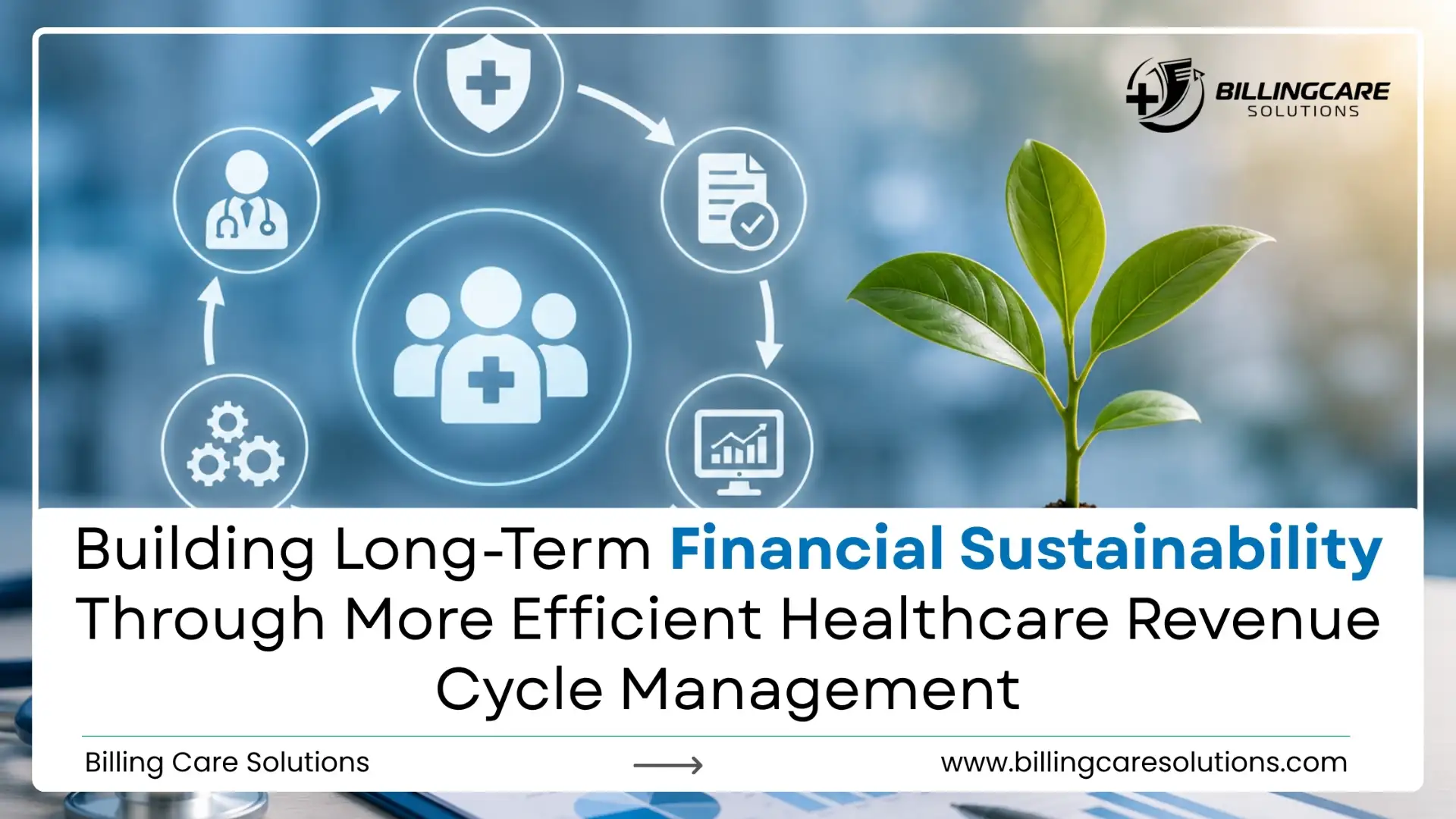
Building Long-Term Financial Sustainability Through More Efficient Healthcare Revenue Cycle Management
Discover how Healthcare Revenue Optimization builds financial sustainability through better operations, lower inefficiency, and stronger revenue performance.
The number of healthcare organizations are continuing to experience a growing imbalance. Between the cost of providing care and the revenue generated by that care.
According to MGMA’s June 2026 poll, 84% of medical groups that responded to the survey had increased year-to-date operating costs compared to 2025. Only 47% reported increases in overall revenue. The issue that plagues healthcare executives is simple: if the issue were not that complex, they wouldn’t be so concerned about it. If expenses increase at a rate greater than the earned money, it becomes a budget issue to protect the earned revenue.
This pressure makes Healthcare Revenue Optimization more important than simply increasing billing volume. Leaders need to know where revenue disappears between the point of service and final payment. Some revenue is never captured. Some are denied. Some are paid below expectations. Other dollars remain tied up in A/R long enough to increase collection costs.
The financial question is therefore more specific: Where does expected revenue diverge from actual revenue, and what is causing the gap?
What Current Data Reveals About Healthcare Financial Performance
The current financial environment shows why Healthcare Revenue Optimization deserves attention at the executive level. A survey of medical groups conducted by MGMA indicates June 2026 there is widespread cost pressure among medical groups, but uneven revenue performance. This is margin pressure before even considering revenue leakage.
The same pressure is felt by hospital systems. Overall, total hospital costs rose 7.5% in 2025, according to the American Hospital Association. Drug costs went up 13.6%, supply costs went up 9.9% and workforce costs went up 5.6%. These figures change the revenue-cycle conversation. An organization does not need to lose millions through outright claim denials to experience financial damage. Small reimbursement gaps repeated across thousands of encounters can also affect operating performance.
Denials illustrate the scale of administrative friction. A 15% denial rate was reported for the 2025 admissions at Cleveland Clinic (including initial and subsequent denials), with the ability to reverse 92% of those denials. Recovery rate is good, but there is a significant amount of resubmissions, appeals, medical reviews and peer-to-peer activity that accounts for significant administrative effort.
MGMA’s January 2026 poll identified denials and appeals as the largest reported source of revenue-cycle leakage at 48%. Front-end issues accounted for another 23%. This is an implication that should not be lost on anyone. Revenue leakage isn’t solely in the billing department. Issues may arise prior to encounter, at claim documentation and coding, at submission of claims, during payer adjudication, or following payment. In the case of Healthcare Revenue Optimization, it is crucial for leaders to have a complete view of the whole financial journey, and not just a single RCM metric.
Where Revenue Leakage Occurs Across the Revenue Cycle
Healthcare Revenue Optimization becomes easier when leadership follows the money instead of viewing RCM as separate departmental functions.
Four leakage categories deserve particular attention.
Revenue That Is Never Captured:
The first problem occurs before billing begins. Missed charges, delayed charge posting, incomplete documentation, and coding gaps can prevent delivered services from becoming billable revenue. This type of leakage is easy to underestimate because it does not always create a denial or an aging account. If a charge never enters the billing system, downstream RCM teams have no claim to recover.
It is therefore important to track charge capture in conjunction with claim performance. Leaders should evaluate the time lag between service delivery, documentation, charge capture, coding and submission. If a delay is happening repeatedly it means there is a problem with the operation, not just with the billing. Effective Healthcare Revenue Optimization starts upstream because preventing lost charges is more efficient than attempting to recover revenue after the opportunity has disappeared.
Revenue That Is Billed but Not Collected:
Once a claim is in the payer system new risks arise. Slow payment can be caused by eligibility issues, authorizations, coding errors, insufficient documentation, claim edits and timely filing problems. The important management question is not simply how many claims were denied. Leadership needs to know which denial categories create the largest financial exposure and which ones repeat often enough to justify process changes. A high-volume, low-dollar denial pattern and a low-volume, high-dollar pattern require different responses. This distinction is central to Healthcare Revenue Optimization because financial exposure depends on both frequency and dollar value.
Revenue That Is Paid but Paid Incorrectly
Underpayments are different from denials because the claim appears successful. A payer processes the claim and sends a payment. Unless the organization compares that payment with the expected contractual amount, the account might close without anyone identifying a reimbursement variance. This makes expected-versus-actual payment analysis an important part of Healthcare Revenue Optimization.
The process should connect:
Contracted rate → Expected reimbursement → Actual payment → Variance → Resolution
The objective is to identify recurring discrepancies by payer, service, provider, or claim type. A paid claim should therefore be treated as financially complete only after the payment has been validated against the expected reimbursement.
Revenue That Costs Too Much to Recover
The final category concerns collection economics. Aged A/R requires staff time. Yet the financial value of pursuing an account varies according to its balance, age, payer, filing deadline, recoverability, and collection effort. Treating every account identically can lead to inefficient resource allocation. A more useful approach is to rank A/R according to expected financial return. This is an important component of Healthcare Revenue Optimization because recovery activity itself carries a cost.
| Leakage point | What happens | Why it is easy to miss | Executive response |
|---|---|---|---|
| Before billing | Services or charges fail to enter the claim workflow | No claim exists to trigger a denial or follow-up task | Monitor charge capture and billing lag |
| During claim processing | Claims are denied or delayed | Teams often focus on individual claims instead of recurring causes | Analyze denial dollars and root causes |
| After payment | Payer reimburses below contractual expectation | Account appears paid and may be closed | Compare expected and actual reimbursement |
| During A/R recovery | Collection effort exceeds economic value | A/R is often prioritized by age alone | Segment accounts by value, risk, and recoverability |
The Revenue-Cycle Metrics That Matter Most to Executives
A dashboard becomes useful when each metric leads to a financial question. Traditional measures such as days in A/R and denial rate remain important. The problem arises when leadership reviews them without segmentation or context. A 10% denial rate, for example, tells management little about the underlying exposure. The rate might be driven by one payer, one service line, one provider group, or a recurring authorization problem.
Healthcare Revenue Optimization requires metrics that reveal where financial performance changes and why.
| Metric | Executive question | Useful segmentation |
|---|---|---|
| Underpayment rate | Are payers reimbursing according to expectations? | Payer, contract, service, claim type |
| Contractual variance | Where does actual payment differ from negotiated terms? | Payer, service line, location |
| Charge capture lag | How long does earned revenue remain outside billing? | Provider, department, service |
| Denial rate | Where are claims failing? | Payer, reason, service, provider |
| First-pass resolution | How much rework does billing generate? | Payer, claim type, department |
| Days in A/R | How quickly is outstanding revenue converted to cash? | Payer, aging bucket, service |
| Cost to collect | What does recovery cost? | Payer, account segment, balance |
| Expected vs. actual reimbursement | Where are payment variances occurring? | Payer, contract, CPT or service |
The goal is not to monitor every possible metric.
The goal is to identify the measures that explain financial variance and point management toward corrective action. That is where Healthcare Revenue Optimization becomes useful as an executive discipline rather than a billing function.
Why Revenue-Cycle Inefficiency Threatens Financial Sustainability
They affect leadership’s ability to state with assurance its cash, resource allocation, investment, and operating performance expectations. Take into account the repeated rejections. Each time you say no, you’re faced with extra work. Staff are responsible for investigating the claim, finding out what is wrong, fixing it, resubmitting the claim or appealing it and following up to see what happens.
If the same denial reason continues to appear, the organization pays for the problem repeatedly. Underpayments create a different form of financial pressure. Revenue enters the organization, but below the amount expected. Without systematic payment variance analysis, leadership might underestimate the true impact.
A/R creates another issue. Revenue recorded on the books does not necessarily mean cash is available for operations. Older receivables carry greater collection risk and often require more staff intervention. Healthcare Revenue Optimization addresses these issues by connecting operational performance with financial consequences.
| RCM problem | Immediate effect | Longer-term financial consequence |
|---|---|---|
| Denials | Rework and delayed payment | Higher administrative cost and less predictable cash flow |
| Underpayments | Cash received below expectation | Gradual margin erosion |
| Charge leakage | Earned services remain unbilled | Permanent loss of potential revenue |
| Aging A/R | Cash remains outstanding | Greater collection risk and working-capital pressure |
| Manual workflows | Staff spend more time per account | Higher cost to collect and limited scalability |
| Payer-specific problems | Repeated issues within certain contracts | Persistent reimbursement variance |
Improving RCM does not necessarily lead to increased profitability.
Financial results continue to be influenced by payer mix, contracts, specialty mix, cost structure, staffing, patient population and operational discipline. The stronger argument is more precise. Better revenue visibility gives leadership better information for controlling avoidable losses and managing cash-flow performance.
Healthcare Revenue Optimization Opportunities Leaders Often Miss
Reducing denials and working A/R remain important. They should not become the entire revenue strategy. Healthcare Revenue Optimization also requires attention to opportunities that conventional RCM reporting often misses.
1. Detecting Underpayments
A paid claim is not necessarily a correctly paid claim. Organizations should establish a process for comparing expected reimbursement with actual payment. The analysis should prioritize high-value services and payers with recurring variances. The first objective is not to challenge every payment difference. It is to determine whether a pattern exists.
2. Connecting Contracts to Actual Payments
Contract language has little financial value if operational teams cannot execute its requirements. Managed care, finance, front-end operations, coding, billing, and payment posting should understand the provisions affecting reimbursement. This creates a direct connection between contract performance and daily workflow.
Leadership should be able to answer:
- Which contract terms create the largest financial exposure?
- Which teams are responsible for operationalizing them?
- How often does actual reimbursement fall outside the expected range?
This contract-to-payment view strengthens Healthcare Revenue Optimization because it connects negotiated reimbursement with actual cash performance.
3. Preventing Pre-Claim Leakage
Revenue optimization should begin before claim submission. Eligibility, authorization, registration, documentation, and charge capture affect the probability of clean reimbursement. MGMA’s 2026 data identifying front-end issues as 23% of reported revenue-cycle leakage reinforces the importance of upstream controls. The opportunity is to prevent avoidable problems before they create downstream rework.
4. Analyzing Payer-Level Performance
Organization-wide averages often conceal concentrated leakage. A payer might represent a modest share of total claims but generate a disproportionate share of denials or underpayments. Payer reporting should therefore connect reimbursement performance with service volume and financial value. This gives leadership stronger evidence for workflow changes and payer discussions. Payer segmentation is one of the most practical ways to improve Healthcare Revenue Optimization because it reveals financial problems hidden by organization-wide averages.
5. Measuring the Economics of A/R Recovery
A/R follow-up should reflect expected return. High-value claims approaching a filing deadline deserve different treatment from small balances with limited recovery potential. The organization should establish prioritization rules based on balance, age, payer, recoverability, filing exposure, and staff effort. This shifts A/R management from volume-based work to financially informed resource allocation.
6. Fixing Processes Before Automating Them
Automation does not repair a flawed workflow. It often accelerates it. Healthcare organizations should map the existing process first, identify unnecessary steps, remove recurring errors, establish ownership, and then determine where automation adds value. Technology should support Healthcare Revenue Optimization only after leadership understands the process it is intended to improve.
7. Connecting Financial and Operational Data
The strongest revenue analysis follows the complete financial path:
Contract → Service → Charge → Claim → Payment → Adjustment → A/R
A break anywhere in this chain can create a variance between expected and actual revenue. Connecting these data points allows leadership to move beyond asking whether revenue fell and instead determine where the variance originated.
| Opportunity | Signal to monitor | Priority question |
|---|---|---|
| Underpayments | Expected vs. actual reimbursement | Which payer or service creates recurring variance? |
| Contract execution | Contract terms vs. payment results | Are reimbursement provisions reflected in daily workflows? |
| Pre-claim leakage | Eligibility, authorization, charge and billing errors | Which problems could be prevented before submission? |
| Payer performance | Denials, payment variance and A/R by payer | Which payer relationships create disproportionate leakage? |
| A/R economics | Recovery value vs. collection effort | Where should staff focus first? |
| Process efficiency | Rework, touches and processing time | Which workflow creates unnecessary labor? |
| Data connectivity | Gaps between contract and payment data | Where does expected revenue diverge from actual revenue? |
Turning Revenue Data Into Management Action
The value of Healthcare Revenue Optimization depends on what leadership does with the findings. A practical approach starts with the largest financial variance rather than the most visible operational problem.
When Denials Are High
- Segment them by payer, reason, service, provider, location, and dollar value.
- Then identify the highest-value recurring causes.
- If authorization errors account for a large share of denial dollars, the response should focus on authorization workflows rather than adding more downstream denial staff.
When Reimbursement Is Below Expectation
- Start with expected-versus-actual payment analysis.
- Confirm contract configuration. Review payment calculations. Separate coding issues from payer processing issues.
- Prioritize recurring, high-dollar variances.
When A/R Is Increasing
- Segment A/R by age, payer, balance, and recoverability.
- Look for the segment driving the increase.
- If older commercial balances are growing, investigate payer-specific causes. If recent high-dollar claims dominate the increase, the response might focus on claim status and payment delays.
When Charges Are Delayed
- Measure the complete timeline from service delivery through claim submission.
- Identify the stage producing the delay.
- Then assign ownership and establish a measurable turnaround expectation.
When Payer Performance Varies
- Create payer-level scorecards.
- Compare denial activity, payment variance, A/R aging, authorization requirements, and recovery outcomes.
- Use the findings to determine whether the solution belongs in operations, contract management, billing, or payer escalation.
When Workflows Require Excessive Manual Work
- Measure the number of touches, rework events, processing time, and avoidable interventions.
- Fix the underlying workflow before introducing automation.
- The decision framework below keeps Healthcare Revenue Optimization focused on financial exposure and corrective action.
| Financial signal | First diagnostic step | Management response |
|---|---|---|
| High denial dollars | Rank causes by payer and reason | Eliminate recurring upstream causes |
| Payment below expectation | Compare contract, expected payment and actual payment | Investigate reimbursement variance |
| Rising A/R | Segment balances by age, payer and value | Prioritize accounts by recovery economics |
| Delayed billing | Measure service-to-submission time | Correct the workflow creating the delay |
| Payer underperformance | Build payer-level performance view | Review contract, policy and operational causes |
| Excessive manual work | Measure touches and rework | Redesign process before automating |
Building a Sustainable Revenue Optimization Model
A project to improve the revenue cycle doesn’t add much value when the performance goes back down six months later. LT Healthcares are not a one shot deal for optimizing revenue; they need a repeatable operating model.
Establish Reliable Data:
Finance, RCM, managed care, and operations should work from consistent definitions and data sources. A denial rate calculated differently by two departments does not support effective executive decision-making.
Assign Clear Ownership:
Every significant leakage point needs an accountable owner. Ownership should extend from charge capture and authorization through claims, payment variance, and A/R.
Review Root Causes:
Teams should track recurring problems rather than treating every account as an independent event. A recurring denial reason is a process signal.
Maintain Payer Visibility:
Payer requirements and reimbursement behavior change over time. Performance should therefore be reviewed regularly rather than only during contract negotiations.
Audit Reimbursement:
Expected-versus-actual payment analysis should form part of ongoing revenue integrity work. High-value and high-volume services deserve particular attention.
Improve Workflows Before Automation:
Technology should support a defined process. It should not substitute for process ownership or compensate for poorly designed workflows.
Connect RCM and Financial Reporting:
Executives need to see how operational problems affect financial results.
A useful reporting chain looks like this:
Revenue variance → Payer or service segment → Root cause → Operational owner → Corrective action → Financial result
Continuously Measure Performance:
The process should operate as a recurring management cycle:
Measure → Identify variance → Investigate → Correct → Re-measure
This structure makes Healthcare Revenue Optimization an operating discipline rather than a periodic cleanup exercise.
Professional Revenue Cycle Support for Sustainable Financial Performance
External RCM support should begin with a measurable business need. External expertise may be considered if the internal team continues to experience denial backlogs, increasing A/R, limited reimbursement analysis, billing workflow inconsistencies, staffing limitations and/or a lack of reporting capability.
Billing Care Solutions provides revenue-cycle solutions, including medical billing, claims management, denial management, A/R follow-up, payment/reimbursement solutions and revenue-cycle reporting.
For organizations evaluating Healthcare Revenue Optimization, external RCM support should therefore be assessed against measurable gaps rather than generic promises of improved collections.
Protecting Earned Revenue Supports Long-Term Financial Sustainability
The financial challenge facing healthcare organizations in 2026 is larger than the denial department. Operating costs are rising. Revenue performance remains uneven. Administrative demands continue to consume resources. At the same time, some reimbursement losses remain hidden because organizations do not compare expected revenue with actual payment.
That makes revenue-cycle performance a financial management issue. Healthcare Revenue Optimization gives leadership a framework for examining where expected revenue differs from actual revenue and determining why the variance exists.
The analysis should start with four questions:
- How much revenue should the organization have received?
- How much did it receive?
- Where did the difference occur?
- What will prevent the same variance from recurring?
Those questions take Healthcare Revenue Optimization beyond Claim Processing. They link reimbursement, operations, payment practices, workforce productivity, and financial viability.
The strongest healthcare revenue optimization strategy is not built around collecting more accounts at any cost. It is built around identifying high-value leakage, correcting its source, allocating resources according to financial return, and creating controls that continue working after the immediate problem has been resolved.
Healthcare leadership is now a practical next step. Understand the revenue variance gap, the financial exposure and how much of the gap can be closed from the processes currently in place.
