

Medical Billing Insights: COPD ICD-10 Codes Explained
Learn accurate COPD ICD-10 coding, avoid denials, and optimize reimbursements with expert billing tips for providers and medical billers.
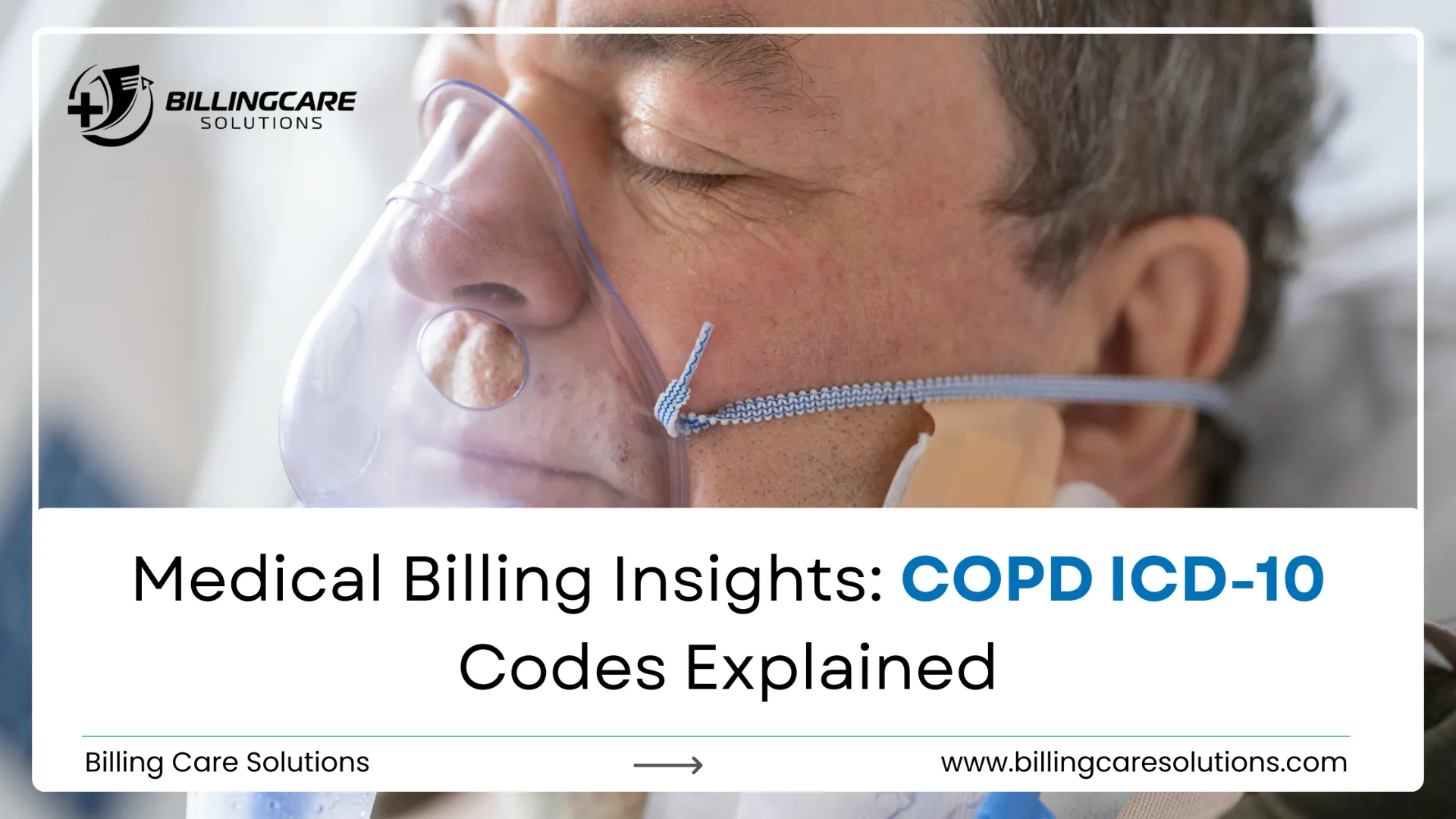
Chronic Obstructive Pulmonary Disease (COPD) is a major health problem in the US and accounts for a large share of the medical bills in the pulmonology practices. The use of correct codes with COPD ICD-10 is a must for the right money flow from the insurance, for conforming to the rules, as well as for quality reporting. This detailed manual explains in detail what to code with COPD ICD-10 for medical billers and healthcare providers.
Understanding COPD and Its Medical Billing Significance
COPD is a group of lung diseases that progress over time and include emphysema, chronic bronchitis, and other respiratory diseases. In terms of billing, COPD is a representative of one of the most frequently occurring chronic conditions that require accurate documentation and coding. The intricacy of COPD ICD-10 codes mirrors the different manifestations, severities, and complications of the disease.
Accurate coding is at the core of revenue cycle management, compliance with payer requirements, and a true reflection of patient acuity. It is very important to choose the right ICD-10 code when billing for COPD-related services in order to have the claims processed without delay and to keep the risk of denials at a minimum.
Primary COPD ICD-10 Codes Every Biller Should Know
J44.0 - COPD with Acute Lower Respiratory Infection
Employ this COPD ICD-10 code for the situations wherein patients carry the history of COPD along with a respiratory tract infection acutely, such as bronchitis or pneumonia. The clinical documentation should explicitly state the occurrence of both conditions. If the billers add the infection code as a secondary code, it will show the exact type of infection, which will help them in submitting complete and accurate claims.
J44.1 - COPD with Acute Exacerbation
This is the COPD ICD-10 code, which is mainly referred to when billing. It is the case when patients have their respiratory symptoms aggravated and are beyond their baseline condition. On rare occasions, exacerbations may have to be treated at the emergency department, require increased use of medications, or necessitate hospital admission. The symptoms of exacerbation are clearly documented, help in assigning this code, and also act as a service level provider's confirmation.
J44.9 - COPD, Unspecified
In case the provider documentation does not specifically indicate the type or status of COPD, J44.9 is used as a default COPD ICD-10 code. Nevertheless, medical billers ought to work in partnership with providers to get detailed documentation if it is feasible. More detailed codes more accurately reflect patient complexity and can potentially lead to higher reimbursements.
Related Respiratory Codes for Comprehensive Billing
Emphysema Codes (J43 Series)
While emphysema is a type of COPD, specific codes exist when providers document this diagnosis explicitly:
- J43.0: Unilateral pulmonary emphysema
- J43.1: Panlobular emphysema
- J43.2: Centrilobular emphysema
- J43.9: Emphysema, unspecified
Use these codes instead of general COPD ICD-10 codes when emphysema is specifically documented.
Chronic Bronchitis Codes (J41-J42)
Chronic bronchitis has to be coded differently:
- J41.0: Simple chronic bronchitis
- J41.1: Mucopurulent chronic bronchitis
- J42: Unspecified chronic bronchitis
Knowing how chronic bronchitis is related to COPD is beneficial for billers when picking the right diagnosis codes as per provider documentation.
Documentation Requirements for Accurate COPD ICD-10 Coding
In fact, the correct COPD ICD-10 code selection is very much dependent on the clinical documentation of the case. The medical practitioners should clearly indicate the kind of COPD (emphysema, chronic bronchitis, or unspecified), the status of the disease (stable, acute exacerbation, or with infection), severity signs and symptoms, treatment given during the visit, and if there are any complications or comorbid conditions.
Detailed documentation allows coding specialists to choose the most exact codes that directly correspond to the medical necessity and that ensure the right level of payment. If the documentation only refers to "COPD" without giving more details, the coders are forced to pick the code for an unspecified condition, J44.9, which probably will not reflect the level of care complexity correctly.
Common COPD ICD-10 Coding Scenarios
Routine COPD Management Visit
In the case of stable COPD patients who come for a routine follow-up without any acute changes, it is appropriate to utilize the code J44.9 in the absence of documentation specifying the type of COPD. If the healthcare providers recognize conditions such as emphysema, then a corresponding J43 code should be chosen.
COPD Exacerbation Requiring Treatment
The J44.1 code should be assigned to a patient with a history of COPD who presents with shortness of breath that has worsened, increased cough, and sputum production. This is a COPD ICD-10 code, which is instrumental in indicating the need for acute care and justifying additional levels of services.
COPD with Pneumonia
In a situation where a COPD patient has pneumonia, the code J44.0 should be documented as the primary diagnosis, with the pneumonia-specific code being the secondary. Together, they give an accurate account of the two diseases and their clinical relationship.
Best Practices for COPD ICD-10 Coding Success
Support Medical Necessity
Each COPD ICD-10 code must be a logical explanation of the services that were billed. For example, spirometry testing, oxygen therapy, pulmonary rehabilitation, and imaging studies should all have correct diagnosis codes that show medical necessity. If there are misalignments between diagnosis codes and procedures, then the cases will be rejected.
Understand Payer Requirements
Medicare and commercial payers have their own set of guidelines that must be followed if there are services related to COPD. Local Coverage Determinations (LCDs) lay down the criteria for coverage of oxygen therapy and pulmonary rehabilitation. It is a good practice to always be up to date with the payer-specific requirements in order to be sure that the billing practices are compliant.
Code to the Highest Specificity
Make sure that you always pick the most detailed COPD ICD-10 code that is supported by your documentation. Detailed codes help to improve the quality of data for quality reporting programs; they also serve as a correct risk adjustment factor in value-based care models, and they are an effective way of preventing claim denials.
Avoiding Common COPD ICD-10 Coding Errors
By Default, Unspecified Codes Are Used
It seems that in a lot of cases, the staff who do the billing just automatically put the code J44.9 on the bill of the patient without really checking the documentation. So, it is advisable to look at the doctor’s notes to see if there is any more detailed information from which a more specific code can be decided. If the medical record only mentions briefly emphysema or acute exacerbation, then different codes should be used.
Improper Use of Coding
The order of diagnosis codes should reflect the main reason for the patient’s visit. In the case of hospital admissions, the principal diagnosis should be the one that is identified after the studies as the main cause of the admission. The correct sequencing has an impact on the payment and the quality indicators.
Missing Related Conditions
For instance, Heart failure, respiratory failure, and pulmonary hypertension are common comorbidities in patients with COPD. Therefore, carefully document and code all the conditions that are present in order to reflect the complexity of the patient and to help with the correct payment.
Not Being Updated Every Year
Changes in ICD-10 codes happen every year and are usually effective from October 1st. A practice of continuous learning can be pursued by using different resources such as CMS announcements, coding newsletters,s and professional development courses. In addition, the core COPD ICD-10 codes, which are the main focus, remain unchanged, but the related codes and the guidelines may change.
Impact of COPD ICD-10 Coding on Revenue Cycle
Accurate COPD ICD-10 coding has a significant impact on the practice revenue through various means:
Claim Acceptance:
The use of correct codes indicates a clean claim submission, which is accepted at the first-pass level most of the time, thus payment delays and administrative rework are minimized.
Appropriate Reimbursement:
The use of the most specific codes that depict the severity of the disease and the presence of complications helps to get the right level of payment for the complex care provided.
Quality Reporting:
A lot of quality programs have COPD measures included in them. Proper coding guarantees that patients will be considered as the correct populations for quality measures.
Risk Adjustment:
In Medicare Advantage and other risk-adjusted models, the COPD ICD-10 codes are used to calculate risk scores that influence capitation payments. The more detailed codes that reflect the severity of the disease help to improve the risk score accuracy.
Improving Provider Documentation for Better Coding
Success with COPD ICD-10 coding is a collaboration between billers and clinical staff. So, it is advisable to have provider education sessions on a regular basis, focusing on the documentation needs; have a clear query process for the incomplete documentation, and create documentation templates that will help the staff to put the necessary details of the COPD.
In case the documentation is not clear, please get clarity from the providers before using the unspecified codes as a default. An effective query process will lead to high coding accuracy and thus a smooth revenue cycle.
Why Choose Billing Care Solutions or Outsource COPD Coding
Billing Care Solutions (BCS) has several advantages when a healthcare organization decides to outsource its COPD coding to them:
- Accuracy and conformity: Professional coders assure the most accurate ICD-10 code selection as well as the correct support documentation.
- Saving time and resources: Medical providers can concentrate on patient care, while the billing staff takes care of the complicated coding.
- Income maximization: The correct coding will lead to the highest possible reimbursement and the least amount of denied claims.
- Preparation for an audit: Thorough documentation and compliance with protocols will serve as a "shield" in the event of an audit by payers.
- Capacity for growth: There is no decrease in accuracy even if the volume of claims varies because Billing Care Solutions has the capacity to manage them.
- The practices that decide to outsource retain the ability to provide quality care, and at the same time, they can be sure that claims are accurate, timely, and compliant.
Conclusion:
Accurate COPD ICD-10 coding plays a crucial role in medical billing that is efficient, proper reimbursement, and healthcare regulations. It all starts with knowing the codes, then steering clear of common mistakes, making proper documentation, and later on, if needed, using the tools, or simply outsourcing the services to Billing Care Solutions, to have improved claim outcomes. As COPD is an intricate and expensive situation, giving accurate coding a top priority is one of the ways to keep the revenue flowing, to be able to give good quality patient care, and to increase overall operational efficiency. The practices that spend on accurate coding processes are the ones that experience fewer denials, get their reimbursements quicker, and are provided with more reliable data for their clinical and financial decision-making.
