


Hospital Revenue Cycle Transformation: A Practical Guide to Driving Financial Performance
Explore how Hospital RCM Services transform billing, collections, denials, and A/R while helping hospitals improve financial performance.
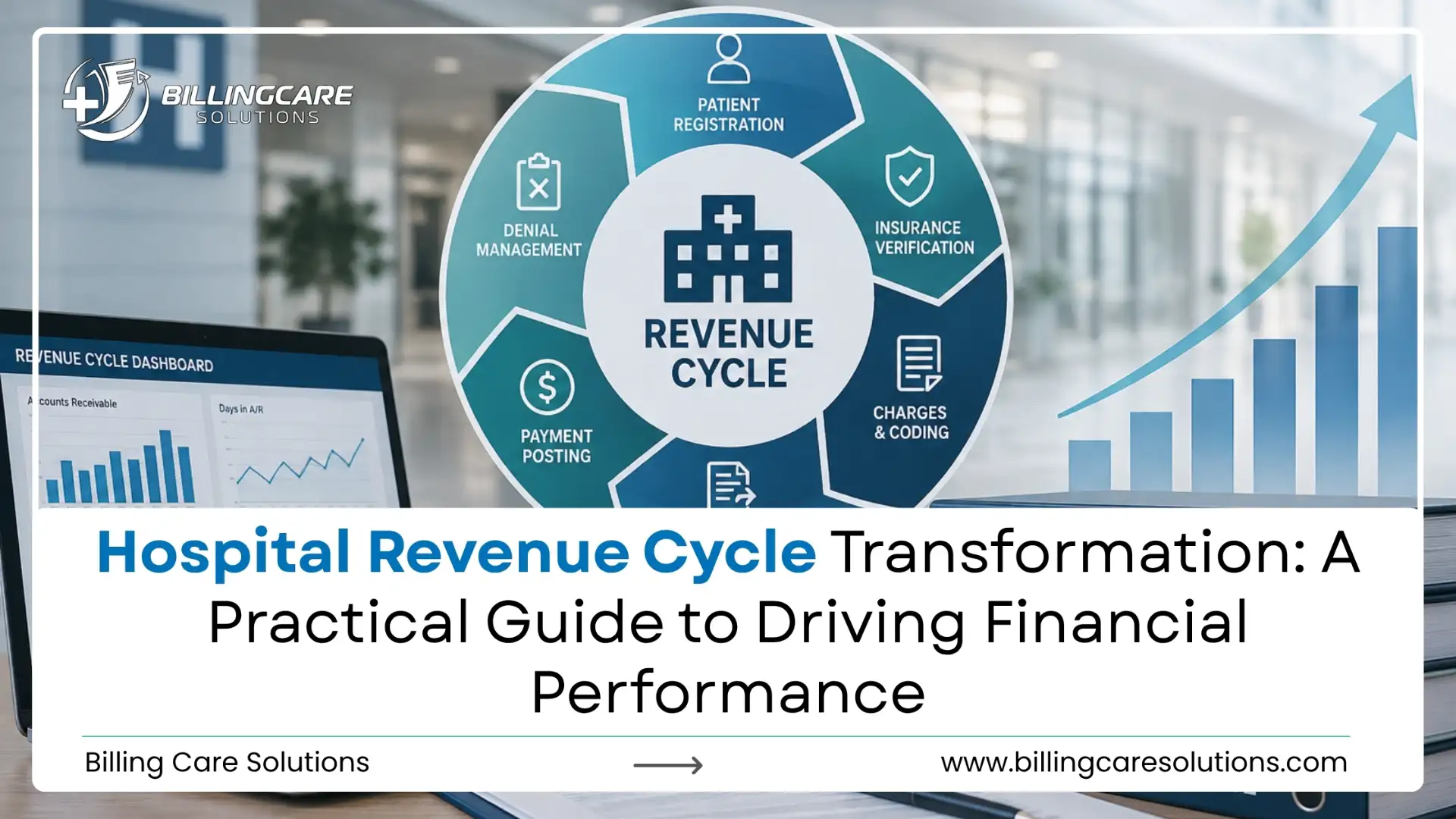
Revenue cycle management is a significant factor in any healthcare organization’s revenue, margins, and financial stability. The complications of using complex payer rules adds extra strains on hospital finance teams. Revenue leakage also happens on many points of the patient’s financial journey. Collections are impacted by registration errors, coding problems, denials, underpayments and A/R delays. Combined with coordinated workflows, specialized expertise, technology and financial analytics, effective hospital RCM services are helping hospitals solve these issues.
Billings is just not sufficient for hospital CFOs. All revenue cycles must be improved in terms of financial governance, measurable performance targets and enhanced control. This guide details how RCM services in the hospital can facilitate transformation of the revenue cycle and help boost financial performance.
Why Hospital Revenue Cycle Transformation Matters
There are hundreds of financial and administrative processes in the hospital revenue cycle. A mistake at the beginning of the patient experience can impact reimbursement months later. Registration inaccuracies can cause eligibility issues, and missing documentation can lead to coding inaccuracies. There can be discrepancies in payment after claims are closed. These issues often span different departments, leading to disjointed processes and lack of financial transparency.
Hospital RCM services in this context are well functioning because they bring these functions together with standard procedures and joint performance information. This provides CFOs with more transparency on revenue leakage, payer performance, A/R trends, collection opportunities and more. The successful transformation is based on the financial results and not on claim volumes. There is a need for measurable collections, A/R and denial rate improvements, payment accuracy, and cost to collect improvements within hospitals.
Where Hospitals Lose Revenue
Revenue leakage occurs throughout the patient’s financial journey. Otherwise, hospitals must look at all steps rather than simply claims and denials.
| Revenue Cycle Area | Common Problem | Financial Impact |
|---|---|---|
| Patient Access | Incorrect insurance information | Eligibility-related denials |
| Authorization | Missing or expired authorization | Delayed reimbursement |
| Documentation | Incomplete clinical records | Coding issues |
| Coding | Incorrect diagnosis or procedure codes | Underpayments and denials |
| Charge Capture | Missing or incorrect charges | Lost billable revenue |
| Claims | Billing and submission errors | Claim delays |
| Denials | Preventable payer rejections | Delayed cash collection |
| Underpayments | Payment below expected rates | Hidden revenue leakage |
| A/R | Delayed account follow-up | Higher A/R days |
| Contract Management | Payment variance | Lost contracted revenue |
Hospital rcm services will assist in pinpointing the source of these issues. This enables teams to assess the monetary consequences and identify recovery opportunities. An average across the entire hospital may mask significant performance issues. One payment source may be effective and another may be a big revenue leak. In fact, CFOs need to segment performance into payer, facility, service line, and account type pieces.
Key Metrics for Hospital RCM Performance
CFOs should not rely on activity-based reporting. Even when claims are counted, it does not indicate if the financial performance of hospital RCM services are improved.
| RCM Metric | Risk Area | Target |
|---|---|---|
| Clean Claim Rate | Claim rework | 95%+ |
| Denial Rate | Revenue delays | Below 5% |
| Days in A/R | Cash flow | Below 40 days |
| Net Collection Rate | Revenue leakage | 95%+ |
| A/R Over 90 Days | Aging exposure | Below 15% |
| Cost to Collect | RCM expense | Below 3% |
It is important to remember that these benchmarks are not universal requirements, but rather management reference points. Performance is dependent on the size of the hospital, payer mix, specialty composition, and case complexity. These metrics should be tracked by hospital by month, by payer and by service line. Trend analysis is used to determine whether improvements to the hospital rcm services are sustainable. CFOs need to link operational KPIs with financial outcomes as well. A lower denial rate is more important if it leads to quicker collections and lower administrative expenses.
How Technology Changes Hospital RCM
Specialized teams, automation, and analytics are becoming a common part of modern hospital RCM services. Manual review is a key requirement in traditional workflows, making it difficult for staff members to review many accounts. Today’s RCM platforms process more information on a variety of financial activities. Eligibility systems check insurance information; claim technology is designed to look for errors before they are submitted.
Predictive analytics can help anticipate parts of a claim which might be more likely to be denied. Payment variance technology is the ability to compare what was reimbursed to what is anticipated and to identify any potential under reimbursements. In addition, automation eliminates repetitive administrative tasks. RCM teams can then concentrate on more intricate accounts, large dollar claims, and payer-specific recovery opportunities. A technology solution is not enough to change an inefficient revenue cycle. Hospitals should reimagine the workflows within their buildings, and assign owners to all workflows.
Building an End-to-End Hospital RCM Workflow
A full patient financial lifecycle should be covered by the comprehensive hospital RCM services. They all impact
on each other, and improvements in any one stage only yield small financial returns if they stand alone.
Patient Access and Registration
The revenue cycle starts before patients get services. Demographic and insurance data is needed for registration teams. Services should be provided if it is possible to verify eligibility prior to the delivery of services. There is also an issue of appropriate authorization and benefit verification for financial clearance. Typical mistakes at this level can cause downstream claim issues and collection delays.
The quality of registration, accuracy of eligibility checks, authorization rates, and financial clearance performance should be monitored by the Hospital RCM services. These metrics detect front-end issues before they can turn into costly back-end issues.
Clinical Documentation and Coding
Proper documentation of clinical information is essential for accurate reimbursement. Coding teams convert clinical data into billable codes and CDI teams assist with ensuring that documentation conforms with the services reported. Hospitals should track coding accuracy, query rates, charge capture, and denials related to documentation. These measures are used to detect a risk of reimbursement prior to impact on payment.
Strong coordination between physicians, CDI specialists, and coding teams also bring a significant reduction in rework. Accurate coding and improved financial integrity of submitted claims is supported by improved documentation.
Claims and Billing
Any claims must be validated prior to submission. Automated claim edits can be helpful in detecting missing data, coding errors, and payer-specific requirements. Hospital billing services should also keep an eye on payer rules, as the rules for reimbursement differ from one health plan to another. Claims submitted at the right time are still important as payments will be delayed if the claim is submitted too late. Hospitals should monitor the number of clean claims they submit in addition to the slow claims. This gives a better perspective on the billing performance and claim issues that can be avoided.
A/R and Denial Management
The key elements of A/R management are: financial value, aging, payer behavior, and recovery probability. Older claims need to be escalated through a structured process, while high dollar claims need to be acted on sooner. Denial management needs to be about the root cause rather than just claim volume. Recurring issues from claims which are reworked, but not corrected, are a waste of man-hours. Underpayment analysis should be a part of the hospital RCM services as well. Payment for a claim doesn’t necessarily mean that the claim is being fairly reimbursed.
Hospital RCM Services That Drive Results
RCM for hospitals should not ignore efficiency in service operations, but should not lose sight of financial aspects either. Some core services include medical billing, medical coding, denial management, A/R follow-up and underpayment recovery. Front-end performance is enhanced by prior authorization and eligibility checks. Revenue Integrity Services can be used to detect missing charges and payment inconsistencies. Contract analysis also allows hospitals to compare what they are paid to what they negotiated.
| Hospital RCM Service | Primary Function | Financial Objective |
|---|---|---|
| Medical Billing | Accurate claim submission | Faster reimbursement |
| Medical Coding | Accurate code assignment | Correct reimbursement |
| Denial Management | Resolve rejected claims | Recover delayed revenue |
| A/R Management | Prioritize outstanding balances | Improve cash flow |
| Underpayment Recovery | Identify payment variances | Recover lost revenue |
| Revenue Integrity | Identify leakage | Protect earned revenue |
| Authorization Support | Verify payer requirements | Prevent avoidable denials |
| RCM Analytics | Monitor performance | Improve financial decisions |
The strongest hospital RCM services connect these functions through shared reporting and defined performance targets. CFOs then receive one view of how operational issues affect financial results.
How CFOs Should Evaluate Hospital RCM Services
Choosing hospital RCM services requires more than comparing service fees. CFOs should evaluate financial outcomes, operational controls, technology, security, reporting, and hospital-specific experience. Ask potential hospital rcm services partners for measurable performance indicators. These should include denial rates, collection rates, A/R performance, recovery results, and financial improvements achieved for comparable organizations.
Review experience with hospitals of similar size and complexity. Specialty expertise also matters because reimbursement requirements differ across departments and service lines. Security should remain a core requirement. Vendors should demonstrate appropriate HIPAA safeguards, data protection practices, and documented quality controls. Reporting capabilities also deserve attention. CFOs need actionable dashboards rather than reports filled with operational activity. The vendor should explain how its hospital RCM services identify root causes and prevent recurring revenue problems. Recovery alone does not create transformation if the same problems continue.
Outsourcing Hospital RCM Services
One of the many issues that hospital management faces is whether to keep revenue cycle functions in-house or outsource them. The best choice depends on staffing, technology, scale, financial performance and expertise within the organization.
| Factor | Internal RCM | Outsourced RCM |
|---|---|---|
| Staffing | Fixed internal capacity | Scalable resources |
| Technology | Hospital-funded infrastructure | Vendor-supported technology |
| Expertise | Requires internal hiring | Specialized external teams |
| Coverage | Depends on staffing | Broader operational coverage |
| Analytics | Depends on internal tools | Advanced reporting options |
| Cost Structure | Payroll and overhead | Contract-based expense |
Outsourcing does not automatically improve finance performance. Effective governance, service-level agreements and performance monitoring are still required in hospitals. The better question is whether external hospital RCM services deliver measurable financial value. CFOs should compare internal costs and performance against expected collection improvements and operational savings.
Measuring the ROI of Hospital RCM Services
RCM transformation needs a financial measurement framework. CFOs should establish baseline performance before changing workflows or implementing new technology. The baseline should include collections, A/R, denials, clean claims, payment variance, and operating costs. After implementation, hospitals should compare results against these original measures. Important financial measures include revenue recovered from underpayments, reductions in preventable denials, changes in A/R days, improved clean claim rates, and increases in net collections. Hospitals should also track changes in cost to collect and staff productivity. Effective hospital RCM services should reduce avoidable work while improving financial results. ROI should account for implementation and operating costs. An RCM investment needs measurable financial returns rather than improved activity levels alone.
Common Hospital RCM Transformation Mistakes
Too many transformation efforts are unsuccessful because hospitals deal with issues without addressing the entire revenue cycle. One of the many common misconceptions regarding the RCM is treating it as a billing activity. Revenue cycle performance starts before claims are sent to billing. Patient access, authorization, documentation, coding and charge capture all factors into final reimbursement.
The other error is to only think about denials. Other factors impact hospital revenue as well, such as underpayments, missed charges, authorization problems, and discrepancies in the contract. If hospitals measure activity, rather than outcomes, then they lose value, too. Claims per employee aren’t always correlated with better claims or better margins. Technology implementation creates another risk. Automation without workflow redesign often moves inefficient processes into a digital environment. Hospitals should first identify process weaknesses. They should then determine where technology provides measurable value. Selecting an RCM partner based solely on price creates another financial risk. A lower service fee does not matter if poor performance results in greater revenue leakage.
A 90-Day Hospital RCM Transformation Plan
A structured approach to implementing it can assist hospitals in prioritizing financial opportunities. The first 90 days are for diagnosis, redesign and measurable optimization.
Days 1 to 30: Diagnose
Start with a complete revenue cycle assessment. Analyze denial trends, A/R aging, payer performance, clean claim rates, payment variances, and collection performance. Identify the highest-value revenue leakage sources. Rank opportunities based on financial impact and recovery potential. This creates a practical starting point for hospital RCM transformation.
Days 31 to 60: Redesign
Implement consistent processes in key areas. Implement payer specific processes as necessary and define ownership of denials, underpayments, A/R and authorizations. Automate repetitive manual tasks where they are adding unnecessary costs. Staff to also be given clear procedures for escalating complex and higher value accounts.
Days 61 to 90: Optimize
Begin to compare outcomes to baseline. Monitor financial results by payer, facility and service line. Review recurring denial and underpayment patterns. Use dashboards to identify new risks and assign accountability for corrective action. Transformation should continue beyond the first 90 days. Hospital RCM services require continuous monitoring, process refinement, and financial review.
How Billing Care Solutions Supports Hospital RCM
Billing Care Solutions provides hospital RCM services designed to improve revenue cycle efficiency and financial performance. Our approach connects billing, coding, A/R management, denial management, and revenue cycle analytics. The goal is simple. Detect, reduce, and enhance reimbursement accuracy and financial results.
Billing Care Solutions caters to healthcare organizations in various revenue cycle areas. These are medical billing, medical coding, claims management, denial management, A/R management and revenue cycle optimization. Our integrated approach enables organizations to solve issues throughout the entire revenue lifecycle. CFOs also have more insight into the business and financial performance.
The appropriate RCM approach will vary based on the individual hospital’s payer mix, specialty mix, model, and financial goals. Billing Care Solutions will aid in determining where the largest monetary risk lies and how to handle it with workflows.
How Hospital RCM Services Improve Financial Performance
Effective hospital RCM services connect operational improvements with measurable financial outcomes. Better front-end processes reduce avoidable claim problems, while accurate coding strengthens reimbursement accuracy. Effective denial management accelerates delayed payments. Underpayment recovery captures revenue that standard A/R processes often miss. A/R management enhances cash flow by concentrating on high value accounts. Analytics offer CFOs deeper insights into payer trends and patterns, operational performance, and revenue leakage. The overall impact is better financial oversight throughout the revenue cycle. Hospitals can better identify no-win areas and what steps will yield real results in the bottom line.
Transform Your Hospital Revenue Cycle
RCM should be treated more like a financial function than administrative process in hospital revenue cycle management. CFOs must have visibility throughout the complete revenue cycle and measurable accountability for their financial performance. The best transformation plan is an integrated, people, technology, process and financial analysis. Hospital RCM services offer more know-how when in-house resources are unable to meet these needs effectively. Billing Care Solutions is a healthcare revenue cycle support provider that helps healthcare organizations bolster their RCM performance. We continue to work on enhancing financial results in billing, coding, A/R, denials and revenue integrity.
Frequently Asked Questions
CFOs should prioritize denial rates, A/R days, clean claim rates, collection rates, payment variance, and cost to collect. These metrics connect operations with financial performance.
By reducing billing delays, faster denial resolution, and quicker recovery of outstanding accounts, effective RCM will accelerate the process of getting paid. This not only makes payments more accurate but also helps minimize lost revenues.
Registration mistakes, unauthorized use, coding issues, missing documentation, charge capture problems, under-payments and delayed A/R follow-up are the most common methods of revenue leakage. These issues grow worse as the children mature.
RCM teams reconcile payments from payers with contracted rates, expected reimbursement, and payment trends in the past. Variance analysis then can identify any recurring discrepancies that need to be followed up with the payers or recover.
There are differences in payment behavior, authorizations, denial patterns, and reimbursement rates among payers. Tracking these disparities enables CFOs to spot monetary risks and also to negotiate better deals.
Hospitals can outsource when they don’t have enough resources, capacity, specialty or technology to handle the situation themselves. External support should result in tangible improvements in collections, efficiency and financial control.
Technological solutions take repetitive tasks off of your hands, detect claim issues, forecasts claim denial risk, evaluates payment discrepancies and enhances reporting. These capabilities enable RCM teams to target higher financial value opportunities.
Hospitals can predict measurable performance reporting, specific specialization, secure processes, scalable staffing, communication transparency and specific financial goals. Vendors need to show results with the appropriate hospital RCM benchmarks.
The first 90 days are a good period to see initial improvements after implementing. To guarantee sustainable results, monitoring of the process, optimization of the workflow, accountability of staff members and regular financial performance reviews are required.
Billing Care Solutions offers hospital RCM services in the areas of billing, coding, A/R management, denial recovery, and revenue cycle analytics. These are services to focus on better collections and better financial results.
