

Struggling with WellMed Credentialing? How to Avoid Enrollment Delays and Get Your Practice Ready to See Patients
Facing enrollment delays? Learn how WellMed Credentialing works, which documents providers need, and how to prevent common application mistakes.
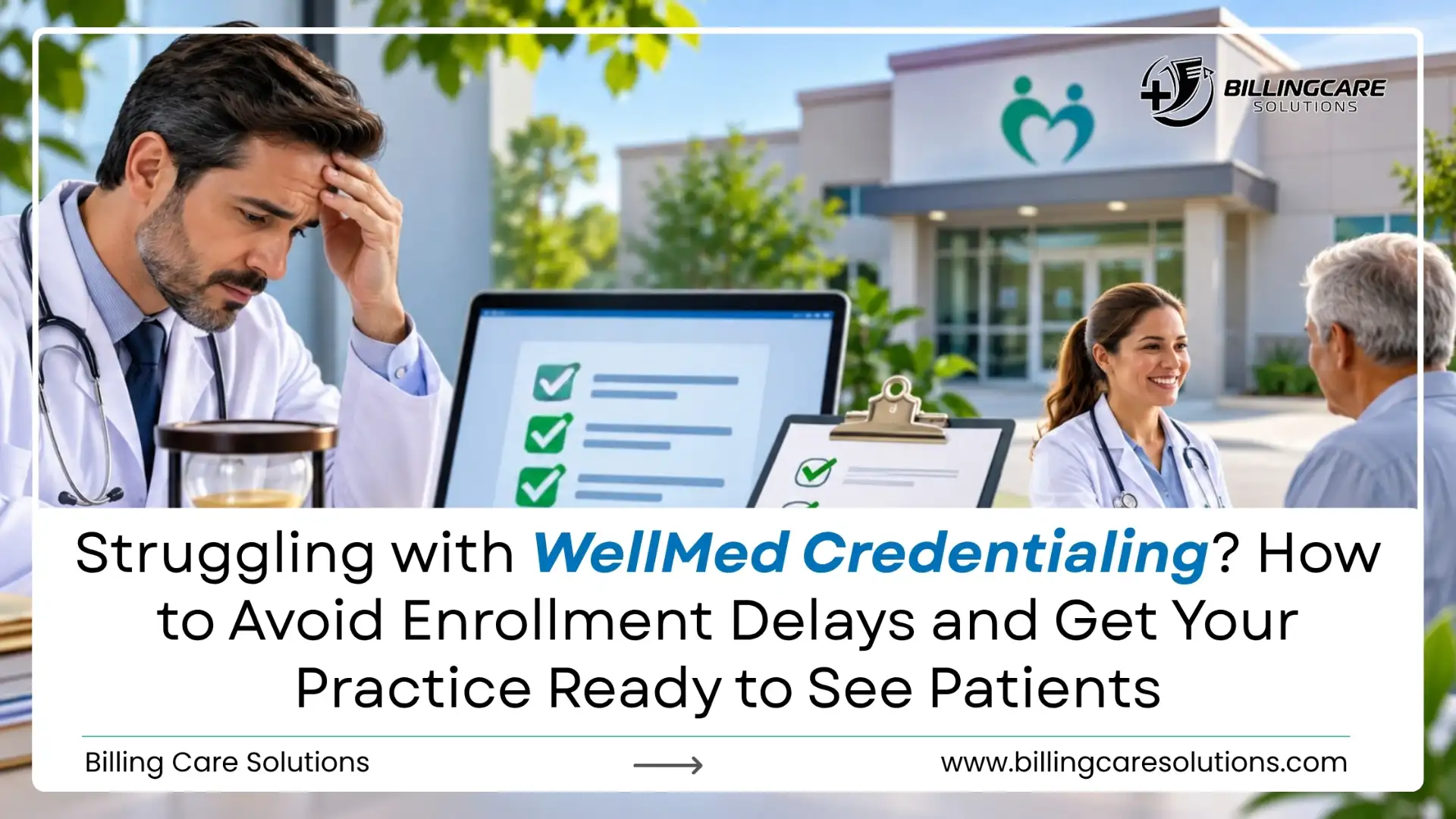
WellMed Credentialing has an impact on the way medical practices train physicians for WellMed network arrangements, where applicable. Participation can be delayed in case of under-filling the application form, missing provider details or a non-solved verification request. Such delays impact patient scheduling, prepping for bills and planning for revenues. A doctor could be an in-network provider, even if they don’t meet all the professional qualifications, if they complete credentialing and contracting requirements.
As a practice owner or administrator, you face several challenges when managing provider records. You also need to review verification requests and confirm provider participation. Handling these responsibilities without disrupting your practice’s daily operations adds another challenge. A streamlined WellMed Credentialing process links enrollment activities to claims submission. Billing Care Solutions assists practices with managing these tasks and with coordinating credentialing support tasks with the billing operations.
What WellMed Credentialing Means for Your Practice
WellMed is not an insurance plan. WellMed Network, Inc. and WellMed Networks of Florida, Inc. work with specific Medicare Advantage health plans. They manage medical risk for members associated with contracted or affiliated providers. The actual terms of participation vary based upon the relevant health plan, contract, and patient population involved. Those details help identify the requirements that the practice will need to meet to be awarded the WellMed Credentialing information.
WellMed Credentialing cannot be applied to all UnitedHealthcare products for this reason. It is important for a practice to first determine which networks and plans it is related to, before they submit information or schedule patients. This is the first audit to ensure a participation way is followed properly with WellMed Credentialing. Ensure that the provider is submitting as an individual provider, as part of a group or as part of a group arrangement.
The practice should also split between credentialing and contract activation and the operation of these. Professional qualifications are evaluated by credentialing. Participation terms are set through contracting. Group affiliation links the service provider with the proper practice or tax identification system. Operational recognition supported with system loading and directory updating. Lastly, there is no evidence that a completed step means that all additional steps are completed. This is a key part of the accurate WellMed Credentialing status verification process.
Understand the Main Enrollment Stages
A sure thing WellMed Credentialing workflow begins with verifying the proper participation pathway. Inquire to the contracting representative or network contact on who needs to be enrolled and what network plan? Specify the provider type, practice location, how the group is related, and whether this is a new provider or a change to an existing provider record. These details help to determine the WellMed Credentialing submission.
1. Confirm network and contract requirements
When preparing an application, clearly specify the network and product. Review to see if the practice already has a group agreement and the need for the provider to be joined with the group agreement. Don’t presume that having an established relationship with another UnitedHealthcare product meets WellMed criteria.
2. Prepare provider and practice information
Gather provider’s legal name, credentials, NPI, Line of Practice, state licensing information, practice location and payment information, and contact information. Verify the legal name of the group and tax ID. Forms, licenses, NPPES, and tax documents have multiple names and/or addresses, which may result in clarification requests. Early medical review of these fields improves the authentic and honest nature of WellMed Credentialing.
3. Submit the required application and documents
Adhere to the application instructions provided for the network and the type of provider. Maintain a copy of all forms and attachments submitted. Notate the submission date, confirmation number, contact’s name and follow-up requirements (if mentioned). Ideally, a traceable file history should be provided with each WellMed Credentialing file submission.
4. Track review and respond to requests
Keep track of the lack of information, expired documents or requests for further clarification. Answer with the things specifically asked for. Don’t send an unrelated document package to a reviewer after their telephone request for a revised practice address.
5. Confirm approval and effective participation
An application receipt shall not be considered an avenue of approval. Request assurance of provider’s status, participating entity, group affiliation, location, products and start date. Inquire if there is any other contracting or system set up work still to be done. Records of enrollment should be maintained in the practice in writing. Closes an important WellMed Credentialing control gap.
Documents to Prepare Before Applying
A complete document file will minimize “is this correct” and the “next slide” for a smoother WellMed Credentialing review. Participation requirements vary by provider type and participation path, so follow the instructions as they are written now in this current pathway by a responsible network or health plan. Do not use a WellMed Credentialing checklist for any route without verifying on that course.
The next items are typical ones used to support provider enrollment and verification:
- Active state Professional License.
- Personnel NPI (individual NPI) and organizational NPI where applicable.
- The most recent certificate and coverage information for malpractice insurance.
- If applicable, provide board certification information.
- Education, residency, fellowship and training history, if requested.
- Labor history and justification for any gaps in labor history, if applicable.
- DEA registration and state controlled substance registration (if applicable).
- If applicable, enrollment details for Medicare.
- Practice location, service addresses and office contact information.
- Include group legal name, tax ID number, and group NPI.
- Details of payment or remittances and other W-9 information on request.
- Required disclosure and provider information (if applicable).
Please preview all documents before sending them. Review expiration dates, spelling, address formatting, and consistency of records. It’s possible that a license that has an outdated address or an insurance certificate which does not contain the same legal name may result in more review.
Any information in the CAQH database that is requested or dependent upon by the relevant enrollment path should be kept up to date. Please do not presume that CAQH will replace the network’s application or document requirements. Identify which parts of the profile should be updated, perform necessary profile confirmations, and ensure information accuracy with respect to the application.
Why Applications Get Delayed
The majority of avoidable delays stem from lack of information or inconsistent information. Some of these may seem like a minor thing to the practice but can be used to trick a reviewer into not being able to validate who the provider is, qualify, verify location, or verify relationship with the group.
Incomplete application fields
If you don’t have all the details that might seem relevant when you’re reaching out, it can lead to a follow-up request. Where a field is not applicable conform with the directions given for marking it as “not applicable”. Don’t leave out required parts.
Conflicting provider data
Ensure provider information, including the provider’s name, NPI, taxonomy, license information and practice address, is consistent for relevant provider records. All application and NPPES, state licensing records, W-9 and malpractice certificate must be correct for submission. Provision of early resolution eliminates unnecessary rework in WellMed Credentialing.
Expired or missing credentials
Verification can be interrupted when a police license has expired, a malpractice policy has expired, a DEA registration is cancelled, or certification is cancelled. Keep enrollers abreast of documents that need to be updated and have them update documents before the enrollers ask for it.
Unclear group affiliation
It is possible for a provider to have an individual record but not an association to a group or location. Verify the Billing entity, the location of the service as well as the Contract relationship. Don’t think you have done enough by adding a provider to one record to do it for all locations.
Slow responses to follow-up requests
Even when the practice is the first one to respond, the complete application may become stuck. Designate a specific individual to keep track of requests, coordinate responses with provider, office manager and credentialing contact. This ownership does not let WellMed Credentialing follow up by the wayside.
How Enrollment Delays Affect Practice Revenue
An incomplete application for WellMed Credentialing can interfere with practice business continuity planning. Therefore, scheduling and revenue cycle leaders should also be able to see the WellMed Credentialing status. The start date for the provider may be earlier than confirmation of participation. This brings grey areas on who to see, what products are on their line, what the claim will be like, and how the practice will manage it.
The monetary ramifications would be determined by the contract, health plan, member benefits and provider status. Don’t take it for granted that every claim will be rejected or that payment will be provided in the past. Rather, check the rules of participation before services are provided and record the directions.
Also, delays impact more than simply getting paid for claims. Practice may have to reschedule patients, redirect patient referrals, customize provider templates, or delay marketing the availability of a new provider. These changes can eat time out of your staff’s schedules and also lead to disruption of continuity for the patients who may have been expecting to see the provider.
There should be a follow-up on the operational expenses of delayed enrolment. Add the dates applications were not started, visits were rearranged, referrals unsolved, and staff time was taken to correct the applications. With this information, leadership can see how the impact is being felt, and can recognize key process failures.
How to Prevent WellMed Credentialing Delays
The prevention begins preceding a request. A cohesive WellMed Credentialing checklist provides a repeatable starting point for staff. Have a standard checklist for each new provider and an owner at every step. This method helps to avoid losing any documents and provides the practice with an escalation strategy. Also, it eases the measurement of WellMed Credentialing’s progress.
Verify the participation route first
Verify the network entity and product, provider Type and the group relationship. Determine if the provider requires a new application, an off-the-shelf contract or an update to an existing application record? Do not delete the answer, it needs to be preserved in the enrollment file’s audit trail from WellMed credentials.
Run a document quality check
Check the application with the provider’s License, NPI Record, malpractice certificate, W-9 & group info. Solve differences prior to submitting. Have a uniform naming system to allow staff to easily find the latest version.
Maintain a live status tracker
Employ a joint tracker indicating the provider name, NPI, group name, location, date of submission, contact details, outstanding items, date of last follow-up and the date effective. Make revisions after each encounter. This provides managers with visibility without the need of scattered email conversations.
Follow up with specific questions
Avoid sending vague status requests. So even if this application is received or not, whether the document is outstanding or not, at what point is it reviewed, whether the provider’s group or provider’s location association is complete or not? If necessary, retain the responses with the application record.
Validate activation before scheduling
Check the effective date and products/areas covered by the provider before assuming that they participate. If a provider directory exists or few operating systems, consult the provider directory or provider operating system, but not the directory listing alone, for a sign of contract status. Operational purposes are achieved when the practice has confirmed the details of participation in WellMed Credentialing.
Use ePRG for Operational Tasks, Not as Proof of Credentialing
WellMed’s eProvider Resource Gateway (ePRG) lets participating providers verify eligibility, verify benefit effective dates and coverage, make and view authorizations, make and view referrals, and status claims. These are functions that assist day-to-day patient and claims activities.
Access to ePRG, however, is not the same as credentialing/contracting. Registration and access to the Account are different from verification of network involvement. The practice should take the time to confirm the provider’s status and effective date via the relevant enrollment/contract contacts.
When access is granted, create roles for staff, ensure secure account management practices. Review the plan, eligibility, referral and authorization rules for each service with the patient’s team of trainers, i.e., front office, billing. After provider activation, these checks provide error reduction.
Prepare Your Practice for the Provider’s First Day
WellMed Credentialing’s last phase, operational readiness, is in place. The end-use should then check the provider’s details of participation and then match up scheduling, billing and patient access processes.
Complete this readiness checklist:
- Repeat the written approval and effective date.
- Ensure the proper group, tax number, NPI, and service locations are coded.
- Verify the health plans and products in an arrangement.
- Verify directory information; notify of errors in appropriate manner.
- Verify availability of ePRG or other necessary operating systems.
- Provide training to staff members in eligibility and referral, authorization, and claim processes.
- Update Templates of updating and provider availability.
- Verify billing system identifiers and payment setting prior to claim submission.
- Provide access to personnel to approval notices and contract records.
Never use oral information for making a start-date or billing decision on the practice. If the provider has participated or provided instructions that impact claims, retain written documentation of their participation and instructions.
How Billing Care Solutions Supports Credentialing Workflows
Coordination between Billers, Government Payors, Practice Administration and Provider is necessary to achieve credentialing. Billing Care Solutions provides medical billing and credentialing services for healthcare practices, to help organize provider information, documentation, follow-up, and other workflows within the healthcare revenue cycle.
With practices using WellMed Credentialing, organized enrollment records alleviate the burden of staff finding missing documents, noticing missing items in the records, and knowing if provider data has been entered into the practice in the system. This focus on clear ownership also minimizes the potential for missed follow-ups in the process of a provider’s induction.
Even when the enrollment is complete, billing shouldn’t require correct provider, group, location and payer dimensions. Billing Care Solutions caters to medical billing processes where accurate provider information, eligibility verification, claim processing and follow-up play a vital role. Basically the practice should establish payer-specific requirements before claiming for a new provider added on the practice.
The enrollment and billing teams should communicate prior to the provider’s start date to ensure the best experience for a credentialing process. This provides the practice with the time to address data concerns, verify enrollment and get employees ready for patient care duties. Billing Care Solutions is ready to support practices in coordinating these administrative workflows and having greater visibility into the revenue cycle.
Get Your Practice Ready for WellMed Participation
The information provided, network identification, documentation and the effective participation date must be accurate in order for WellMed Credentialing to be successful. A procedure involving an enrollment process is better monitored, has visibility of what remaining requirements are and avoids unnecessary administrative disconnects.
Acknowledging an application submission or an informal status update is no reason for planning a covered service. Verify provider contract and network status, products and locations, and set-up the billing system prior to outbound claims. The process of medical billing is critical for any healthcare setting, including WellMed Credentialing.
