

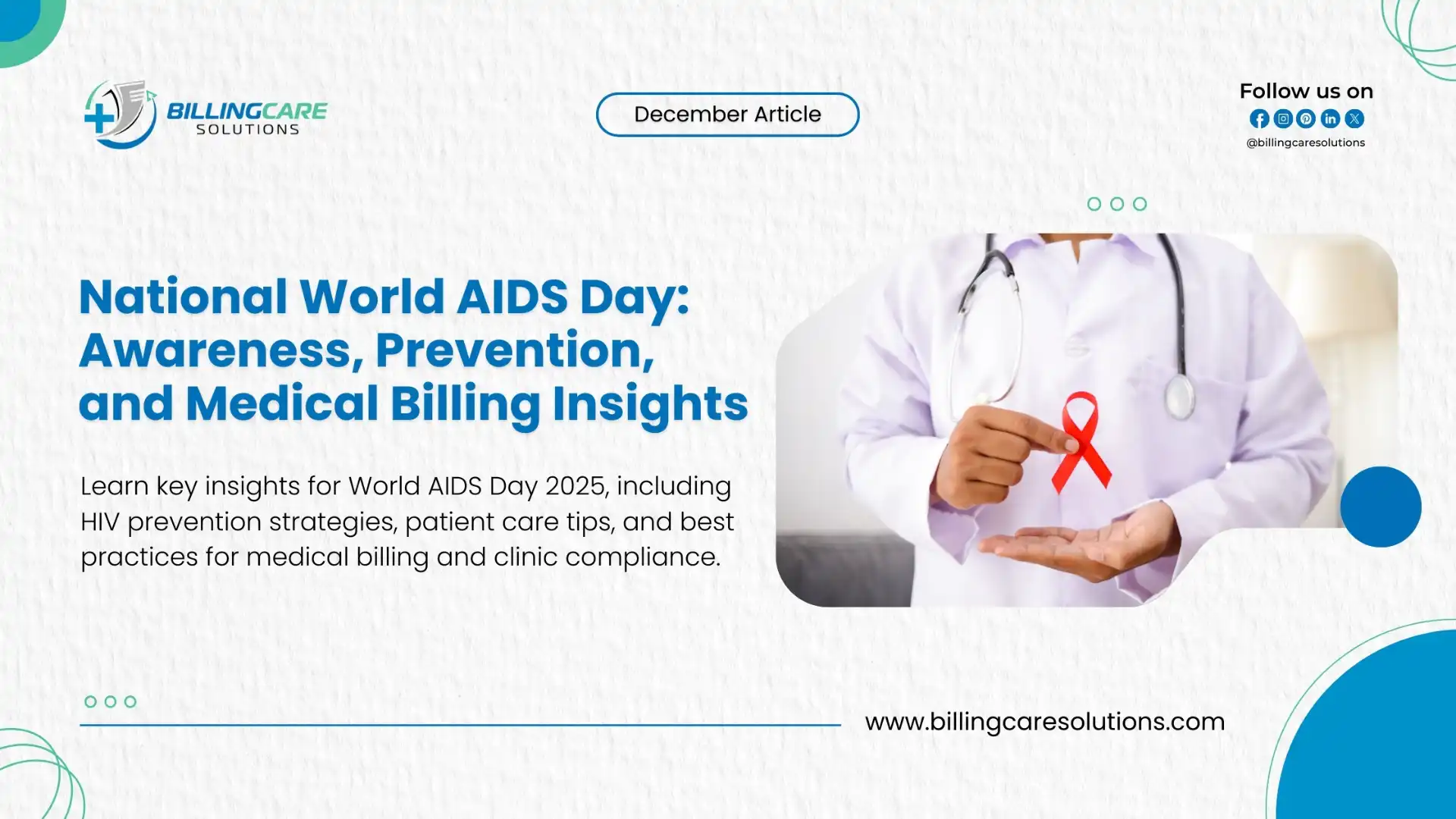
National World AIDS Day: Awareness, Prevention, and Medical Billing Insights
Learn key insights for World AIDS Day 2025, including HIV prevention strategies, patient care tips, and best practices for medical billing and clinic compliance.
World AIDS Day, which is held every year on the 1st of December, is a call to remember the terrible effects that HIV and AIDS still have on the world today. To healthcare professionals, it is a signal to keep these issues in mind, to prevent them, to educate the patients, and to ensure correct medical billing. Clinics and billing teams are essential in maintaining the correct recording, coding, and payment of the services related to HIV. This article is dedicated to the healthcare providers who are willing to learn the clinical and billing aspects on the occasion of World AIDS Day and on any other day.
Understanding the Importance of World AIDS Day
World AIDS Day was created in 1988 to help the world know more about the disease, encourage testing, and give support to those infected with HIV. For medical professionals, it is an opportunity to look at their clinical work, see if preventive measures are really being executed, and check the correctness of the billing. There are more than 38 million people infected with HIV all over the world. Doctors and nurses are very busy because they have to diagnose, treat, and educate. If done in the right way, coding and documentation during testing and treatment can be a great help to clinics in their compliance and in saving money.
Awareness and Education:
Raising awareness of HIV/AIDS through education is a big part of what World AIDS Day is all about. The emphasis is put on the fact that HIV is a transmissible disease, testing should be frequent, and there are no other diseases in the body related to AIDS. Health workers advise that those who have sex should be tested for HIV as a matter of routine, and that they should practice safer sex, such as the use of condoms, consistently, and limit the number of sexual partners.
On World AIDS Day, community programs frequently arrange workshops, webinars, and festivities to spread the word about prevention methods. These activities are also a source of assistance for people living with HIV as they work through their treatment, psychological support, and social services. Public education is still an important part of the HIV prevention toolkit and goes a long way to addressing the stigma that comes with it.
Prevention Strategies:
Prevention is one of the main points in the worldwide fight against the HIV/AIDS epidemic. Various programs are promoted as part of this stance, such as safe needle distribution for drug users and pre-exposure prophylaxis, generally called PrEP. PrEP is a single daily medication that, if used regularly, lowers the chance of HIV infection by a great deal.
The AIDS day can be used as an instrument to remind about the prevention methods and to prompt the medical personnel to explaining the measures of prevention to their patients. Intervention on time, constant testing, and catching the disease in its early stage are the keys to restraining the spread of HIV and to elevating the infected people's chances for good health in the future.
The Role of Medical Billing in HIV Care:
Healthcare billing is the backbone that keeps the HIV/AIDS care sector going. Essentially, precise billing gives the patients the freedom to avail the treatments they need without going through the financial stress and at the same time, it is a way of healthcare providers to be able to operate in a way that is both beneficial for them and the patients. Some of the common billing codes in HIV care are CPT codes that are laboratory tests, antiretroviral therapy, and consultation services.
Billing specialists must always be aware of the standards concerning HIV testing, treatment coverage, as well as preventive medications. Documentation and coding done in the right way, are insurance claims facilitators, they lead to fewer errors and thus, there is improved revenue cycle management for healthcare organizations. Billing Care Solutions experts in handling complicated billing situations make sure that clinics and hospitals are free to concentrate on patient care while at the same time, they are in financial compliance.
Common Codes Used in HIV Care
| Service | CPT/HCPCS Code | Notes |
|---|---|---|
| HIV Screening | 86701 | Standard antibody testing |
| HIV Confirmation Test | 87389 | Confirmatory testing using immunoassay |
| Antiretroviral Therapy | J0510–J0560 | Coverage for prescription medications |
| Routine Lab Panels | 80061 | Lipid panels for monitoring medication effects |
| Consultation/Follow-up | 99213 | Standard outpatient visit |
Accurate use of these codes ensures patients are billed correctly and providers receive proper reimbursement, supporting a sustainable healthcare system focused on HIV prevention and treatment.
Supporting Patients and Communities:
World AIDS Day is about showing compassion and lending support to the people infected with HIV. Various community programs, counseling services, and peer support groups, which are the main sources of emotional and social help, provide people with it and this is equally important as medical treatment. Elimination of stigmatization leads to a great number of people who decide to get tested and follow their treatment plans.
Moreover, healthcare professionals should be at the forefront of this mission by giving patients advice on the right use of medication, providing mental health support, and helping them manage their lifestyle. Billing Care Solutions helps clinics streamline administrative processes, allowing providers to dedicate more time to patient care and less to paperwork.
Conclusion:
World AIDS Day serves as a point in time to remember the absolute need for these things: awareness, prevention, and empathetic healthcare. The journey from educating the public to encouraging the use of fair medical billing procedures is one of the many ways by which the care of HIV patients can be improved. Proper coding and billing that come from such entities as Billing Care Solutions are the ways through which healthcare systems remain strong and capable of delivering these vital services.
We pay tribute to the people living with HIV/AIDS when we take time to reflect on this issue, and at the same time, we pledge to fight the HIV/AIDS epidemic through education, prevention, and the provision of excellent medical care.
