

New York Infusion Centers Stop Losing Revenue to Claim Denials: Here's How MSOs Improve Infusion Billing KPIs
See how MSOs improve Infusion Billing KPIs in New York through stronger collections, fewer denials, faster payments, and better revenue performance in 2026.
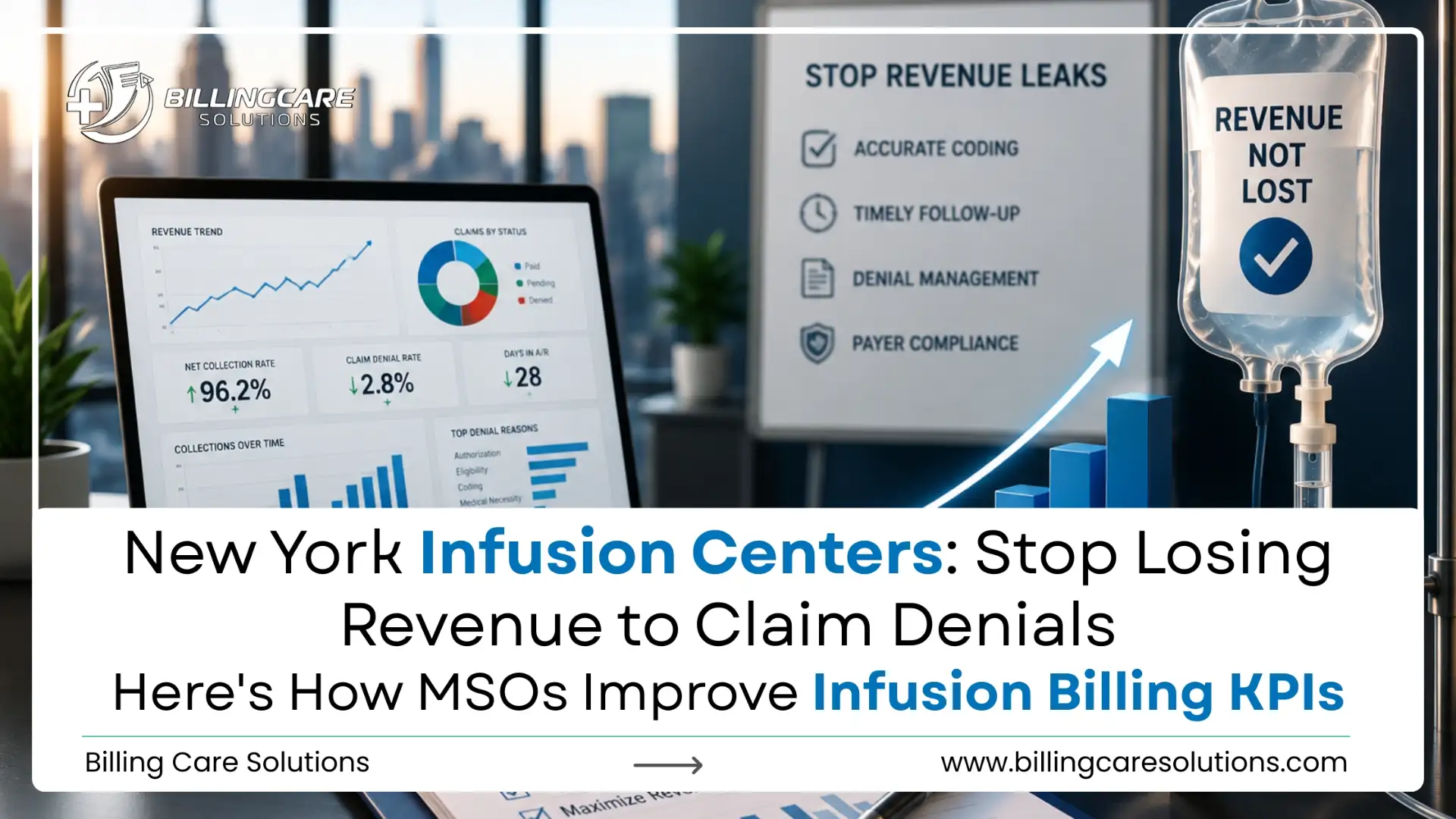
One of the most complicated and closely watched revenue cycle management sub-processes in healthcare is infusion billing. The infusion centers of New York have several special problems, such as strict state restrictions, a multi-state payer mix, and growing audit pressure. Management Services Organizations (MSO’s) have become crucial strategic partners to assist infusion centers in maximizing their Infusion Billing KPIs and revenue protection.
This guide is designed to discuss how MSOs can optimize key performance indicators (KPIs) that impact critical infusion billing for providers in New York. You’ll discover the key metrics that are most relevant to infusion billing performance, what MSOs are doing to get to the bottom of denials, and the tangible benefits of MSO partnerships in the real world. The results demonstrate that MSOs can lower the denial rate, speed up cash flow, and boost net collection rates for infusion services.
Key Takeaway: By leveraging their specialized expertise, technology and scale, MSOs can help New York infusion centers improve on denials to less than 3 %, collection rates to more than 95 percent and days in accounts receivable.
The 2026 Reality of New York Infusion Billing
The financial challenges for infusion centers in New York are increasing in 2026. Infusion billing has become a very complicated process. Payers are having stricter rules to monitor drug administration, dosage, medical need and site of care policies. These changes will directly impact infusion reimbursement.
Documentation has tightened up. Payers are now able to request detailed justification for infusion for diagnosis, evidence of prior unsuccessful therapies, laboratory results indicating ongoing treatment and provider notes indicating clinical improvement. One of the biggest barriers to denial rates at infusion centers is still poor medical record keeping.
New York infusion clinics have to face some extra complications. The state has specific billing requirements for Medicaid Managed Care and the Office of Mental Health offers comprehensive billing guidance for behavioral health services, such as long-acting injectables. This regulatory climate requires the infusion center to have special expertise that may not be available at the center.
| Challenge | 2026 Reality | Impact on Infusion Billing KPIs |
|---|---|---|
| Payer Automation | AI-driven denial algorithms flag more claims | Denial rates increasing |
| Prior Authorization | Expanding into more infusion therapies | Delayed reimbursements |
| Documentation Scrutiny | Payers demand detailed clinical justification | More denials and audits |
| Coding Complexity | New rules for modifiers, time-based codes | Billing errors and rework |
| Staff Shortages | Difficulty hiring infusion billers | Administrative bottlenecks |
The infusion billing KPIs that matter most are under pressure. Denial rates are climbing. Days in accounts receivable are growing. Staff burnout from denial rework is intensifying. This is the reality facing New York infusion centers in 2026.
The MSO Advantage for Infusion Centers
MSOs can provide a strategic benefit in infusion billing performance. Management Services Organization (MSO) is a framework that focuses administration and management, leverages economies of scale, and improves revenue cycle performance. This method is well suited for more complicated services, such as infusion therapy.
The U.S. healthcare MSO market will reach a double-digit growth rate by 2030 and the revenue cycle management service will be the largest segment. This growth is a testament to the growing awareness that specialized RCM support is crucial for financial sustainability.
MSOs provide several key benefits for infusion billing:
Specialized Expertise: Knowledge of HCPCS J-codes, CPT infusion codes and JW and JZ modifiers and encounter-based billing are needed for infusion billing. MSOs employ specialists with the specific requirements in mind and keep up with changes.
Technology and Automation: MSOs invest in technology to automate eligibility verification, prior authorization, charge capture, and denial management. This minimises manual errors and speeds up claims processing.
Economies of Scale: MSOs are able to negotiate with payers and vendors that individual infusion centers can’t match. This results in greater reimbursement rates and reduced costs.
Staffing Stability: MSOs offer dedicated teams to the billing process, which frees up time from the challenge of recruiting and retaining qualified infusion billers. This helps to maintain consistent performance and safeguard infusion billing KPIs.
Comprehensive KPI Monitoring: MSOs are able to monitor each and every key performance indicator (KPI) related to infusion billing, including denial rates, days in A/R, net collection rates, and claim clean rates. Regular reporting creates trends and helps for continuous improvement.
Critical Infusion Billing KPIs Every MSO Must Track
To enhance the effectiveness of your revenue cycle, it’s important to grasp the right infusion billing KPIs. They are the indicators of your infusion center’s financial vitality. These KPIs are tracked on a daily basis by MSOs to pinpoint areas for improvement and strategically decide on solutions.
1. Denial Rate
Denial rate is the percentage of denied claims by payers. This KPI is especially important for infusion centers, as infusion claims can be for costly medications and are often complicated in nature. Infusion centers that find a best-in-class support with MSO have denial rates less than 3 percent. This is in contrast to 8% or more for centers that have no specific RCM support.
2. Days in Accounts Receivable
Days in A/R is the length of time it takes to collect payments on claims. For infusion centers, where treatments can be hundreds of dollars, and even thousands of dollars, each day in A/R is a day that represents lost money. A good MSO partner enables infusion centers to maintain days in A/R below 35 days.
3. Net Collection Rate
The net collection rate is a ratio of the proportion of collectible revenue that is actually collected. Infusion Centers should aim for 95% or more. Anything below 90% means there is significant revenue leakage. MSOs can accomplish this with proactive underpayment detection and recovery practices.
4. Claim Clean Rate
Claim clean rate is the proportion of claims that are received as clean on the first time of asking. MSO-supported infusion centers have a clean claim rate of 98-99%. This helps to minimize re-work and speed up cash flow.
5. Cost to Collect
The cost to collect reflects the administrative cost of the revenue cycle. MSO’s are able to lower this cost by automating and optimizing their workflows. Best in class companies have a cost to collect at less than 3 percent of net revenue.
| Infusion Billing KPI | Industry Average | MSO-Enhanced Performance | Improvement |
|---|---|---|---|
| Denial Rate | 8% or higher | Below 3% | 60-70% reduction |
| Days in A/R | 50+ days | Under 35 days | 30% reduction |
| Net Collection Rate | 88-92% | 95% or higher | 3-7% improvement |
| Claim Clean Rate | 90-95% | 98-99% | 4-9% improvement |
| Cost to Collect | 5-7% of revenue | Under 3% of revenue | 40-60% reduction |
How MSOs Improve Denial Rates for Infusion Claims
Denials of infusion claims are now a major financial problem. The major factors include clinical documentation, coding errors and prior authorizations. Each of these root causes is systematically dealt with by MSOs.
Clinical Documentation Improvement
One of the biggest issues impacting denials at infusion centers is poor medical record-keeping. Clinical criteria gaps are on the rise as reasons for claims denial by payers. It’s not uncommon for claims to be denied due to missing or unclear clinical indicators for the diagnoses.
MSOs have structured documentation requirements to ensure that medical necessity is well documented. This consists of rationale for diagnosis-specific infusion, documentation of failed previous therapies, and provider notes documenting clinical improvement. MSOs collaborate with clinical personnel to enhance documentation forms and to include medical necessity criteria.
Proactive Denial Prediction
MSOs leverage technology to detect claims before they are submitted that may be denied. Clearly identified claim patterns using AI tools and potential problems highlighted. It enables staff to tackle issues in a proactive way, not reactive.
Automated eligibility and prior authorization tracking to avert denials due to coverage problems. MSOs have benefit verification systems in place and use real time benefit verification mechanisms to determine benefit eligibility prior to receiving services.
Coding Accuracy
Healthcare billing is the most complicated, and most audited, coding in infusion. Single hierarchy errors, single missing JW modifier, one incorrect initial code, and single OIG visit. MSOs have infusion coding specialists that are certified and have an understanding of the hierarchy rule, therapeutic infusion codes and drug waste modifiers. Recurrent coding reviews can reveal inaccuracies before they result in denials.
| Denial Cause | Traditional Response | MSO Solution | Impact on Infusion Billing KPIs |
|---|---|---|---|
| Documentation Gaps | React to denials | Pre-bill documentation review | 40-50% denial reduction |
| Coding Errors | Fix after denial | Certified coders and audits | Improved claim clean rate |
| Prior Authorization | Manual tracking | Automated tracking and alerts | Faster reimbursement |
| Eligibility Issues | Discover at billing | Real-time verification | Fewer preventable denials |
How MSOs Accelerate Days in Accounts Receivable
Days in accounts receivable is an important infusion billing KPI that can directly affect cash flow. Each day of A/R means a day of locked-up capital. MSOs speed up A/R with a methodical follow-up and technology.
Tiered Follow-Up Processes
MSOs have a structured escalation process based on the age of the claim. As claims grow older they get increasingly followed up. This way, no claim will slip through the cracks. Standard follow-up is provided to claims that are less than 30 days old. Claims that fall in the range 30-60 days are prioritized. Priority claims include management escalation for those with a claim duration of 60+ days. By implementing this systematic approach, claims will not become uncollectible.
Automated Work Prioritization
MSOs use technology to prioritize work queues. Claims are ordered so staff focus on the most important and time-sensitive items first. This ensures that high-dollar infusion claims receive priority attention. Payer-specific timely filing calendars track every payer’s unique deadlines. MSOs ensure claims are submitted and followed up before deadlines expire. This is particularly important for infusion claims where timely filing windows can be short.
Real-Time Denial Triage
When denials occur, MSOs respond quickly. Denials are triaged and assigned based on complexity. Fixable denials requiring additional information are handled separately from appealable denials requiring clinical justification. MSOs set aggressive appeal turnaround goals of 7 to 10 business days. This ensures that appeal deadlines are met and revenue is recovered quickly.
How MSOs Increase Net Collection Rates
The net collection rate measures how much of what you are owed you actually collect. This infusion billing KPI reflects the effectiveness of your entire revenue cycle. MSOs improve net collection rates through several mechanisms.
Underpayment Detection
Infusion centers often accept payer payments without verifying they match contracted rates. This leads to significant revenue leakage. MSOs systematically compare each payment against contracted rates and flag underpayments automatically. MSOs audit remittances and pursue corrected claims for underpayments. This ensures that every dollar owed is collected. The impact is significant. Practices using MSO support achieve net collection rates of 95 percent or higher.
Patient Collections
Patient responsibility has grown substantially. MSOs implement effective patient collection strategies including upfront collections, payment plans, and digital payment options. MSOs collect payments at the point of service. This improves collection rates by capturing patient balances before they become difficult to collect. Patients are more likely to pay when they receive services versus after billing cycles.
Write-Off Reduction
MSOs reduce write-offs through persistent follow-up and effective appeals. The gap between initial and final denial rates shows that many claims are ultimately paid after appeals . MSOs pursue appeals aggressively to maximize recovery.
How MSOs Reduce Cost to Collect
The cost to collect is an often-overlooked infusion billing KPI. Administrative costs consume a significant portion of revenue. MSOs reduce these costs through automation and efficient workflows.
Automation of Manual Tasks
MSOs leverage technology to automate repetitive tasks. Claims submission, payment posting, and denial appeals are automated where possible. This reduces manual effort and improves accuracy. Automated charge capture eliminates manual data entry. Practices using MSO support experience a 50 percent reduction in charge lag time compared to traditional approaches. This accelerates the entire revenue cycle.
Staff Efficiency Gains
MSOs optimize staff productivity through clear roles and responsibilities. Staff focus on high-value activities rather than routine tasks. This reduces the number of staff needed to manage the same volume of claims. Practices embracing MSO-supported optimal workflows can boost their billed encounter volume by 20 to 30 percent without expanding their workforce. This represents significant cost efficiency.
Real-World Impact of MSO on Infusion Billing KPIs
The impact of MSO support on infusion billing KPIs is measurable and significant. Real-world examples demonstrate the power of specialized RCM partnership.
Case Study: Rheumatology Practice Achieves 98.5% Collection Rate
A New York-based rheumatology practice teamed up with a MSO to relaunch and operate an infusion center on their premises. The infusion model had already discontinued its infusion program because of staffing logistics, scheduling problems, and prior authorization requirements.
After partnering with the MSO, the practice achieved a 98.5 percent collection rate for infusion services . This is 12.5 percent greater than the infusion industry average of 86 percent. The infusion business grew 1 percent year over year from 2021 through 2024, despite market changes and falling reimbursements. Total return on revenue was 9 percent greater than average for rheumatology practices.
The MSO provided dedicated business optimization and clinical operations managers for daily operating needs. A dedicated claims collections team followed up on denied claims for two years, fueling the collection rate long after charges might otherwise be written off.
| Metric | Before MSO | After MSO | Improvement |
|---|---|---|---|
| Collection Rate | Industry average 86% | 98.5% | 12.5% improvement |
| Year-over-Year Growth | Declining | 1% growth | Significant turnaround |
| Return on Revenue | Industry average | 9% above average | Substantial margin improvement |
Case Study: Unlimited Financials Infusion RCM Results
Unlimited Financials provides RCM solutions specifically for infusion centers. Their clients have experienced significant improvements in infusion billing KPIs including a denial rate drop from 8 percent to under 3 percent. Other measurable improvements include a 3 percent improvement in charge capture accuracy and a streamlined two-day reduction in time to file claims . Practices using their solution achieve a more robust bottom line with less effort, allowing them to spend more time caring for patients.
Why New York Infusion Centers Need MSO Support in 2026
New York infusion centers face unique challenges that make MSO support essential in 2026.
Complex Payer Mix
New York has a diverse payer mix including commercial plans, Medicare, Medicaid, and Managed Medicaid. Each payer has unique requirements for infusion billing. New York State Medicaid Managed Care has specific behavioral health billing and coding requirements . Staying current with these requirements demands specialized expertise.
Regulatory Environment
New York has stringent healthcare regulations that impact infusion billing. The state has detailed guidance for billing behavioral health services, including long-acting injectables. Regulatory changes occur frequently, requiring constant monitoring and adaptation.
Competitive Market
New York is a competitive healthcare market. Infusion centers that do not optimize their billing KPIs risk falling behind. MSOs provide the expertise and scale needed to compete effectively. Practices that partner with MSOs achieve better financial performance and can invest in growth.
Staffing Challenges
Finding qualified infusion billers is difficult in New York’s competitive labor market. MSOs provide dedicated billing teams, eliminating the challenge of hiring and retaining specialized staff. This ensures consistent performance and protects infusion billing KPIs.
The Solution: MSO Partnership for Infusion Billing Success
MSOs provide comprehensive support for infusion billing KPIs. The MSO model centralizes administrative functions and strengthens revenue cycle performance. This approach is particularly effective for complex service lines like infusion therapy.
Comprehensive KPI Management
MSOs monitor all the key infusion billing KPIs, such as denial rates, days in A/R, net collection rates, and claim clean rates. Reporting is regular and allows for continual improvement. This data-driven approach enables infusion centers to assess and fine-tune their performance.
Technology-Enabled Efficiency:
MSOs invest in technology that automates billing processes and reduces manual effort . Automation of charge capture, claims submission, and denial management improves accuracy and speeds up the revenue cycle. This directly improves infusion billing KPIs.
Staff Augmentation:
MSOs provide experienced billing staff who understand infusion billing requirements. This eliminates the challenge of hiring and training specialized billers. Staff focus on high-value activities that drive revenue.
| Solution Component | How It Improves Infusion Billing KPIs |
|---|---|
| Clinical Documentation Review | Reduces denials by 40-50% |
| AI-Powered Denial Prediction | Prevents denials before submission |
| Automated Prior Authorization | Accelerates reimbursement |
| Real-Time Eligibility Verification | Reduces preventable denials |
| Coding Audits | Improves claim clean rate |
| Denial Analytics | Identifies trends for prevention |
| Structured Appeals | Maximizes revenue recovery |
Billing Care Solutions Your MSO Billing Partner
At Billing Care Solutions, we understand the unique challenges of infusion billing in New York. With 17 years of experience in revenue cycle management, we have helped hundreds of healthcare organizations optimize their infusion billing KPIs.
Who We Are
Billing Care Solutions is an all-in-one RCM solution for infusion centers, physician practices and MSOs. We specialize in infusion therapy billing and provide services to healthcare organizations in all 50 states. You can rely on our team of experienced professionals to safeguard your revenue, minimize the administrative burden and more.
What We Deliver
Specialized Infusion Expertise: We know HCPCS J-codes, CPT infusion codes, JW and JZ modifiers, and encounter-based billing. We keep up to date on coding changes and payer guidelines.
Preventing Claims: We implement proactive measures to prevent claims from occurring. Our pre-bill clinical documentation review and AI-powered denial prediction stop denials before they happen.
Complete KPI Management: All key infusion billing KPI’s such as Days in A/R, Net Collection Rate, Claim Clean Rate and Denial Rate are tracked. You’ll get real-time insight into your financial performance via our dashboards.
Technology for Efficiency: Automation of eligibility verification, prior authorization tracking, claims submission and denial management. This will save man power and enhance accuracy.
Dedicated Team: We provide a dedicated account team with infusion billing expertise. Your team knows your practice, your payer mix, and your unique workflows.
New York-Specific Support: We understand New York’s regulatory environment and payer landscape. Our team navigates the complexities of New York Medicaid Managed Care and commercial payer requirements.
Conclusion
Infusion billing KPIs are key indicators of your infusion center’s financial wellness. The effectiveness of your revenue cycle is reflected in denial rates, days in accounts receivable, net collection rates, and claim clean rates. The complexities of infusion billing have increased to a level most independent infusion centers cannot effectively manage in 2026. The data is clear. The days in A/R are under 35 days, net collection rate is over 95 percent and denial rate is under 3 percent for infusion centers that work with MSOs. They bring in more income, quicker and at lower costs. The cost to the financial bottom line is in the millions, not the thousands.
New York infusion centers face unique challenges including a complex payer mix, stringent regulations, and a competitive market. MSO support provides the specialized expertise, technology, and scale needed to navigate these challenges successfully. The choice between managing infusion billing in-house and partnering with an MSO is not just an operational decision. It is a strategic imperative that directly impacts your infusion center’s financial health and long-term sustainability. The best time to start was yesterday. The second best time is today. Billing Care Solutions is ready to help you transform your infusion billing KPIs from a source of stress to a source of strength.
Frequently Asked Questions
Infusion billing KPIs are key performance indicators that measure revenue cycle health. These include denial rate, days in A/R, net collection rate, and claim clean rate.
Best-in-class infusion centers achieve denial rates below 3 percent. Industry average is 8 percent or higher . MSO support helps achieve optimal performance.
MSOs bring specialized expertise, technology automation, and dedicated staffing. They address root causes of denials and accelerate cash flow.
Infusion centers should target 95 percent or higher net collection rate. This measures how much collectible revenue is actually received .
MSOs reduce days in A/R through tiered follow-up, automated work prioritization, and real-time denial triage. The target is under 35 days.
Most infusion denials stem from documentation gaps, coding errors, and prior authorization issues. Inadequate medical records are a primary cause.
JW and JZ modifiers document drug wastage for infusion claims. Correct usage ensures proper reimbursement and prevents denials.
MSOs use automation for eligibility verification, prior authorization tracking, and denial management. This reduces manual errors and accelerates claims.
MSOs provide specialized expertise, technology, and scale that independent centers cannot. They improve all critical infusion billing KPIs.
MSO support typically delivers significant ROI through recovered revenue, reduced costs, and improved cash flow. ROI of 5 to 8 times is common.
