

Stop Claim Rejections Before They Happen: 5 Claim Scrubbing Strategies for a Healthier Revenue Cycle
Claim Scrubbing helps revenue leaders find costly errors before submission. See how smarter checks reduce rejections, speed payments, and protect revenue.
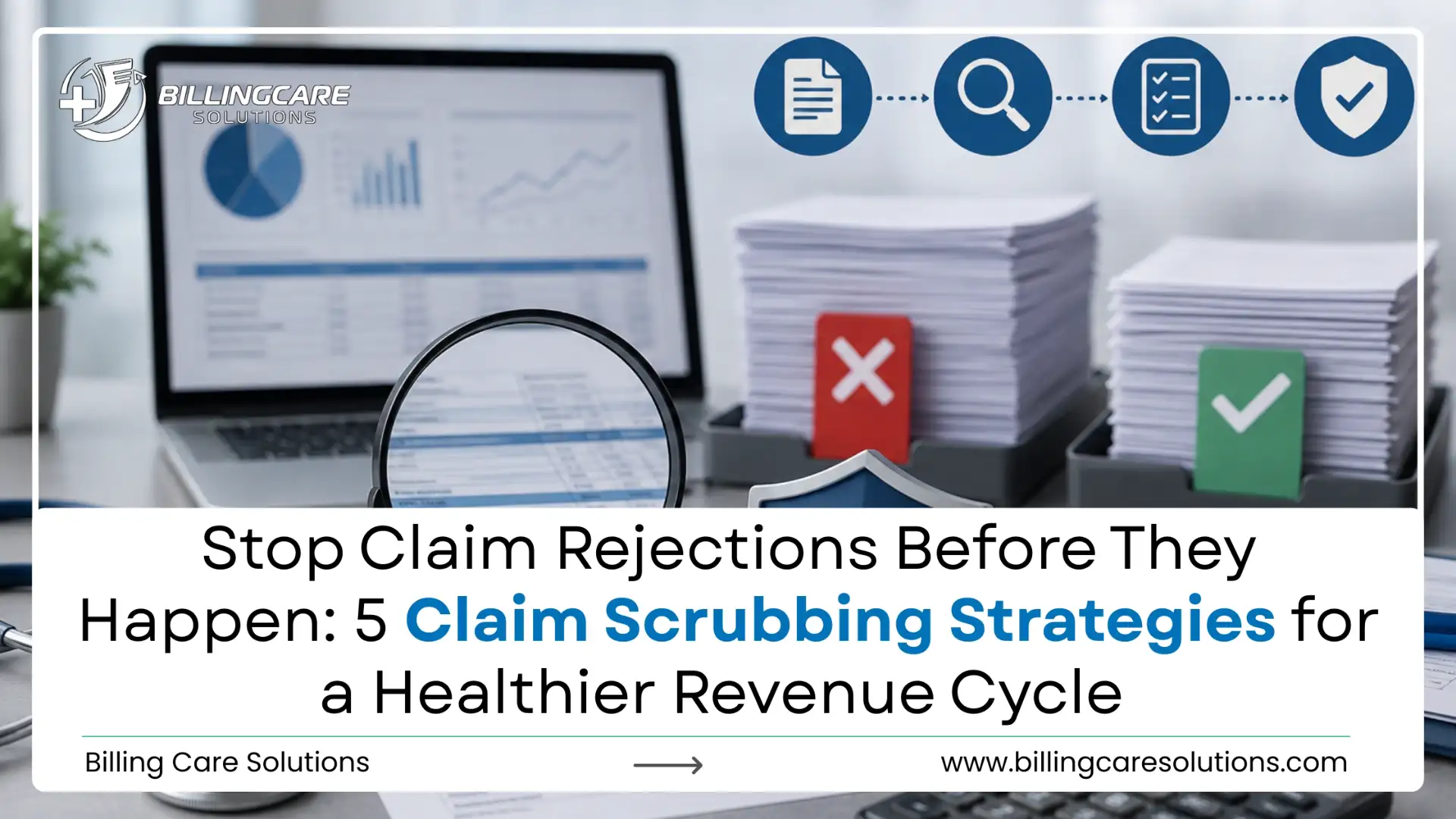
Claim rejection highlights areas of weakness in the revenue cycle before they turn into payments issues. Every reject is a rework, delays cash, and uses up billers’ time. Rev. leaders aren’t concerned with the speed of rejected claims. It is decreasing the mistakes that is what it’s doing. Good claim scrubbing provides a proactive control before claims go to the payers’ adjudication.
The best strategies will link scrubbing rules to the accuracy of the coding, the eligibility of the patient, the authorization of the procedure, payer requirements, and trends in cancellations due to rejections. Leaders also expect to see measurable outcomes such as clean claim rates, rejection rates, volume of rework and days in A/R. This guide offers some practical steps healthcare organizations can take now to minimize unnecessary claim rejections and preserve revenue.
What Is Claim Scrubbing in Medical Billing?
Medical billing claim scrubbing is the automated process of checking medical claims for errors, inaccuracies, and compliance issues before they are submitted. It reviews coding components, modifiers, diagnosis codes and claim structure. The objective is to find problems that might cause a denial of payment or delay. If claim scrubbing is not done properly, problems arise once the claims are submitted. This results in rework, late deliveries and extra administration. Effective claim scrubbing can identify claims early, at a time when they can be corrected with minimal impact on reimbursement.
Why It Matters for Revenue Leaders
In 2026, the initial claim denial rate in the U.S. stood at 11.8% to 12.6%, with submission errors and inaccurate patient details being key reasons for denials. Each denied claim costs an average of $118 for staff time and overhead in fixing and re-submitting the claim. Healthcare organizations that have robust claim scrubbing processes can expect to see claim cleanliness rates of 95% and higher.
| Metric | Without Effective Scrubbing | With Effective Scrubbing |
|---|---|---|
| Clean Claim Rate | 70-80% | 90-95%+ |
| Denial Rate | 10-15% | Below 5% |
| Days in A/R | 45-60 days | 30-35 days |
| Cost to Collect | 5-7% | 3-4% |
Why Traditional Claim Scrubbing Falls Short in Today’s Complex Payer Environment
Typical claim scrubbing involves standard claim edits and a basic set of rules that validate claims. These controls identify typical errors, but they may not identify all of the requirements specific to that particular payer. Healthcare organisations are now dealing with a variety of commercial payers, Medicare, Medicaid, and specialty plans. Each payer may have varying coding, authorization, modifier, documentation and claim submission requirements.
A claim could be scrubbed normally and then not be accepted by the payers. For instance, the CPT code may be covered, but the payer may need to obtain prior authorization for the service. The issue gets bigger if the scrubbing rules are not updated on a regular basis. There are two dangers of obsolete edits. They fail to capture new requirements for payers and mark claims that no longer require correction.
| Traditional Approach | Current Challenge | Financial Impact |
|---|---|---|
| Generic billing edits | Payer rules differ | Missed rejection risks |
| Static code checks | Coding rules change | Incorrect claims |
| Basic eligibility checks | Coverage changes frequently | Eligibility rejections |
| Manual authorization review | High claim volume | Delayed submission |
| Infrequent rule updates | Payer policies change | Recurring errors |
The Missing Pieces in Traditional Scrubbing
Clinical Validity: Traditional scrubbing does not test clinical validity but only code format. Diagnosis and procedure codes can be valid by themselves, but not in combination with each other clinically. This discrepancy causes medical necessity denials that scrubbing cannot stop.
Authorization Status: For scrubbing, the authorization fields are filled but do not necessarily indicate that authorization is still active. Authorizations that are expired pass scrub but don’t pass payer review. This is an important issue that is not addressed by scrubbing without real-time authorization integration.
Payer-Specific Nuances: The Generic edits are applied to all of the payers, here are the Payer-Specific Nuances. However, modifiers, diagnosis documentation and coding are different for each payer. If one payer claims a clean claim it can be denied by another payer. This variation can’t be solved by generic scrubbing.
Patient Eligibility: Scrubbing verifies that the patient has an insurance ID, but doesn’t determine if coverage is active. Coverage may pass the scrubbing process during a midcycle but then be denied as if it were not covered.
Documentation Support: Scrubbing is unable to identify whether or not clinical documentation substantiates services rendered. It doesn’t recognize documentation deficiencies that result in medical necessity denials. These problems can only be detected by human eyes and experience.
To deliver more than automated error detection revenue leaders must therefore apply more. They must have claim scrubbing with today’s payer rules, past denials, eligibility, claim authorization, and human intervention.
5 Practical Claim Scrubbing Strategies You Can Implement Today
Strategy 1: Build Data Accuracy at the Front End
Inaccurate patient information is always cited as a major reason for denials and rework. Registration and eligibility mistakes are responsible for almost a quarter (24%) of denials.
Front-end accuracy to prevent revenue cycle errors. Those with streamlined front-end processes have much fewer denials and faster reimbursement.
What to Do:
Automate Eligibility Verification: Implement real-time eligibility and verification at the scheduling and check-in stages. This helps to address coverage problems before service delivery. The benefits and authorization requirements are validated in advance of service delivery, via automation.
Re-Verify Coverage on the Day of Service: Insurance coverage changes often. Coverage can lapse, may be cancelled, or coverage may be altered between scheduling and services. Re-verifications on the day of service will identify these changes during coverage and will prevent claims from being claimed on inactive policies.
Standardize Registration Protocols: Develop common registration procedures at every location. The consistent data capturing ensures that patient data is accurate, even as the patients go from one location to another and one staff member to another. This minimizes denials during registration.
How to Implement It:
- Set up your EHR to perform eligibility verification during appointment scheduling.
- Provide a checklist for front desk employees to check the coverage at check-in.
- Make sure insurance is re-verified when not recently seen by a patient for 90 days.
- Review Audit Registration data every week to see if there are any common errors.
- Give feedback on staff based on the audit results.
What to Measure:
- The number of denials for registration (month over month).
- Proportion of claims which are rejected due to lack of eligibility.
- Prior to and after Front-end changes, clean claims to ensure rate is accurate.
- The percentage of accurate registrations (clean registrations) is the registration accuracy score.
Industry Context:
The largest percentage of denials (MGMA said almost 24%) is due to registration and eligibility errors. Businesses that use automated eligibility verification find that they are able to decrease denials for registration. According to the HFMA, front-end automation is one of the best practices that can be used to enhance clean claim rates.
Strategy 2: Configure Payer-Specific Scrubbing Rules
The same rules are used for all payers in a generic scrubbing. However, each payor has their own set of payer-specific modifier requirements, diagnosis coding, documentation and claim submission requirements. Payer-specific review is often not successful for claims that pass generic scrubbing.
Develop individual payor-specific scrubbing rules. These rules identify aspects of the payer’s submission that are likely to be denied and encourage more submissions to be accepted.
What to Do:
Identify Payer-Specific Requirements: Examine reports for the last 6 months. Identify Payer-Specific Requirements. Classify denials by payers. For each payer, list the top 3 denial reasons. Record each payers’ specific needs.
Create Custom Rules: Develop custom rules that identify those issues prior to submission. For instance, if Payer A denies claims if diagnosis code X is charged without modifier Y, make a rule that identifies these claims for review.
Update Rules Quarterly: Rules from the payers are subject to change. Custom rules reviewed and updated on a quarterly basis to respond to new requirements. Follow up on denial reports for new payer-specific issues.
How to Implement It:
- Examine denial reports for the last 6 months by the payer.
- Record the number one denial reasons by each major payer.
- Set up individual scrubbing rules for each payer.
- Run the rules on a small number of claims before implementing them.
- Educate staff about the new regulations.
- Review all rules by each specific payer on a quarterly basis.
Example Payer-Specific Rules:
| Payer | Denial Reason | Scrubbing Rule |
|---|---|---|
| Aetna | Missing modifier 25 | Flag claims with E/M service without modifier 25 |
| UnitedHealthcare | Diagnosis code mismatch | Flag if diagnosis does not support CPT |
| Medicare | Invalid place of service | Flag if POS does not match service type |
| BCBS | Authorization expired | Flag if authorization date is expired |
| Cigna | Missing NDC | Flag if drug claim missing NDC |
What to Measure:
- Rejection rate by payer (month over month)
- First-pass acceptance rate by payer
- Number of claims flagged and corrected by custom rules
- Reduction in denials for targeted issues
Industry Context:
Healthcare organizations with payer-specific scrubbing rules have significantly higher first-pass acceptance rates than those with generic edits. According to the Healthcare Financial Management Association, validation by the payers is one of the most important factors in achieving clean claims.
Strategy 3: Leverage Your Clearinghouse for More Than Submission
Many hospital leaders consider a clearinghouse as more of a digital post office. They only utilize it to send claims, withstanding important instruments that can lessen claims denials.
Today, clearinghouses provide claim scrubbing, real-time claim status tracking, and denial management integration. These capabilities ultimately minimize denials and speed up payment.
What to Do:
Enable Clearinghouse Claim Scrubbing: Clearinghouse claim scrubbing can boost to 90-95% first-pass claim acceptance rates vs 70-80% without claim scrubbing automation. To enable Scrubbing features, contact your clearinghouse representative.
Set Up Real-Time Claim Status Alerts: Modern clearinghouses provide real-time status updates on claims. Set up notification for rejected and pending claims. This allows the process to be quicker, which helps avoid rejections before they turn into timely filing rejections. Real-time claim tracking can reduce days in A/R by up to 30% through practices.
Use Integrated Denial Management: Some clearinghouses integrate denial management tools that automatically identify the denials, indicate the specific denial codes the payer has for each denial, and propose resubmission actions. Automated denial grouping can save a tremendous amount on rework costs.
How to Implement It:
- Talk with your clearinghouse company about the scrubbing and analytics options that are available.
- Set up claim alerts on rejected claims and pending claims.
- Review rejection reports from the clearinghouse on a weekly basis.
- Identify patterns and tweak your internal scrubbing rules using the data.
- Educate employees on the handling of training and alerts in the clearinghouse.
What to Measure:
- The percentage of claims that were denied by the clearinghouse and rejected by the payers.
- The amount of time that passes between the submission and the first status update.
- Rejection resolution time
- Days in A/R pre and post clearinghouse features
Industry Context:
Today the clearinghouse is equipped with tools that can have a major impact on the first-pass claim acceptance rate. Companies that use clearinghouse services to their full capacity state that claim resolution is quicker and days in accounts receivable are lower.
Strategy 4: Create a Weekly Denial Review Cadence
Denials are inconsistent and only reviewed when there is a delay of payment. This results in failure to meet deadlines, failure to appeal, and reoccurring errors.
A weekly denial review process, which is structured, identifies patterns rapidly. Preventing denials from becoming systemic issues for organizations.
What to Do:
Review All Denials Weekly: Collect all denials that were received in the last week. Avoid waiting for monthly reports. Early identification means quicker intervention.
Categorized by Root Cause: Payer, Reason Code, Procedure, Provider, and Root Cause. Identify the most frequent types of denials: authorization, eligibility, coding, medical necessity documentation, timely filing.
Assign Ownership: Identify one person who will be responsible for each Root Cause Category. This helps to guarantee responsibility and action.
Track Progress: Monitor week to week by root cause denial volume changes. Make half of the number half; explore double the number.
How to Implement It:
- Build a basic denial tracking spreadsheet/dashboard.
- Create a denial report on a weekly basis (Monday).
- Re-check data at a weekly meeting of 30 minutes on Tuesdays.
- Classify denials according to root cause.
- Ownership for each root cause category.
- Monitor and follow up action points.
- At the next weekly meeting review results.
What to Measure:
- Number of denials by root cause (week over week)
- The time frame to resolve denials
- The percentage of denied claims that were appealed and succeeded.
- Reduction in recurring denials
Industry Context:
Studies have revealed that structured denial review processes have higher appeal success rates and quicker resolution time in industry organizations. The Advisory Board feels the weekly denial review is a good practice in the revenue cycle.
Strategy 5: Build a Feedback Loop Between Scrubbing and Denial Data
Scrubbing rules are fixed but payer requirements are constantly changing. Feedback without feedback loops is obsolete and useless.
Continuously update scrubbing rules using denial data. Establish a Denial Trend capture and translation to preventive control process.
What to Do:
Analyze Every Denial for Scrubbing Opportunity: Determine for each denial, whether it could have been caught by scrubbing. If so, note the problem and the rule that might have solved the problem.
Create or Update Scrubbing Rules: Create specific scrubbing rules from denial patterns. Test the new rule on claims from the past to check if it does work. Install and track the performance of the rule.
Maintain a Scrubbing Rule Library: Record all the scrubbing rules, their rationale and when they were implemented. Check the library quarterly and take out obsolete rules and use these to replace new ones.
How to Implement It:
- Now look at each denial and ask yourself: “Could this have been prevented by scrubbing?
- Record the particular problem and the needed rule.
- Make or edit the scrubbing rule.
- Check the rule for historical claims.
- Deploy the rule.
- Follow-up for 30 days.
- If necessary, modify the rule.
Example Feedback Loop:
| Denial Pattern | Scrubbing Update | Result |
|---|---|---|
| Payer rejects claims for CPT 99213 without modifier 25 | Rule created to flag CPT 99213 claims missing modifier 25 | Future claims with this error are caught |
| Medicare denies claims with POS 11 for telehealth | Rule created to verify POS 02 for telehealth claims | Future telehealth claims use correct POS |
| UnitedHealthcare denies claims with missing prior auth | Rule created to flag claims without verified authorization | Future claims have authorization verified |
What to Measure:
- Number of new scrubbing rules added monthly
- Reduction in denials for previously identified issues
- Percentage of denials that could have been prevented by scrubbing
- Clean claim rate trend
Industry Context:
Having a feedback loop between denial data and scrubbing rules results in progressive denial reduction over time. Data-driven rule updates is a common characteristic of high-performing revenue cycles, which is continuous improvement.
Technology That Enhances Claim Scrubbing
AI-Powered Claim Scrubbing
Unlike traditional claim scrubbing, AI-powered claim scrubbing takes a holistic approach by assessing claims. It examines the relationships between the coding elements, not just individual elements.
What AI Detects That Traditional Scrubbing Misses:
- Situations where diagnosis codes do not fully support procedures billed
- Modifier combinations that appear valid on their own but conflict when used together
- Patterns associated with payer edits or delayed processing
- Structural inconsistencies that can affect how claims are interpreted
- Clinical documentation gaps that could trigger medical necessity denials
Earlier Validation: AI-powered scrubbing provides immediate feedback without requiring protected health information. This allows teams to review claims in real time.
How to Start with AI Scrubbing:
- Identify a specific problem area (e.g., high denial rate for a particular payer).
- Pilot AI scrubbing on claims for that payer.
- Compare denial rates before and after the pilot.
- Expand to additional payers based on results.
Predictive Analytics
Analytics tools can detect patterns that indicate denial risk, and can help rectify the errors before claims are even filed. Predictive analytics can track the trends and patterns in denials issued by the payers.
How to Use Predictive Analytics:
- Analyze historical denial data to identify patterns.
- Create predictive models that flag claims with high denial risk.
- Route flagged claims for additional review before submission.
Embedded AI-Automation in the workflows: AI and automation should not be bolted on top of other workflows. This will ensure that claim scrubbing is not an extra task to complete, but a normal process to go through.
How Billing Care Solutions Strengthens Claim Scrubbing
Billing Care Solutions strengthens claim scrubbing by combining automated claim checks with experienced billing review. This approach helps identify errors before claims reach the payer. The process considers coding accuracy, payer requirements, eligibility, authorization, modifiers, units, and claim formatting. High-risk claims receive additional review when automated checks identify potential payment issues. Rejection trends also guide workflow improvements. Recurring errors are analyzed by payer, procedure, provider, and rejection reason. These findings help refine future pre-submission checks.
| Claim Control | Billing Care Solutions Approach | Financial Benefit |
|---|---|---|
| Coding validation | Reviews CPT, HCPCS, ICD-10, and modifiers | Fewer coding-related rejections |
| Payer edits | Applies payer-specific billing requirements | Better claim acceptance |
| Authorization | Verifies required approvals | Lower authorization risk |
| High-risk claims | Adds targeted pre-submission review | Protects high-value revenue |
| Rejection analysis | Tracks recurring rejection patterns | Stronger preventive controls |
| Feedback loop | Denial data drives scrubbing updates | Progressive denial reduction |
Conclusion:
Claim Scrubbing helps healthcare organizations identify billing errors before they become costly payment problems. It reduces preventable rejections and limits unnecessary claim rework. Effective scrubbing requires more than basic automated edits. Revenue teams should combine payer-specific rules, coding validation, authorization checks, and rejection trend analysis.
Organizations can also use continuous monitoring to detect recurring issues. With these insights, teams can enhance billing processes and ensure that the same issues do not impact future claims. Billing Care Solutions integrates technology and experienced billing supervision to enhance pre-submission claim controls. This will help to ensure accurate claims, lower administrative costs and quicker reimbursement. Billing Care Solutions can assist you in further improving your claim scrubbing efforts and cut down on claim denials. Call us today to get a full revenue cycle audit.
Frequently Asked Questions
Claim scrubbing is an automated process, which examines claims for any errors prior to submission. It validates the coding accuracy, modifiers, and payer specific rules to reduce rejections.
Medical necessity and authorization can also be cited as reasons for a claim denial even when the claim is clean. A scrubbing check will format, but it can’t check for clinical validity or active coverage.
Almost 24 percent of claim denials are due to front-end errors. Patient data accuracy leads to rejections downstream which slows payment and adds to administration.
Rejections happen prior to claims being processed by payer systems. Denials occur following a claim that has been accepted, but is determined to be unpayable because of a particular reason.
Establish specific rules for each large paying entity. These rules serve to identify special needs prior to submission and to substantially lower denial rates.
Clearinghouses provide claim scrubbing, real-time status tracking and denial management capabilities. These attributes can markedly improve the first-pass acceptance rates.
Re-evaluate scrubbing rules every four months in line with payer policy changes. The rules are updated regularly to keep them effective and up to date.
The top organizations reported a clean claim rate of more than 95 percent. This is high accuracy of claims and less administrative rework.
Traditional scrubbing methods cannot find clinical mismatches, while AI can. It offers validation prior to the need of protected health information.
Billing Care Solutions provides automated scrubbing along with billing review by experts. This can help detect errors before they’re submitted and helps to enhance clean claim performance.
